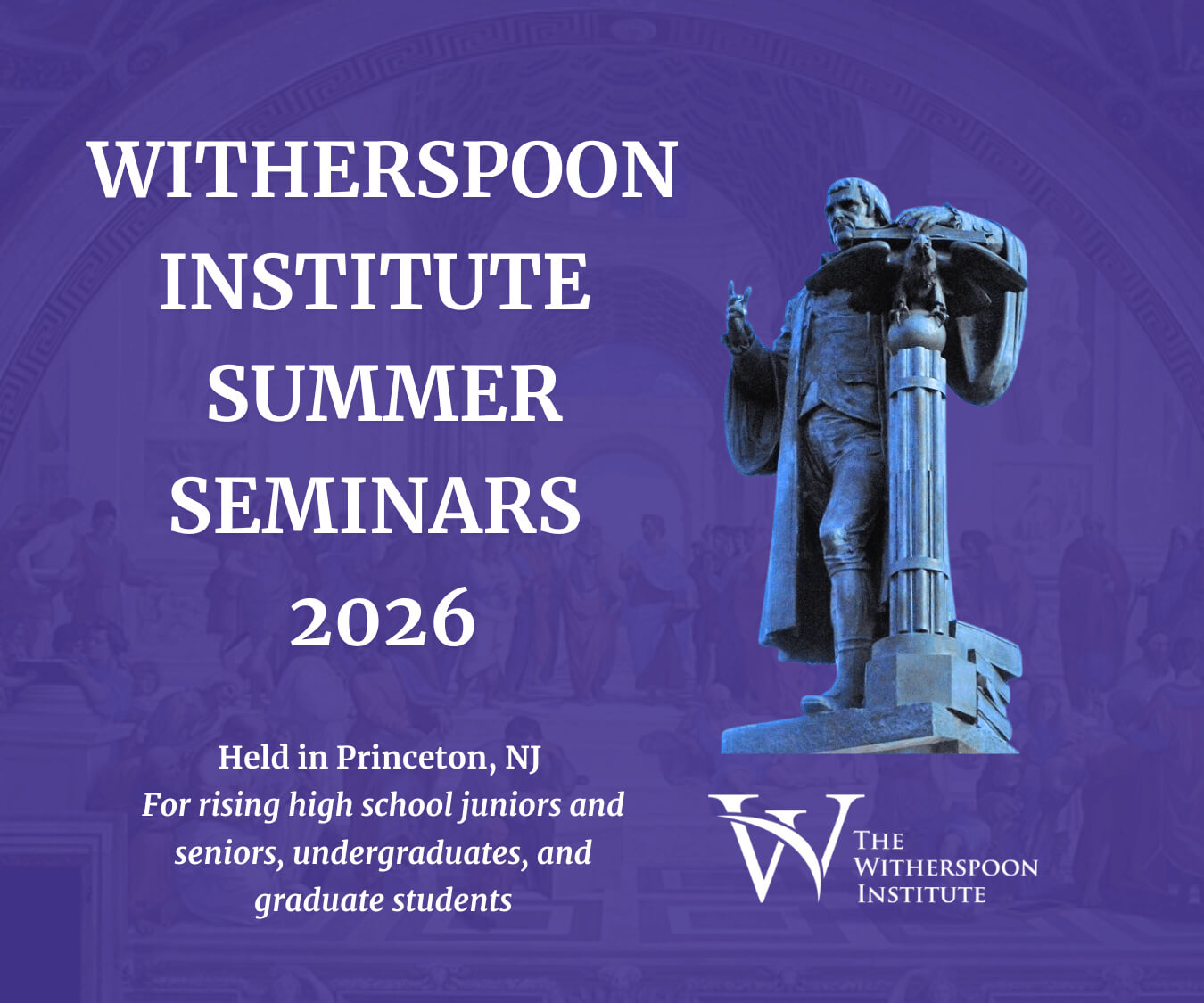
Witherspoon Institute
2026 Summer Seminars
Held in Princeton, NJ
For rising high school juniors and seniors, undergraduates, and graduate students.
Keep up with the conversation! Subscribe to Public Discourse today.
Interviews
By Matthew X. Wilson and Stephen Macedo
There was a fundamental failure of toleration for alternative points of view. I think some of it might be explained by the fact that it was a pandemic. For public health guidance to be effective, people have to comply. To that I would say fair enough, but it’s also equally important—or more important—to have confidence that the policies are sound. People complying en masse with unsound policies won’t do us a whole lot of good. That’s what open debate is supposed to address.
Everyone can have their own beliefs about the ethical principles of human fertility. From a pure accounting perspective, however, the problem is people are not getting married. So, making IVF cheaper, for example, is not solving that issue.
The book’s importance goes beyond the perennial value of Newman; Görres penetrates deeply into the heart of Newman’s character and life. In doing so, she reveals what made him holy, and holiness is of perennial value.
By Adam Kirsch and Nathaniel Peters
The only way to actually create a better future is to start with the world we actually live in and move forward—which may require “despairing” of the past, which cannot be changed.
By Nathaniel Peters and Mehmet Ciftci
Christians should always make the best of any pragmatic agreements they can find with non-Christians on any issue. But the evangelical reasons why we support, for instance, constitutional government should be made clear, not veiled in embarrassment by translating them into the idiom of natural law or human dignity out of a misguided concern to avoid blurring the boundaries between political and religious affairs.
By Matthew X. Wilson and Angel Alvarado
At this moment, what we can do is the right thing. And sometimes the right thing is very risky—going out into the streets and demonstrating your opinions on the situation. It's risky, but I think it’s our right, and I think it’s what is right.
Religious conservatives should be open to the idea that progressives and liberals might be able to take their own path and still find some common ground on the essential question of the goodness of human life.
By Patrick T. Brown and Tim Carney
The belief that childrearing is prohibitively expensive could be understood as a fruit of our collapsing civil society. Some people today don’t even consider that extended family, neighbors, churches, and other little platoons can, at least theoretically, provide real support to parents. They fall into believing that the only places to turn for help are the market and the state. Parents without community support then shift more burden onto themselves.
By Nathaniel Peters and Bronwen McShea
I’m hopeful, therefore, that not just ordinary readers, but also readers at the higher levels of ecclesial leadership, will learn some new things about women and Church history from my book. I also hope that some might reconsider and refine what they say in connection to the past and present role of women in Christian ecclesial and social life.
Book Reviews
Only a revitalization of the richness of Christian marriage will suffice as a bulwark against the insanity, exploitation, and selfishness of the gender and sexual revolutions.
Field’s account is eye-opening. At the same time, as a professed “liberal,” she exhibits elements of excessive partisanship that weaken her argument.

While conversion may involve a love of beauty, a hunger for doctrinal security, the frisson of transgression, or a desire for the forgiveness of sins, it is ultimately a deep mystery of grace and therefore transcends our understanding.
What are the options for scholars or funders committed to encouraging more bright students and thus improving our university system?
The decisive question for this and every age, Trueman argues, is Who and what is Man?
Padilla Peralta wants something, but the way he’s attempting to get it could potentially cost him, and all of us in academia, what little we already have.
Joshua Herring offers a refreshing break from the mundane, a sort of punk rock alternative to gender orthodoxy. He reminds us again that, even as Lewis championed tradition and order, he refused to be conventional.
An in-depth review of Matthew Tapie’s The Mortara Case and Thomas Aquinas’s Defense of Jewish Parental Authority
We are using our genius to degrade ourselves into nothing much at all, and the existential results are anxiety and shame at how small we have become.
Long Reads
There’s no point in writing laws if the courts won’t follow them. It’s the trial judges, not the president, who are sapping Congress’s power. Perhaps it’s time that Congress does something about it.
By Gary Morson
When it comes to human beings, learning must not consist in committing a pre-packaged truth to memory, but an endless process of discovery and self-critique.
By Andrew Abela
What we need is a restoration of virtue in our land, in order to tame the strong gods and ensure that their power serves the good—so that the return to reality is marked not by domination, but by integrity, not by chaos, but by character.
What is the nature of human dignity? What is it to act justly towards another human being? For Augustine, the answer is that justice towards another human being is a matter of recognizing God’s image in them, and all that follows from that, the deep solidarity and communion that arises from this.
Why should we be faithful constitutionalists on matters of war powers in the first place (as opposed to being hard-headed “pragmatists”)? Why should we care about the Constitution, about this violation of it, by this president, at this time?
By Paul Sullins
Suppressing disfavored ideas from consideration has serious consequences for the possibility of scientifically informed public discourse in our day.
The Ukrainian Greek Catholic faithful, both lay and religious, are hard at work helping their country to forge a future worthy of human dignity.
By Jason Bedrick and Thomas Jipping
Parents’ authority over their children’s education is being challenged as much today as it was a century ago. Pierce remains a solid basis on which parents can insist on their proper place in the family and society.
By Brad East
To be sure, there remain some true-believing via media Protestants who are morally and theologically conservative and continue to attempt to strike the balance between high and low. But whatever their future, they will not be resuming their place at the commanding heights of the culture.
Newsletters
We work hard at every level of the editorial process to ensure that our essays are well-crafted, that our language is precise and that our arguments are sound. But most of all, we want to encourage and teach our readers to appreciate a well-formed argument, even if they ultimately come to a different conclusion than we do.
By R.J. Snell
Strap in, everyone, for we need to acknowledge that what is called for now is a generational effort, likely to be multi-generational, to recover reality. And it all requires the family. As the family goes, so goes our society. The flashpoint at the university, in the end, is far downstream from what is happening in the family.
The truth lurking inside the great morass of opinions, questions, and fears about the human condition is that a confluence of factors leads to greater personal, familial, and communal flourishing.
Reflections on hope, plus a roundup of this month's essays
Tension is something we at Public Discourse strive to handle well. Ours is a voice of reason, moderation, and calm even as storms swirl around us. The kind and thoughtful operation of reason always leaves peace, not awkwardness, not lingering tension, in its wake.
By R.J. Snell
Such technocratic management, incapable of moral action, is, I suggest, what Magerman notes at Penn. But, alas, it is true of far too many of our institutions and those who manage them. Not so at Public Discourse, however, and not so for those educated in older, richer, wiser traditions of moral reflection and judgment—and thus of action. Our essays this past month are full of such riches.
By R.J. Snell
Conflict is underway. Even already, so early in what could be a protracted war, the suffering is profound, the loss grievous and terrible. Things are almost certainly to become worse. It’s only natural, only human, to blanch at such pain, to avert one’s eyes, and wish for it to cease. But such sentiments, so natural and understandable, do not obviate the need to understand, deliberate, and judge according to the rule and demands of justice.
Back-to-school reflections, plus a roundup of this month’s essays