The Body of this Death: Letters from the Last Archbishop of Lancaster is a haunting work, written, as it were, in chiaroscuro. It weaves its spell through language at once gnomic and precise, incantatory and compelling.
That the letters have survived and been published is, itself, a minor miracle. They seem to have existed in two manuscripts, one in their original English, somehow uncovered in Buenos Aires; the other, a Spanish translation, improbably discovered at the auction of “a bankrupt Spanish bookseller in Copenhagen.” They have now been edited and published by Vincent Hermès, who has elsewhere written a history of the text and its author. In the present edition, he has added several explanatory footnotes and references to other literature. His brief but indispensable “Note to the Reader” serves as preface to the letters themselves. There his address is given as Clermont-Ferrand, France, and dated: “Year 20 of the New Common Era.”
It has been suggestively proposed that the book’s “presiding genius is Pascal.” Indeed, Pascal is cited or referenced fourteen times in the extant letters. One may note, in passing, that Clermont-Ferrand, the editor’s residence, is the birthplace of Pascal.
Perhaps, however, the archbishop’s vision owes even more to the second century Church Father Irenaeus of Lyons. The dual manuscript tradition, the English and Spanish versions of the letters, present, according to Hermès, “no variant readings,” save in one important particular. The heading of the English recension echoes Athanasius and reads forthrightly: “Letters on the Incarnation.” The Spanish compilation, instead, adapts Irenaeus, with an added flourish: “Letters on the Detection and Overthrow of Reality Falsely So Called.” Assuredly, the archbishop is bent on calling out the simulacra of reality that grow ever more pervasive and controlling.
Still, both renditions capture something essential about the spirit and scope of these letters. For they offer a penetrating and passionate refutation of a prevalent Gnosticism that abhors this body, this community, this Church, where true life is won, paradoxically, only at the price of this death. Thus, the letters constitute an uncompromising polemic against what the archbishop calls the “disincarnation” practiced by the “indefatigable Gnostics.”
Start your day with Public Discourse
Sign up and get our daily essays sent straight to your inbox.The published letters are addressed to a relatively small number of recipients. We only glean their own views mediated through the archbishop’s remarks and responses. Among the recipients are a longtime friend, Sister Perpetua; a Muslim acquaintance, Ms. Bushra; and, toward the end of the volume, there ominously appears a new recipient, a collective, addressed as “My dear inquisitors.”
In the course of the letters, we learn that the archbishop had been raised Quaker but found the notion of unmediated access to the divine unrealistic. Hence his turn to the sacramentally mediated religion par excellence: Catholicism. The letters also provide a further crucial revelation: he is the custodian of his young goddaughter, Felicity, whose parents had been killed in an accident. He frankly shares with several of his correspondents his concerns about instructing the precocious youngster in the faith and preparing her for the sacraments.
The archbishop’s pastoral and personal responsibilities occur in the context of a society and culture he speaks of as “metamodernity,” characterized by the growing dominance of “IR”—immersive virtual reality—in which “everyday life is flattened by the mania of immersive experience.” “Immersive” means “to recreate the object into whatever we want it to be.” The tragic result, in his eyes, is to produce “unreal neighbors, unreal bodies, unreal consequences,” fueling “a flight toward a more dissolute disembodiment.” He cites approvingly and amplifies T. S. Eliot’s persuasion that humankind “cannot bear reality.”
A society in which IR rules is overseen by a repressively tolerant state, teetering toward technological totalitarianism and, as the archbishop’s fate will reveal, inevitably succumbing. This context of an aimless West, a confident Islam, and a Church too often forgetful of its own foundation presses the archbishop to ponder and present to his correspondents his own life-affirming vision and contrarian confession.
The compiler of the English manuscript rightly summarizes its thrust by titling the collection: “Letters on the Incarnation.” Though his name is never mentioned in the published letters, I could not help but be reminded of a dictum by the twenty-first century Catholic philosopher Charles Taylor. Amid a secular society marked and marred by “excarnation,” Taylor called his fellow Christians “to recover a sense of what the Incarnation can mean.” In his pastoral initiatives and endeavors, and, finally, in his own sacrificial witness, this is precisely what the archbishop determines to do. He resolutely denounces the heresy of excarnation.
Thus, as if heeding Taylor’s injunction, the letters share a vision whose center is the Incarnation. Or, to change the image, the letters conspire to outline a mosaic whose tiles cohere around the Incarnate Christ. If they are epigrammatic in form, there is no doubt that their depth grammar is Christ. As with Irenaeus and Pascal, they are Christoform. Hence, they incline, suaviter, fortiter, to silence and to prayer.
Like Irenaeus of Lyons, the archbishop of Lancaster possesses an acute sense of the plasma, the sheer materiality of our reality: “the givenness of the material thing.” We stub our toes against things, jockey shoulder to shoulder for position. We meet resistance. And he insists, “the great danger of the immersive, which after all is still half-bodied, is how little stubborn in this sense it is.” It yields only that it might better ensnare.
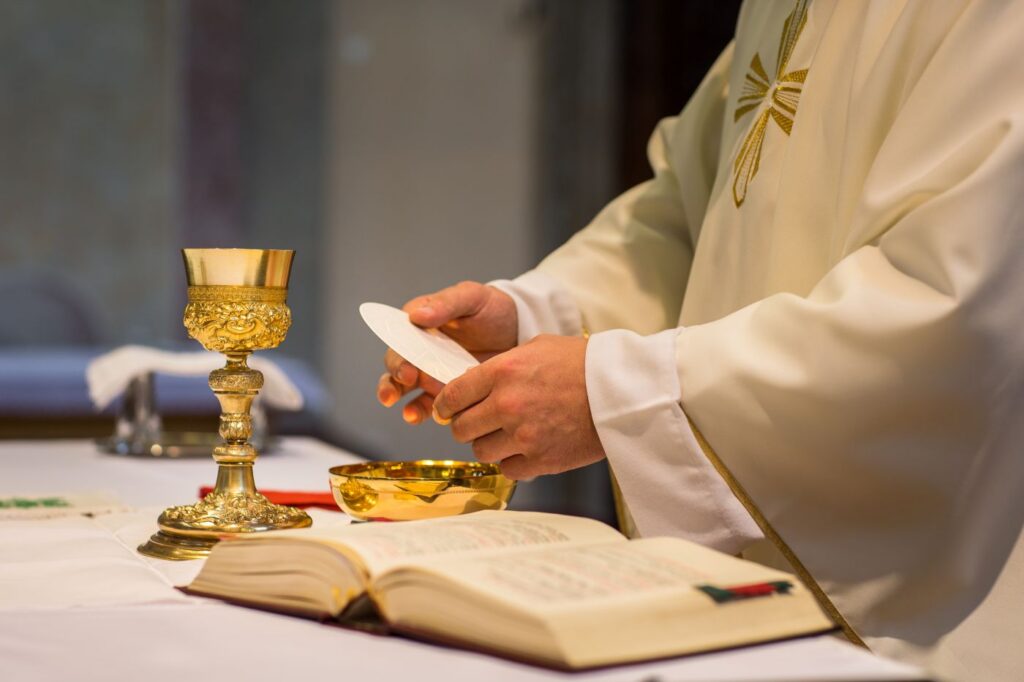
Catholicism’s grace and challenge is that it binds one sacramentally to the Christian body that is the very Body of Christ. Baptism plunges one bodily into Christ’s death, and the Eucharist sustains the spirit somatically, through bodily food. How, otherwise, could embodied creatures be saved? What emerges with increasing clarity in the course of the volume, however, is precisely the cost of Incarnation: a cost, which T. S. Eliot, so crucial a poet for the archbishop, holds to be “not less than everything.”
That cost is already prefigured in the Church’s practice of infant baptism—a practice the archbishop fervently defends in the face of the liberal critique that attacks it as a form of child abuse. To Ms. Bushra he acknowledges that infant baptism is “subjecting your newborn to the death of the old man.” But the practice embodies Catholicism’s insistent claim that the intermediate authorities of family, community, and tradition are crucial to counter the hegemonic overreach and assaults of the state. The Church thereby bears witness “to an order that asks it to realize itself in sacrifice.” And this “witness,” this marturia, will, finally, extol and celebrate the martures, those who shed their blood for Christ. The child Felicity and Sister Perpetua serve as salient reminders that we are indeed surrounded by such a cloud of witnesses.
Of course, the import of baptism goes well beyond the individual, for it incorporates the believer into the new somatic reality that is the body of Christ. The new person emerges from the waters of baptismal death into the new creation that is communal and universal in scope. Christians are im-plicated, involved, entangled with one another, in mutual responsibility. The enticements of excarnation are exorcized by the redemptive love of the body’s Head, Christ. And the archbishop boldly proclaims: “if we expand our love enough, we will find ourselves part of him.” But such expansion is, under the conditions of our present disarray, perforce cruciform.
Catholicism’s grace and challenge is that it binds one sacramentally to the Christian body that is the very Body of Christ.
Of all the letters, the strangest by far is the last, placed by the editor, just prior to the appendix of “posthumous” ones. Alone among the letters it is dated and bears a title. The title is “Letter to Death” and the date, significantly, is March 25th; significantly, because that is the date of the Church’s liturgical celebration of the Annunciation/Incarnation. But a venerable tradition of the Church also holds it to be the very date of Christ’s Crucifixion. The Letter is addressed: “My dear Asterion,” a name given to the Minotaur who dwells in the labyrinth and who, every nine years, devoured the noblest of Athenian youth.
Vincent Hermès hastens to signal a cautionary note to the reader. Some, it seems, question the author’s “mental condition” at the time of its writing, fearful that the techniques of his prolonged interrogation may have produced “mildly dissociative effects.” Without doubt, the experience of the state’s power and procedures, overseen by masked functionaries, can certainly inspire labyrinthine fantasies. Yet the final paradox of this “Letter to Death” is the archbishop’s conviction that death, from which the world endlessly flees, has itself “been despoiled not to be set aside but reconciled,” first and paradigmatically, of course, in Christ; but then by those who have been baptized in Christ, whether by water or by blood. It is they who, truly transfigured, standing before the throne of the Lamb and chanting their praise, have deprived death of its sting.
Given the concentration of the archbishop’s vision upon the Incarnation even unto the atoning death of Christ, it appears perplexing that his surviving letters never refer to the most famous of English Catholic divines, the saint and doctor of the Church John Henry Newman. Yet the whole thrust of his teaching ineluctably calls to mind Newman’s great sermon, “The Cross of Christ the Measure of the World.” There Newman insists: “Thus in the Cross, and Him who hung upon it, all things meet; all things subserve it, all things need it. It is their centre and their interpretation. For He was lifted up upon it, that He might draw all men and all things unto Him.”
Here, then, we may fittingly invoke what is perhaps the most probing and mysterious of the archbishop’s epigrams. He contends: “Christ is not nailed to the cross; the cross is nailed to Christ.” And he continues: “It is not the savior that flees the world but the world that flees its salvation.” The immersive world flees embodiment and death. It embraces excarnation. But absent Incarnation, the world languishes and grows old, bereft of Eucharist.
It may seem untoward for a reviewer to insinuate himself into a text. But a volume that also includes the archbishop’s “posthumous letters” (a variant tradition does not even exclude their having been dictated at a date posterior to his death) may permit an imaginative, though not impossible, conjecture: namely, that a personal “memorial” was discovered after his death. Indeed, that it had been sewn, Pascal-like, into his garment. On it, some verses of T. S. Eliot were scribbled in an unsteady hand. They were not, however, from “Four Quartets,” amply cited in the letters themselves. Rather, the fragment transcribes the concluding lines of Eliot’s “Journey of the Magi,” heavily underscored:
…this Birth was
Hard and bitter agony for us, like Death, our death.
We returned to our places, these Kingdoms,
But no longer at ease here, in the old dispensation,
With an alien people, clutching their gods.
I should be glad of another death.
I trust neither Monsieur Hermès nor Professor McCullough will deem this gloss inopportune or unwelcome.