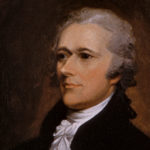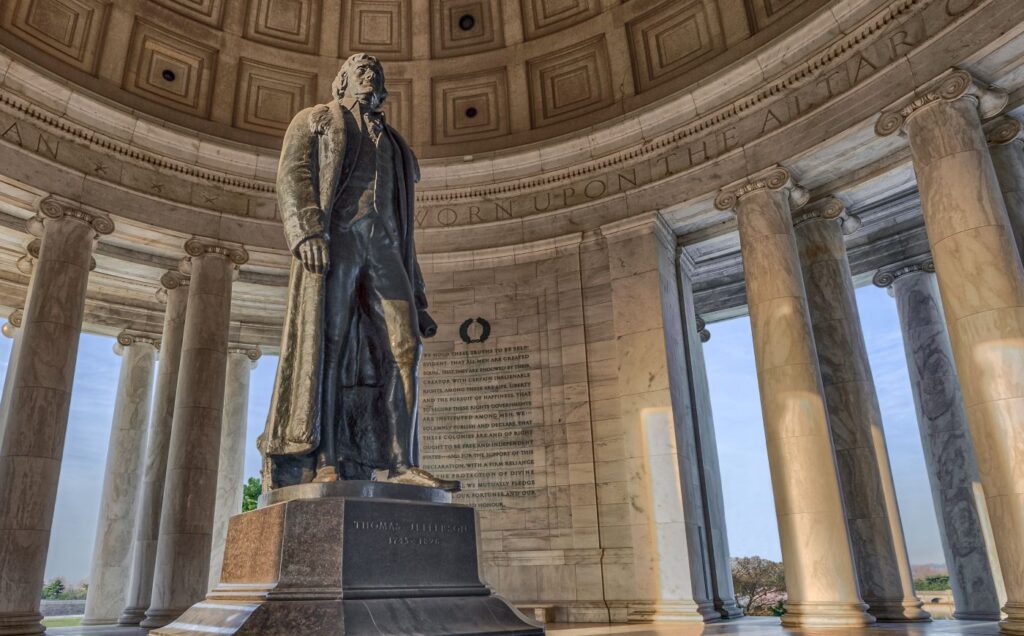
The popularity of Lin-Manuel Miranda’s musical “Hamilton” has generated a surprising reversal (though not for the first time) in the relative reputations of Alexander Hamilton and his (usual) antagonist, Thomas Jefferson. Miranda’s show, inspired by Ron Chernow’s 2004 biography, resuscitates its subject’s standing from the elitist image with which Americans had been presented for roughly the past century, in contrast with the supposedly more egalitarian, hence more appealing, Virginian.
In The Pursuit of Liberty: How Hamilton vs. Jefferson Ignited the Lasting Battle Over Power in America, Jeffrey Rosen, president of the National Constitution Center, traces “the interwoven threads” of the debate between partisans of these two great figures as a way of “clarifying the most significant political, economic, and constitutional battles” that have marked American history. He aims to “avoid taking sides,” but to inspire readers to consult “the primary sources” so as to make up their own minds. In this extensively researched and quite readable survey, Rosen largely succeeds in his promise of evenhandedness, even if his attempts to apply the debate to contemporary constitutional controversies are sometimes misleading.
Before taking up the opposition between Jefferson and Hamilton that emerged during the debate over the establishment of a national bank, Rosen devotes his first two chapters to sketching the two men’s intellectual and political outlooks and backgrounds. Stressing Jefferson’s aristocratic origins as a member of one of Virginia’s wealthiest families, Rosen portrays him as “the American archetype of the democratic aristocrat,” who “ascribed the greatest importance” to his ancient English pedigree. Indeed, “tracing American rights and liberties back to their supposed roots in the English past became a touchstone of Jefferson’s vision for American democracy.” Rosen thus depicts Jefferson as “prophet of two competing visions” of American democracy: “one rooted in expanding equal rights [only] for white planters and farmers” (although Jefferson never overtly stated such a limitation); the other, stated in the opening paragraph of the Declaration of Independence, calling for recognizing the equal rights of all human beings.
Acknowledging Jefferson’s practice of large-scale slave owning, which he recognized violated the principles stated in the Declaration, Rosen cites his justification for keeping his slaves: his hope of paying off his incessant debts “with their labour,” being “governed solely by their happiness,” by avoiding having to sell them off. Nonetheless, though speculating about the likelihood that black people were naturally inferior to whites, Jefferson also authored what became the prohibition of slavery in the Northwest Territory, and “unlike the next generation of enslavers, he never defended” the institution’s justice, let alone representing it as a “positive good.” At the same time, Jefferson’s “libertarian” or “populist” streak led him to justify uprisings like Shays’s Rebellion, and later, even more foolishly, the bloodiness of the French Revolution.
If the wealthy Jefferson professed to be “tormented” by his debts, while still taking pride in his ancestry, Hamilton, by contrast, was “defensive throughout his life” about the (technically) illegitimate character of his birth in the West Indies, though he grew up in an environment “full of books,” which he “devoured.” After his mother’s death when he was fourteen, Hamilton was left penniless, until taken in “as a kind of adopted son” by a prominent merchant and given a job as clerk that gave him experience in “the details of international shipping, trade, and finance that would prove invaluable when he constructed” America’s banking system. At the same time, Rosen notes, Hamilton’s “experience of growing up with free and enslaved Black people committed Hamilton to abolitionism and even equal opportunity,” in contrast with Jefferson’s “racism.” (After the Revolution, Hamilton would organize the Society for Promoting the Manumission of Slaves.)
Start your day with Public Discourse
Sign up and get our daily essays sent straight to your inbox.Additionally, Rosen reports, Hamilton was “the most philosemitic of the Founders,” representing Jewish clients, persuading Columbia University (which he had been enabled to attend by his West Indian benefactor) “to appoint its first Jew to the board of trustees,” and “unlike the anti-Semitic Jefferson, praising the achievements of individual Jews and the Jewish people.” Surely these facts belie the claim that Hamilton was less faithful to the principles of the Declaration than was its primary author. It must be noted, however, that Jefferson was not simply anti-Semitic: while he challenged the authority of the Hebrew Bible on rational and moral grounds, just as he rewrote the Christian Bible in a way that eliminated its supernatural elements, Jefferson did author a bill for establishing religious freedom in Virginia that would cover the Jews, and in correspondence lamented the persecution that they had suffered historically.
Although Hamilton joined the patriot cause as an artillery captain in 1776, distinguishing himself in battle before soon being chosen by George Washington as a key aide throughout the Revolution, Rosen stresses the influence on his thought of the Scottish philosopher David Hume, who favored a government strong enough to promote free trade and hence liberty. Jefferson, by contrast, abhorred Hume’s thought and favored the elevation of agriculture over commerce. But Rosen perhaps oversimplifies by attributing the difference between Hamilton’s and Jefferson’s approaches to political economy to Hamilton’s being “a conservative who embraced the Tory theory of English history” while Jefferson was “a libertarian who embraced the Whig theory of English history.” And Hamilton’s belief in the need for a strong national government, as Rosen goes on to note, was grounded in his observation of the irresponsibility of the state governments under the Articles of Confederation, more than on a “pessimistic view of human nature.” Well before then, he had emphasized the need to give democracy a stable form, in contrast to Jefferson’s celebration of popular uprisings.
In subsequent chapters Rosen traces the influence of Jeffersonian and Hamiltonian approaches to government through successive stages of American history, starting with the battle over the national bank and the “nullification” crisis under the Adams administration rooted in competing attitudes toward the French Revolution and the adoption of the Alien and Sedition Acts. Here, however, Rosen passes over Jefferson’s assertion in the Kentucky Resolutions of the right of state governments to prosecute Federalist “sedition;” he was much more concerned with federalism (as he understood it) than with the free speech. And in upholding “states’ rights,” Jefferson was potentially protecting states’ right to preserve their “peculiar institution” against federal interference.
Rosen then traces the battles between Jefferson and Chief Justice John Marshall over both judicial review and the constitutionality of the bank; and among such competing professed heirs to Jefferson’s legacy as Clay, Webster, Calhoun, Jackson, and Lincoln over Union and secession. During the slavery crisis, he notes, both sides claimed Jefferson’s authority (Lincoln for the libertarian principles of the Declaration, the secessionists for his assertion of nullification). At the same time Lincoln praised Hamilton as “one of the most noted anti-slavery men” of the Founding era.
In an 1861 Fourth of July oration, future president James Garfield described how rereading “the history of the constitution” confirmed his “love for Hamilton” as a partisan of national strength while weakening his “regard for Jefferson” as author of nullification. And in the post-Civil War era, Hamilton’s name was invoked in support of the Fourteenth ad Fifteenth Amendments and federal legislation enforcing them. However, after the withdrawal of federal troops from the South in 1877, that legislation was largely nullified by the courts, with Justice John Marshall Harlan being the leading dissenter from those rulings (most famously in Plessy v. Ferguson). Meanwhile, Republican Senator Henry Cabot Lodge led the “Hamilton revival” of the late nineteenth century’s “Gilded Age.” In 1890, Lodge was inspired by Hamilton’s legacy, notably, his use of military force to suppress insurrections under Washington’s presidency, to introduce a federal elections bill that, anticipating the Voting Rights Act of 1965, would have authorized federal courts to supervise state elections to protect the franchise.
But at this point, populist Democrats championed a new vision of Jefferson, not as an anti-centralizer but as a hater of banks and monopolies—and thus, in their view, an advocate of economic equality to be promoted by federal policies. In turn, Republican Theodore Roosevelt embraced Hamilton’s support of the government’s “implied powers” so as to justify his New Nationalism. Roosevelt claimed to be both a “Jeffersonian” in his “faith in democracy” and a “Hamiltonian” in the belief that government needed “broad powers.” His attempted “synthesis” of Hamilton and Jefferson was described by New Republic founder Herbert Croly as using “Hamiltonian means to achieve Jeffersonian ends.” Later, Franklin Roosevelt, having initially maintained that Jefferson and Hamilton “personified the struggle between democracy and aristocracy” (this despite differing attitudes towards slavery), adopted Croly’s formulation to justify a vast expansion of federal authority under his New Deal.
While Hamilton favored a more active role for government in promoting commerce, his ultimate aim was almost the same as Jefferson’s: securing the rights proclaimed in the Declaration.
In fact, Croly and FDR’s formulation was ludicrous. Aside from his use of the term “equality” and his hostility toward major commercial institutions, there is little in common between Jefferson’s politics and FDR’s (though both were “aristocratic liberals”). The “equal rights” that Jefferson favored were “negative” liberties: protection against invasion of one’s life, liberty, property, and opportunity to pursue happiness. As a strict constructionist who aimed to confine government’s powers within the narrowest possible compass, Jefferson would have been appalled by almost the entirety of FDR’s legislative program.
For his part, while Hamilton favored a more active role for government in promoting commerce, his ultimate aim was almost the same as Jefferson’s: securing the rights proclaimed in the Declaration. But by enhancing commerce, Hamilton aspired to enable ordinary Americans to emulate his path of rising to prosperity through their own initiative and industry.
Both men would surely have been horrified by the enormous and intrusive bureaucracy that the progressive movement bequeathed to us. As Rosen puts it, “in the name of Jefferson’s commitment to equal economic opportunity, Roosevelt had buried Jefferson’s commitment to limited government” (though Rosen surely errs in calling his program “Hamiltonian”). Rosen does cite Ronald Reagan’s “Jeffersonian criticisms” of the Great Society “antipoverty” program of FDR’s successor Lyndon Johnson for undermining welfare recipients’ incentive to work, while also noting how the articles of impeachment that Congress drew against Richard Nixon, drawing on Federalist no. 69, finally “refuted” Jefferson’s charge that Hamilton had been a monarchist
Finally, in the area of constitutional interpretation, Rosen quotes Justice Antonin Scalia’s embrace of “the interpretative approach of the Hamiltonian justice Joseph Story” according to which the Constitution’s words should be construed neither broadly nor strictly, but rather taking them “in their natural and obvious sense” (though that phrase obviously leaves considerable room for dispute in particular cases). But Rosen departs from Scalia by insisting that “the central dispute on the Supreme Court” since the Founding “has not been between originalism and non-originalism, but between liberal and strict construction of federal power”: how would that distinction apply to decisions applauded by “living constitutionalists” like Roe v. Wade, which have no grounding in the Constitution’s text at all?
Whatever one’s judgment of these controversies, it is impossible to differ with Rosen’s concluding judgment that “the greatest threat to the American Idea” throughout our history has come not from those who inconsistently apply Hamilton’s or Jefferson’s principles, but “from those who have rejected the principles entirely,” from Calhoun and others who renounced the claim of natural human equality as “a self-evident lie” to “progressive and conservative ideologues today” who would replace the Constitution entirely with a “resort to violence.” Taken as a whole, Rosen’s book offers a learned and sober account of the relevance of Hamilton’s and Jefferson’s principles to America’s past, present, and possible future.