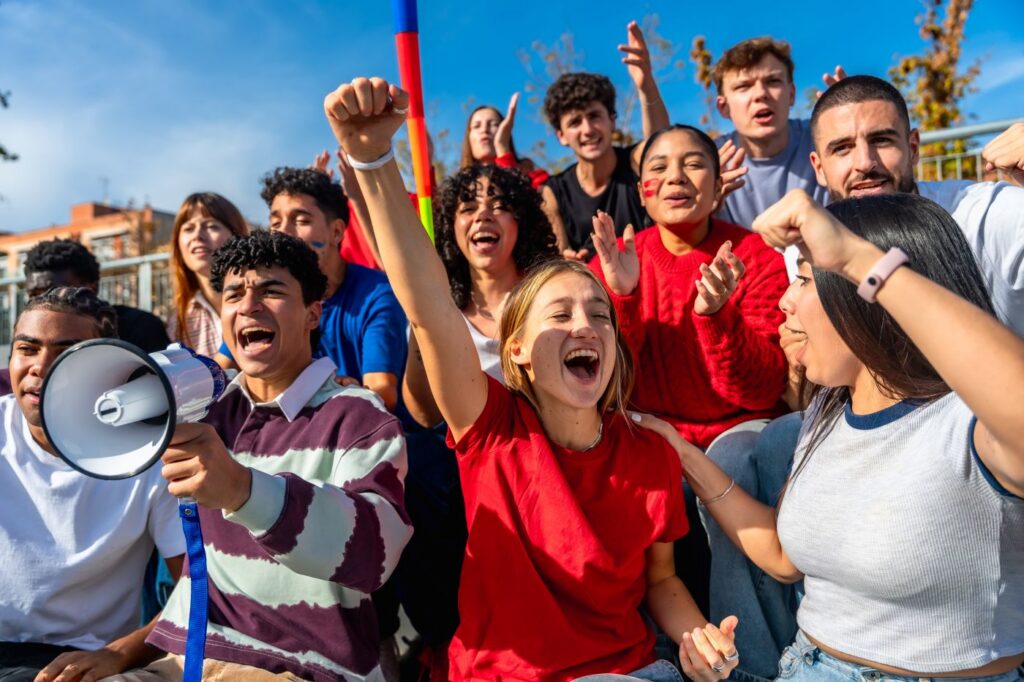
“Death to Israel!” she yelled, mid-stride, as she passed our debate table and disappeared into the crowd. I recognized her—a fellow student from my time on campus. Just minutes earlier, I had invited her to sit down with me and make her case for her position on Israel, but she declined.
This encounter happened earlier this year, when I returned to Randolph-Macon College, my alma mater in Ashland, Virginia, to host a debate on whether the West should stand with Israel. In the days leading up to the event, it gained traction: flyers spread across campus, the online poster was shared more than sixty times on social media, and on YikYak, an anonymous campus app, someone reposted it with the caption “let’s go embarrass them,” racking up nearly 100 upvotes—the top-trending post.
The passion was unmistakable. What followed was something else. Dozens showed up, but mostly to watch. One student approached the table and asked about the prompt. I invited him to debate. He hesitated, then said he “just [didn’t] have the words.” A cash prize and free donuts drew some to participate—mostly students with moderate views or none at all. The ones with the strongest convictions, several of whom I knew personally, were nowhere to be found.
This is not a story about censorship. Nobody banned the event. Nobody shut it down. The students opted out voluntarily—and that is precisely the problem.
For years, the campus free speech debate has focused almost entirely on deplatforming speakers and censoring certain kinds of speech. That fight matters. But the more corrosive problem is going largely unaddressed: a generation of true believers with no appetite for any legitimate challenge to their views.
Start your day with Public Discourse
Sign up and get our daily essays sent straight to your inbox.My undergraduate ethics professor has watched this happen in real time. Year after year, students have become increasingly reluctant to weigh in on controversial political topics, even when directly prompted. The epiphany came the day after the 2024 presidential election. Despite months of visible anxiety over the results, his class sat in silence when the topic was broached in class discussion. The data confirm it isn’t just one classroom: a 2024 Knight Foundation survey found two in three college students self-censor during classroom discussions; FIRE’s 2026 College Free Speech Rankings, drawing on 68,510 respondents across 257 schools, found 52 percent self-censor at least once or twice a month.
Students aren’t being silenced. They’re going quiet on their own. The question is why.Politics has become our identity. Criticize someone’s politics and you are no longer questioning an opinion; you are questioning their very self. There is a reason students cover their laptops with political stickers and their social media bios with activist hashtags. They aren’t just signaling what they believe; they’re signaling who they are. And being proved “wrong” about who you are, then sent off into an existential spiral, is no longer an irrational thing to fear.It is also a crisis of intellectual honesty. Many students with strong political views have never seriously interrogated them. On a typical campus, liberals outnumber conservatives roughly 5.5 to 1 among students, 6 to 1 among faculty, and 12 to 1 among administrators. The asymmetry naturally instills a kind of unchallenged orthodoxy where the dominant views are repeatedly accepted and reinforced. Conservative students face the opposite problem: sensing their opinions are unwelcome, they self-censor at twice the rate of their liberal peers. Their views don’t get interrogated either—they just stay buried. Across the ideological spectrum, the result is the same: what passes for conviction is usually a set of inherited talking points sitting atop an unexamined foundation—one probing question away from the entire worldview collapsing.
Students know this. And so they avoid discussing incendiary issues, keeping their convictions—however fervent—close to the chest, so as to require no defense and invite no reply. In time, those convictions fuse with identity. The dogma ossifies. The cycle repeats.
Students know this. And so they avoid discussing incendiary issues, keeping their convictions—however fervent—close to the chest.
You don’t need to be a political theorist to know that this is detrimental to democracy. Without the dialectic, democracy decays. John Stuart Mill understood that it is only through the clash of ideas that we learn which beliefs earn the right to be held. “He who knows only his own side of the case,” Mill wrote in On Liberty, “knows little of that.” Without challenge, even our most fundamental beliefs hollow out—the words remain, but the underlying reasoning decays. A generation whose primary form of political engagement is reposting headlines on your Instagram story is not just intellectually lazy; it is democratically unfit. Self-governance requires citizens who can face scrutiny, examine their deeply-held beliefs, update their views when they’re wrong, and disagree without doubling down. Instead, we are cultivating a class of young adults fluent in slogans and bathing in dogma.
Universities bear responsibility for this. For a decade, they have treated student discomfort as an institutional problem to be solved with safe spaces, conflict-averse administrators, and a campus culture that clutches its pearls at ideological heterodoxy. The message students receive, implicitly and sometimes explicitly, is that disagreement is a threat to be managed rather than an opportunity to think. And then the students act accordingly. The Knight Foundation found that most students are unaware of any programs at their institutions that promote constructive dialogue. Yet among those who know no such programs exist, a clear majority want them. The demand is there, but the institutions aren’t meeting it.
The campus free speech fight has been almost entirely defensive: stop the bans, protect speakers, resist censorship. These measures are necessary, but not sufficient to restore fruitful, civil debate and genuine intellectual friendship among the student population. Universities need, instead, an affirmative case for free speech on campus. That means building structured debate into the core curriculum, not as an elective or a club activity, but as a graduation requirement. It means faculty treating the morning after a historic election as an occasion for discussion rather than stultifying silence. It means administrators measuring success not by how comfortable students feel, but by how often they’ve been genuinely challenged. Campuses shouldn’t stop at being open fora for speech; they should be combative, in the best sense.
The student who shouted and walked away from my table had a position worth contesting. I would have pushed back. She would have had to answer. That exchange—however uncomfortable—is precisely what a college education is supposed to produce. At a moment when Americans can barely speak across political lines, we are graduating a generation that never learned how. That is not a campus problem. It is a democratic emergency.