Author’s note: Professor Holloway is a friend, and thanks me for some conversations we had before he began writing this book.
Many landmarks of twentieth-century liberal judicial activism have been built on “law-office history”—a tendentious and selective attempt to give a pedigree to what are in fact innovations. The Roberts Court has gone far toward correcting these abuses; this is some of the beneficial fruit of “originalism” and “history and tradition” jurisprudence. In Dobbs, Justice Alito put paid the spurious historical claims of Roe v. Wade (which the Court had already largely abandoned in Casey). The “wall of separation” metaphor that launched modern religious liberty doctrine (Everson) has given way to a more accurately historically informed “accommodationist” perspective. Now Professor Carson Holloway gives us a rich account of the Anglo-American law of libel, exposing the flimsy basis of Justice Brennan’s opinion in New York Times v. Sullivan. With No Liberty to Libel, he has probably saved some future Supreme Court clerks a lot of legwork.
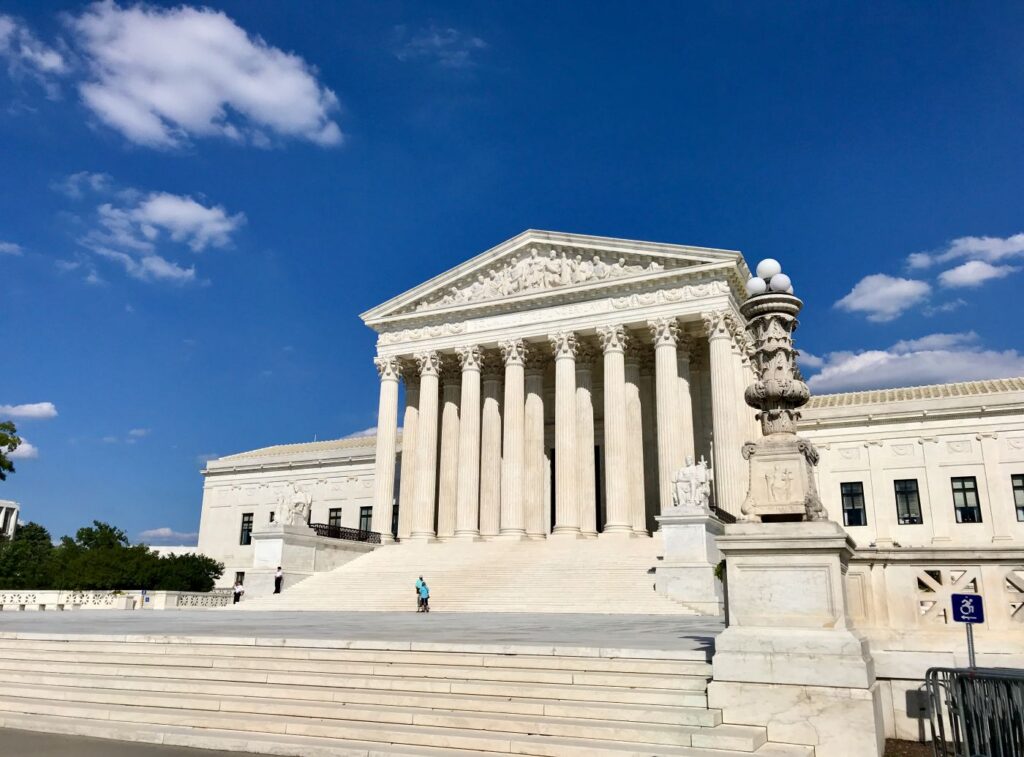
The Sullivan case (1964) arose out of the civil rights movement. Civil rights organizations took out an ad in The New York Times protesting the repressive acts of officials in Birmingham, Alabama. Several of the allegations were inaccurate, at least in detail, and those officials (Sullivan was a municipal “commissioner of public affairs”) sued for libel. Alabama, like most states at this time, held publishers liable for false and defamatory statements (though, as Holloway points out, Sullivan was not named in the ad, so really wasn’t “defamed”—but the Supreme Court was looking for a way into, not out of, reviewing the state case), and a jury awarded the plaintiff $500,000. Such awards would effectively inhibit media coverage of the civil rights campaign.
Overruling the Alabama court, the Supreme Court established a new, national standard of libel. Public officials (later “public figures”) could not win a libel suit unless they showed “actual malice”—that the publisher had knowingly published defamatory falsehood, or had done so with reckless disregard to the truth. This was an exceedingly difficult standard for plaintiffs to meet.
Holloway provides a masterly and smoothly written survey of the case law and treatises on libel from the Founding to the present. The English common law of libel at the time of the American Founding was quite plaintiff-friendly. As Blackstone explained in his 1760s Commentaries, it amounted to nothing more than “no prior restraint”—no censorship; no need to obtain permission to publish beforehand. You could publish whatever you wanted, but would be held liable for the harm that you did to anyone’s reputation by it. Malicious intent was assumed; the defendant had to rebut the presumption. Truth was no defense—the maxim was “the greater the truth, the greater the libel.” If you wrote that the King was a fat idiot, no BMI chart and IQ test would save you. You were guilty of (seditious) libel for undermining popular confidence in the government. Holloway points out that the American judge and commentator James Kent took issue with this standard, claiming that it was “an oppressive innovation of the Star Chamber.”
Start your day with Public Discourse
Sign up and get our daily essays sent straight to your inbox.So much for Blackstone. Americans had already expressed a more libertarian attitude in the eighteenth century. The famous Zenger case (New York, 1735) seemed to establish a truth-defense standard, but, as Paul Finkelman noted, the case was “not so much a ‘legal precedent’ as an act of jury nullification.” The best evidence for a more permissive American attitude in the Founding era is, ironically, the notorious Sedition Act of 1798. This statute made it criminal to publish false and defamatory statements about the federal government’s officers. The act modified the common law by making truth a defense (though it had to be proved by the defendant), let the jury rather than the judge decide the legal question of whether the publication was defamatory (previously all the jury decided was the fact of whether the defendant had published it), and limited the penalties.
The Jeffersonian Republicans condemned the Sedition Act, which expired in 1801, coincident with the Republicans’ electoral sweep. New sedition acts were enacted in 1918 and 1940. None was held unconstitutional. (Holloway notes that John Marshall defended the 1798 act’s constitutionality, but opposed it as bad policy. I would quibble here; dispute remains about whether Marshall wrote in defense of the act.) The Sullivan Court remarked that the Sedition Act had been “condemned by the court of history.” But the Jeffersonian Republicans objected primarily on constitutional, especially federalism, grounds. And the First Amendment was not among their principal objections. First was that punishing this crime was not among the enumerated powers of Congress, contrary to the Federalist argument that federal courts could punish seditious libel as a common law crime, absent any enumerated power. The Republicans argued that seditious libel could be punished by the states (state laws like Virginia’s were harsher than the federal act), but not by the federal government. Republicans objected, with some justice, that the Federalists used the act for partisan purposes.
After this Founding-era fight, libel law did not evolve much. The Sedition Act controversy involved seditious libel—libels against the government—and criminal libel. It did not affect the private (tort) libel laws of the states at all. Criminal libel had all but disappeared by the twentieth century, Holloway points out. The mid-century American Law Institute’s Model Penal Code did not include a criminal libel section. Sullivan conflated these—it turned a state private or civil libel case into a public, First Amendment case, and asserted that the First Amendment imposed a new, national libel standard. Holloway discusses six federal private libel cases (involving the territories and District of Columbia) before Sullivan that raised no First Amendment concerns. As late as 1942 Justice Frank Murphy (a passionate liberal often seen as a Warren Court precursor), wrote that “There are certain well-defined and narrowly limited classes of speech, the prevention of which has never been thought to raise any constitutional problem. These include the lewd and the obscene, the profane, the libelous.” Some state courts had gone further. Kansas, in Coleman v. MacLennan in 1908, provided the principal historical precedent for Brennan, though Holloway explains that this case had not done what Brennan claimed it had.
Clearly, the Court was legislating, not adjudicating, in Sullivan, imposing its preferred standard of libel over those of all the states, as it would impose a national abortion code for all the states in Roe. A significant but overlooked feature of Sullivan is how the liberal justices revived one of the liberals’ “Lochner-era” bêtes-noires, a federal common law. The Constitution gives the federal courts the power to decide controversies between citizens of different states (“diversity jurisdiction”). In 1842 the Court decided that the federal courts did not have to use the common law of the states (as the Judiciary Act of 1789 seemed to require), but could consult general principles of law in diversity cases. Progressives complained that the federal courts chose rules that favored big business defendants, and in 1938 they convinced the Court to repudiate the federal common law. Sullivan established a federal common law of libel, to trump Alabama’s libel law. The justices did not admit that they were doing this, any more than they admitted that Roe revived the “Lochner era” doctrine of “substantive due process.”
Holloway is a political scientist; I’m a historian. I am grateful and satisfied that he has done the work that historians should be doing, replacing law-office history with real history. Alas, historians have too often prostituted themselves to lawyers’ needs for history in high-profile constitutional law cases. Alfred H. Kelly, the historian who worked with the NAACP on the Brown case, was one of the few who admitted as much. (Apropos, Kelly wrote an important article on the history of libel law in the 1968 American Historical Review.) In a confessional article (after the Court said that the history was too indiscernible to decide the case—“we cannot turn back the clock,” it said) entitled “Clio and the Court: An Illicit Love Affair,” he said that his brief “manipulated history in the best tradition of American advocacy, carefully marshalling every scrap of evidence in favor of the desired interpretation and carefully doctoring all the evidence to the contrary, either by suppressing it when that seemed plausible, or by distorting it when suppression was not possible.” He traduced the standards of the historical profession, but he did it for a good cause.
One should appreciate Holloway’s historical work whether one favors or rejects the “actual malice” standard of Sullivan. As he concludes, overturning Sullivan “would not be gutting the First Amendment but restoring its true meaning.” Holloway is firm but circumspect about the substantive issue. He does critique the public-private figure standard and notes that Sullivan gave the media a privileged status that is incompatible with the principles of republican government. It’s hard to deny that The New York Times was on the right side in this case. (I grew up with the Times and still subscribe—but only for the crossword.) Clearly, Holloway carries the death warrant for Sullivan. What would be the practical result of its overturning? I guess that most states, having lived with the actual malice standard for sixty years, would adopt it, just as most states, their populations inured to abortion-on-demand for fifty years, have adopted the Roe standard. This would be a pity, for, as Holloway points out, American self-government has not benefited from two generations of the Sullivan standard.