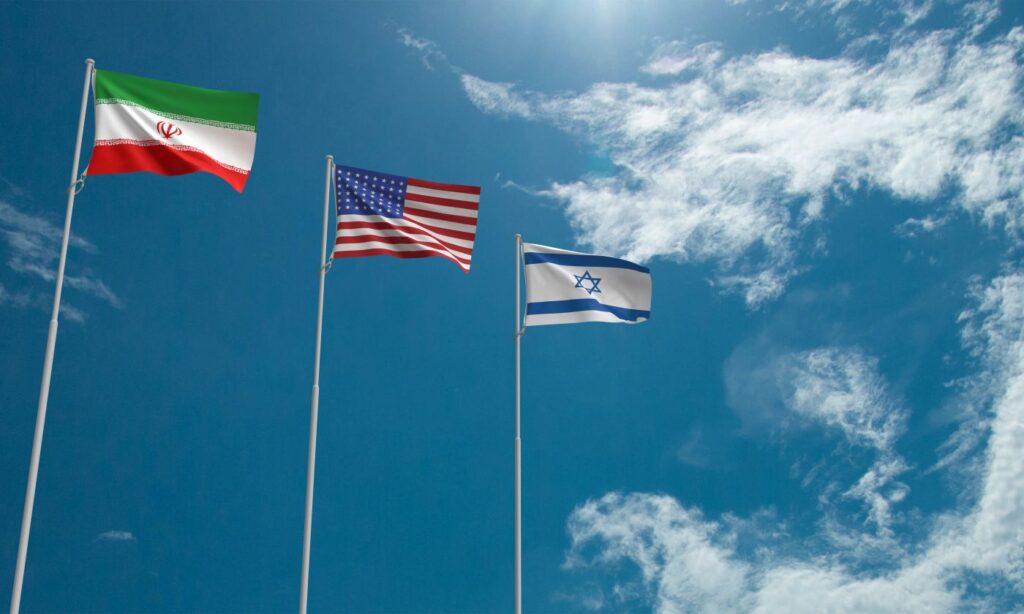
America is in an unconstitutional war. Does anybody care?
Early on Sunday morning local time, June 23, United States armed forces at the direction of President Trump undertook a large-scale military attack on Iran, a nation with which we were not (then) in a state of war. Though there had been tensions, hostile acts, and military reprisals for many years—including the targeted drone killing of Iranian general Qassem Soleimani in Iraq in January 2020—neither nation had initiated an armed attack against the other nation on its own soil. Until last month.
President Trump ordered the attack on his own authority. Congress had not authorized war with Iran. It had neither formally declared war nor enacted the legal equivalent of such a declaration in the form of a statutory “Authorization for Use of Military Force” (AUMF). Nor did the attack on Iran fit within the scope of any prior, extant congressional authorization of force, like the September 18, 2001 authorization of force against nations and organizations responsible for the September 11 attack on America. Iran has done many bad things, but there does not appear to be a true connection between Iran and the September 11 attacks a quarter century ago.
The United States’ attack on Iran was not a defensive military action directed to repelling an immediate attack on the United States or on its armed forces abroad. Nor was this an attempted rescue operation to free U.S. persons being held abroad (as President Carter attempted unsuccessfully in 1980). Nor was it a situation of immediate emergency where use of force was necessary to the preservation of the nation or its people, and where Congress could not act within the relevant timeframe. The Iranian nuclear threat had been gathering for a long time. Robert George and I publicly proposed that Congress authorize the use of force more than a decade ago. There was plenty of time, and sufficient reason, for Congress to have exercised its constitutional power to declare war, in the form of such a statutory authorization. This was not a sudden, defensive response to an otherwise unanticipated situation.
No. This was an offensive military attack: Trump, acting on his own claimed authority, ordered American planes to bomb sites and facilities believed to be the locations of Iranian nuclear weapons development. The attack involved multiple B-2 “Stealth” bombers dropping fourteen 30,000-pound GBU-57 “Massive Ordnance Penetrator” bombs. The objective was to preemptively deprive a potential future war enemy of military capabilities and potential weaponry that might be used against us (or against one of our allies) in a conflict. In this respect (but of course not in others), the U.S. attack on Iran resembles the Japanese attack on Pearl Harbor on December 7, 1941: a nation not then at war with a potential adversary attacks first, attempting to destroy the adversary’s military capabilities.
Start your day with Public Discourse
Sign up and get our daily essays sent straight to your inbox.It is indisputable that the massive U.S. attack constituted an act of war, initiating a state of war between the United States and Iran. Just how long this state of war will last and what future battles or engagements, if any, will occur is unknown, as it is at the beginning of any war. But irrespective of its length, on June 23 the United States inaugurated war by launching an offensive military attack on Iran. This moved the United States from a state of peace and simmering, uneasy tensions to a legal state of war.
The attack, as I will explain, was illegal under the U.S. Constitution. But it was hardly unprecedented. Presidents have done this sort of thing before. This raises troubling questions: is the Constitution altered—amended, superseded, repealed—by its repeated violation? If Trump has merely done what a lot of presidents have done, if perhaps more dramatically, can his attack on Iran really be said to be “unconstitutional”? Does the Constitution really even provide an operative rule of law if presidents do not observe that rule and no one else enforces its observation? Should one care about what the Constitution says and what its framers intended if our constitutional practice has steadily moved in a different direction, the courts have not rejected that movement, technological or social conditions have changed, and one perhaps favors military action against Iran in any event? Isn’t this violation of the Constitution relatively “harmless”? As nails in the Constitution’s coffin go, isn’t this a rather small one? And finally, do we even care about the Constitution anymore when it comes to war powers (and to what else)?
These are important questions. The Iran attack offers a disturbing parable about constitutional interpretation and the state of constitutional discourse today—and about what that condition might portend for the future.
What the Constitution Says about War Powers
It is hard to deny that Trump’s unilateral initiation of war violates the U.S. Constitution. At least, it is hard for anyone who takes the text, structure, and original meaning of the Constitution seriously. The Constitution vests in Congress—and not in the president—the power “to declare War.” The original meaning of “declare” in this context, as it concerns “war,” is the initiation by words or actions of a legal condition of war. And the original meaning of “war”—the broadly accepted understanding of the framing generation and recognized by the “law of nations” at the time of the Constitution’s adoption—encompasses all uses of sovereign armed military force in which a nation seeks to prosecute its claims or grievances against an enemy.
An armed attack on another nation therefore is clearly a declaration of war within the original understanding of the Constitution’s words. The fact that the war might have, from one side’s perspective, a limited objective, and might be intended to be of limited duration, is immaterial. Small wars, swift wars, “limited” wars, and (supposedly) “easy” wars are all still war. (The notion of a military “strike” or “attack” that is somehow not “war” is foreign to the original meaning of the Constitution—an anachronism.) By granting to Congress the power to declare war, the framers gave to Congress, and not the president, the power to decide whether to initiate war. Simply put: Congress has constitutional power to declare war and the president does not. The president may not—at least not constitutionally—launch a war all on his own. That power belongs to Congress
In parallel fashion, the Constitution vests in the president—and not in Congress—the authority to conduct war. The Commander-in-Chief Clause of Article II gives the president the formidable, plenary, and exclusive power of military command of the nation’s armed forces. The president is military Commander-in-Chief and Congress is not. Just as the Commander-in-Chief Clause does not give the president authority to declare or initiate a war, the Declare War Clause does not give Congress the power to direct and control—to “micro-manage” (or for that matter to “macro-manage”)—the conduct of hostilities it has authorized.
That is the Constitution’s scheme of separation of powers concerning war, an arrangement deliberately chosen by the framers. Those who drafted the Constitution consciously departed from the traditional arrangements of England and continental Europe, where the military power of the state was considered an executive power possessed solely by the monarch. The framers intentionally divided the war power, removing from the American executive the king’s traditional executive power to declare or initiate war. In a republic, they believed, the power to take the nation from a condition of peace to a state of war belonged with the legislative branch. When one delegate to the Philadelphia Convention drafting the Constitution suggested that the president have the power to declare war, he was promptly slapped down. Elbridge Gerry, a delegate from Massachusetts (and later vice president) caustically remarked that he “never expected to hear in a republic a motion to empower the Executive alone to declare war.” The Convention carefully and deliberately chose language, proposed by Gerry and James Madison, that would retain in the president the traditional executive power to repel “sudden attacks” on the nation and also make clear that the president would possess exclusively the power to conduct war—thus the change from Congress’s having power to “make” war to having power “to declare” war. But that is as far as the framers would go in the direction of presidential war power. The president was to have no constitutional power to start a war by attacking another nation.
No prominent member of the framing generation—and as far as I can tell, no obscure one—took a different view of the Constitution’s language. George Washington, John Adams, Alexander Hamilton, Thomas Jefferson, James Madison and literally everybody else agreed on this fundamental point and acted accordingly. Indeed, the very division of war powers between the two branches—Congress decides on war, the president conducts the war where authorized—would permit each to check the other. Neither branch could take America into war without the affirmative assent of the other. Trump’s attack on Iran thus violates the Constitution’s most fundamental structural arrangement, its specific provisions, and its framers’ intentions concerning the power to take the nation from a state of peace to a state of war. Trump has started an unconstitutional war.
Does Contrary Practice Overrule or “Amend” the Constitution?
Some have suggested that the law of the Constitution is unclear or uncertain on the division of war powers. Nonsense. The Constitution is perfectly clear on this score. (There are some hard questions, at the margin, of application of the Constitution’s assignment of war powers, but this isn’t one of them.) It is simply that our practice does not consistently conform to the Constitution. (I have explained the examples of the Korean War (1950-1952), the months-long air war in Kosovo (1999), the 2011 Libya bombing, and Trump’s strikes in Syria in 2017, in other writing. There are many other arguable illustrations, but these are pretty clear.) The Constitution’s rules are straightforward; we just don’t follow them all the time.
But that is an entirely different problem—not a question of constitutional clarity but one of constitutional priority and fidelity: where practice, or precedent, has departed substantially over time from the Constitution’s actual linguistic meaning and original design, which one should control our actions going forward—the practice and precedent or the text’s original meaning? This is a question common to many areas of constitutional law. A great deal of our constitutional practice and precedent is at odds with what the Constitution actually says and rightly means. What should we do in such situations?
In one school of thought, usually associated with political liberals and judicial activists, ours is a malleable “living Constitution,” the meaning of which changes with times and circumstances. A competing school of thought, associated with political conservatives and constitutional originalists, holds that the Constitution sets forth permanent rules and standards; that these rules are changeable only by the Constitution’s prescribed amendment procedures; and that these rules are never properly altered by precedent or practice that departs from the Constitution’s original meaning.
Ironically, as it concerns war powers, the positions of the contending camps are often reversed. Conservatives, more hawkish on military matters, abandon their claimed constitutional principles and defend presidential war-initiating power, against nearly all evidence of the text’s original meaning, structure, and history. Instead, like the liberals they decry, conservatives embrace precedent and practice departing from originalism, cite changed circumstances and technologies, and adopt “evolving” views of war powers under the Constitution to better suit the times and their policy preferences of the moment. Not to be outdone, so too do dovish liberals change their constitutional interpretive stripes when it comes to war powers, clinging as nowhere else to the Founding Fathers’ intentions and deliberate design, and to the original eighteenth-century meaning of the words of the Constitution’s text. One never saw such strict, rigorous textualist-originalist-formalists as political liberals opposing conservative presidents’ unilateral warmaking.
But a principled approach dictates that where practice or precedent departs from the original meaning of the Constitution—that is, the meaning the document’s words, phrases, and structure would have had, in historical and linguistic context, at the time they were adopted, to a reasonably informed speaker or reader of the English language reading a document of this type—the faithful constitutionalist must go with the Constitution and not with faithless departures from it. Always. It is fundamental, or should be, to our system of written constitutionalism that political actions and judicial decisions straying from the Constitution’s meaning do not supersede, displace, or repeal the Constitution’s original meaning. Such acts of constitutional betrayal do not change the Constitution’s meaning; they violate it.
It follows that deviations from the Constitution in practice should not be followed in subsequent situations. One constitutional violation does not justify another—and another, and another. The Constitution itself is the supreme law of the land—not practice, not precedent, not politics. The Constitution must always be given precedence over conflicting judicial interpretations, contrary practice, and unconstitutional legislative enactments or executive orders. This applies to matters of war as to any other. Unconstitutional practice or precedent can never rightly replace the Constitution’s true meaning.
Interpretive Dodges and Ruses
Lawyers and commentators possess seemingly limitless imagination in coming up with arguments for ignoring the Constitution. It is practically an iron law of nature that lawyers, judges, politicians, and even some law professors will employ stratagems, subterfuges, and creativity to avoid the clear force of a constitutional provision in direct proportion to the political inconvenience the provision creates. I have written about this phenomenon in several other contexts. It obviously holds true for efforts to avoid the rule that Congress must authorize offensive military force against another nation.
The dodges and ruses run the gamut from dubious to ridiculous. Try this one: bombing another country is not “war.” A one-day “strike” is not “war.” Nonsense. Would it not be “war” for Iran to have bombed the United States? Was it not “war” when the Japanese bombed Pearl Harbor? As noted above, the intended (or even actual) brevity of a particular military action—the use of sovereign coercive armed force to achieve an objective—is immaterial to the constitutional legal meaning of “war.” It is a modern anachronistic characterization projected onto the constitutional text. Short wars are wars.
Or how about this one? Congress’s power is only to “declare” war—to note the fact of war’s existence, for certain public or diplomatic purposes—not a power over its initiation. This is flatly ahistorical—a ridiculous, anachronistic literalism belied by the Constitution’s structure and all evidence of original intention and understanding.
Then there’s the sophistic argument that, since Congress gave the president an army, navy, air force, and weapons, he may do with them as he wishes, and if Congress disapproves, it can cut off funding. This mistakes the availability of one method by which Congress might “check” presidential lawlessness—itself not always available or possible, given the presidential veto power—for a grant of plenary presidential power whenever the check is not exercised. That is simply not logical. The Constitution grants Congress, and not the president, the power to declare or initiate war. Sometimes Congress can enforce that correct constitutional understanding with the added oomph of its appropriations power. Sometimes it cannot. But in any event, the Constitution’s allocation of war powers remains the same. The appropriations power is a separate and incidental power, not the war power itself.
Finally, there is this whopper: the very fact that people disagree over war powers shows—proves—that the Constitution is unclear and uncertain on this point! That is illogical to the point of being comical. Disagreement, by itself, proves nothing. It may well be the case—it often is the case—that one view is right, and the other view is simply wrong.
Doesn’t the War Powers Resolution License Presidential Warmaking for Sixty or Ninety Days?
More plausible, but just as deeply flawed, is the argument one sometimes hears that the War Powers Resolution of 1973, although enacted with the goal of reining in presidential warmaking, in fact accomplished the reverse: that it authorized presidents to use force as they see fit, so long as they notify Congress, but that such authorization lasts for only sixty days (ninety, if the president certifies the need for an extension).
But that is not what the War Powers Resolution says. The WPR makes crystal clear Congress’s enacted view (set forth in Section 2(c) of the WPR) that a president constitutionally may employ military force only pursuant to (1) a formal declaration of war, (2) a specific statutory authorization of military force, or (3) a national emergency created by an attack on the United States, its territories or possessions, or its armed forces. The WPR further specifies (in section 8) that nothing in the WPR itself should be construed as authorizing presidential use of military force, introduction of U.S. forces into hostilities or imminent hostilities, or enlarging presidential constitutional power in any way. Simply put, the War Powers Resolution authorizes nothing.
What give rise to confusion (and thus manipulation) are the provisions of the WPR that purport to restrict presidential Commander-in-Chief actions that might be said to be “war-adjacent” or that threaten to create circumstances in which armed hostilities are likely or possible. In such instances, the WPR requires presidents to “report” to Congress such actions, which then triggers a sixty-day clock (extendable by thirty days) after which the president must cease such actions. Congress can also “veto” such presidential actions by passing a disapproval resolution (not requiring the president’s assent). These provisions are riddled with constitutional problems and rightly have proved to be unenforceable and almost completely useless.
But the essential point remains: the War Powers Resolution nowhere itself authorizes the use of military force and specifically disclaims that it does so. To argue that unconstitutional procedural provisions authorize presidential warmaking within the sixty- (or ninety-) day window is simply wrong.
What If Courts Don’t or Can’t Decide the Issue?
A variation of this “the law is uncertain” trope proceeds from the observation that constitutional questions concerning the division of war powers between Congress and the president are rarely addressed and decided by the courts. This is not quite true, as a descriptive matter, but it almost is. While a few lower courts have held presidential initiation of wars unconstitutional, the U.S. Supreme Court has never decided a case that squarely presented that issue. The Prize Cases, the landmark 1863 decision upholding President Lincoln’s blockade of the South during the Civil War, remains the Supreme Court’s most authoritative pronouncement on war powers. In dictum, the Court drew precisely the line established by constitutional text and history: if a foreign nation invades, the president is “not only authorized but bound to resist force by force.” But the president otherwise “has no power to initiate or declare a war either against a foreign nation or a domestic State.” The Prize Cases were a big deal, and the Court’s dictum is not exactly nothing. But it’s true that most judicial challenges to presidential warmaking have been dismissed for lack of legal “standing” of any proper party to contest what a president has done (for lack of a concrete injury specific to that person) or because the dispute is otherwise thought to lie outside the judicial power as a matter for Congress and the president to resolve between themselves.
But even if the observation is mostly correct, the suggested inference is completely wrong: that a relative dearth of judicial decisions leaves the proper understanding of the Constitution up in the air. No judicial decision, no law, right? If the Supreme Court could never rule on the constitutionality of Trump’s attack on Iran, that makes it legal, right?
Wrong. The Constitution means what the Constitution means, whether there is a specific judicial decision on the point or not, and irrespective of whether a given question could ever properly become the basis for a court case. The Constitution is not the exclusive property of the Supreme Court. It is supreme law that “We the People” adopted as a political society and continue to maintain. The Constitution by its own terms is binding on all government officials and citizens; all who swear an oath to uphold it are governed by its terms. The fact that some constitutional questions might never take the form of a case appropriate for judicial resolution does not mean that those constitutional questions don’t have right answers or that those answers are not law unless and until declared by the Supreme Court. (Besides, the Supreme Court has weighed in on this precise question, albeit long ago and in dictum, in The Prize Cases.)
For the same reasons that unconstitutional practice does not override the Constitution, and that rarity or absence of judicial decisions does not mean there are no rules at all, it should be abundantly clear that executive branch legal opinions—which (surprise!) tend to favor executive power—do not change the meaning of the Constitution either. Years ago, I was an attorney in the Department of Justice’s Office of Legal Counsel (OLC), the office traditionally responsible for formulating the executive branch’s constitutional interpretations and producing that branch’s formal legal “opinions.” At its best, OLC provides presidents and executive branch agencies with sound, principled, objective legal interpretations of the Constitution, guiding the executive branch to faithful execution of the law and its constitutional duties. At its worst, OLC can be a disingenuous shill for its “client,” producing self-serving executive branch legal rationalizations for lawless executive actions.
Of late, on war powers, OLC has behaved in the latter fashion—and done so shamelessly, on behalf of presidents of both major parties: The president wants to bomb or invade a foreign country? No problem! The use of overt, armed force against another nation is not “war” that Congress needs to authorize if the president does not mean such action to be considered a war, or if the use of force was intended to be of short duration, or if it involves aerial bombing attacks and missile launches but not ground troops. (Tell that to the nation being attacked: we’re not waging “war” against you, we’re just bombing you.) The president can take any such actions on his own authority as Commander-in-Chief, as long as the president decides that they further an “important national interest”(in the president’s estimation). Besides: Presidents have done things like this before; therefore, such actions are constitutional. If Congress wishes to stop the president, it can cut off funds.
So OLC has argued several times now, each time citing its own prior opinions as precedent. As one former head of the office has noted, it would be a piece of cake for him to argue, as an executive branch lawyer advising the executive branch, that presidents can take what military action they wish, based on these opinions: it’s not a war, so Congress doesn’t need to authorize it; it advances important national interests; and presidents have done this sort of thing before.
With all due respect, these OLC opinions should not be taken seriously because they do not take the Constitution seriously. The Constitution’s meaning does not change because executive branch attorneys say it does.
But This Is a “Good” War! Should We Really Care About Constitutional Niceties?
The question of the constitutional propriety of a military attack is distinct from the question of its moral propriety. Bombing Iran’s nuclear sites might be thought, on balance, justified from a strategic, tactical, and moral standpoint yet not be justified from a legal standpoint. (It might be a very good idea that Iran not have nuclear weapons capabilities. But whether achieving that goal requires preemptive war, and whether the current administration is competent to—and can be trusted to—evaluate facts accurately and weigh risks and related considerations appropriately may well be doubted.) The questions of legality and morality are not entirely distinct, however: a component of traditional “just war” moral theory about when it may be right for a nation to go to war (jus ad bellum) is not only that the war be (1) for just cause, (2) undertaken as a last resort, and (3) have a reasonable prospect of success, but also (4) that it be waged pursuant to proper authority. An unconstitutional war is therefore (probably) not a just war.
It does not matter that one might think the Iran attacks were “good” as a military, strategic or moral matter. If one is a faithful constitutionalist, that is beside the point.
There is a real danger to our constitutional order in our increasing tolerance for—becoming conditioned to, grudgingly acquiescing in, subtly coming to accept as inevitable—violations of the Constitution large and small.
Presidents Have Done this Kind of Thing Many Times. What’s the Big Deal?
I conclude with the questions I posed at the outset: if Trump has merely done what a lot of presidents have done (and Congress has never prevented presidents from doing) can Trump’s attack on Iran really be said to be unconstitutional? Does the Constitution actually provide an operative rule of law if presidents do not observe that rule and no one enforces its observation? Should one even care about what the Constitution says, and what its framers intended, if our constitutional practice has moved in a different direction, the courts have not rejected that movement, technological or social conditions have changed, and one favors military action against Iran?
My answers to these questions are Yes, Yes, and Yes. Trump’s unilateral initiation of war with Iran is unconstitutional irrespective of what other presidents have done and what courts do or don’t do. If we care about the Constitution, we must abide by its rules and not simply violate them or shunt them aside whenever we find them inconvenient, tiresome, or unhip. The Constitution means what the Constitution means. The fact that other presidents may have violated the Constitution with respect to war powers does not make Trump’s actions in Iran any less a violation of the Constitution. Likewise, as already noted, the fact that a particular constitutional question might not give rise to a “case” for courts to decide does not mean that the Constitution’s rules do not exist otherwise.
The last question is perhaps harder. Why should we be faithful constitutionalists on matters of war powers in the first place (as opposed to being hard-headed “pragmatists”)? Why should we care about the Constitution, about this violation of it, by this president, at this time?
Part of the answer is that principles are pragmatic. A hard-headed realist must recognize that the costs of abandoning principle are often tragic. If we give up on the Constitution’s strict division of war powers—if we accede to the idea that presidents can start wars whenever they conclude that doing so advances what they think are “important national interests”—then why might not Trump, if so inclined, attack (or threaten to attack) Canada, Denmark, Panama, or Mexico over slights, real or imagined, to his own authority or ambitions?
As for this violation of the Constitution arguably not being as flagrant as some others—if it is even possible sensibly to make such distinctions—it is hard to know what exactly to make of such a suggestion. Should we therefore acquiesce in this violation? How does the reality of other, multiple, and novel violations of the Constitution make a more familiar, repeated violation somehow more acceptable?
There is a real danger to our constitutional order in our increasing tolerance for—becoming conditioned to, grudgingly acquiescing in, subtly coming to accept as inevitable—violations of the Constitution large and (ostensibly) small. James Madison wrote, in his Memorial and Remonstrance Against Religious Assessments, that it is “proper to take alarm at the first experiment on our liberties.” It was, indeed, the “first duty of Citizens” and “one of the noblest characteristics of the late Revolution,” to resist violations of principle at their earliest appearance. “The free men of America did not wait till usurped power had strengthened itself by exercise, and entangled the question in precedents. They saw all the consequences in the principle, and they avoided the consequences by denying the principle.”
Just a few years later Madison, writing in The Federalist No. 47, said, of the central importance of maintaining the Constitution’s separation of powers, that “the accumulation of all powers, legislative, executive, and judiciary, in the same hands . . . may justly be pronounced the very definition of tyranny.” The consequences of executive aggrandizement of the war power do not just happen “over there.” They happen here, in our midst, and have costs here as well. (Madison elsewhere called war the “true nurse of executive aggrandizement” of power generally.) Presidents enjoy the power they have unconstitutionally accrued, so the prospect of executive self-restraint is unlikely. And courts have a limited capacity and inclination to intervene in this area. Hence, we need to do some hard thinking about how to change the incentives in our political institutions and our elections so that Congress recovers its collective self-respect as the branch of our government that acts for the nation deciding whether to take us to war—and defending its prerogatives when presidents usurp them. To accomplish this, we, the people of the United States, need to begin by emphatically denying the principle—and the legitimacy—of unilateral presidential war-making.
Image licensed via Adobe Stock.