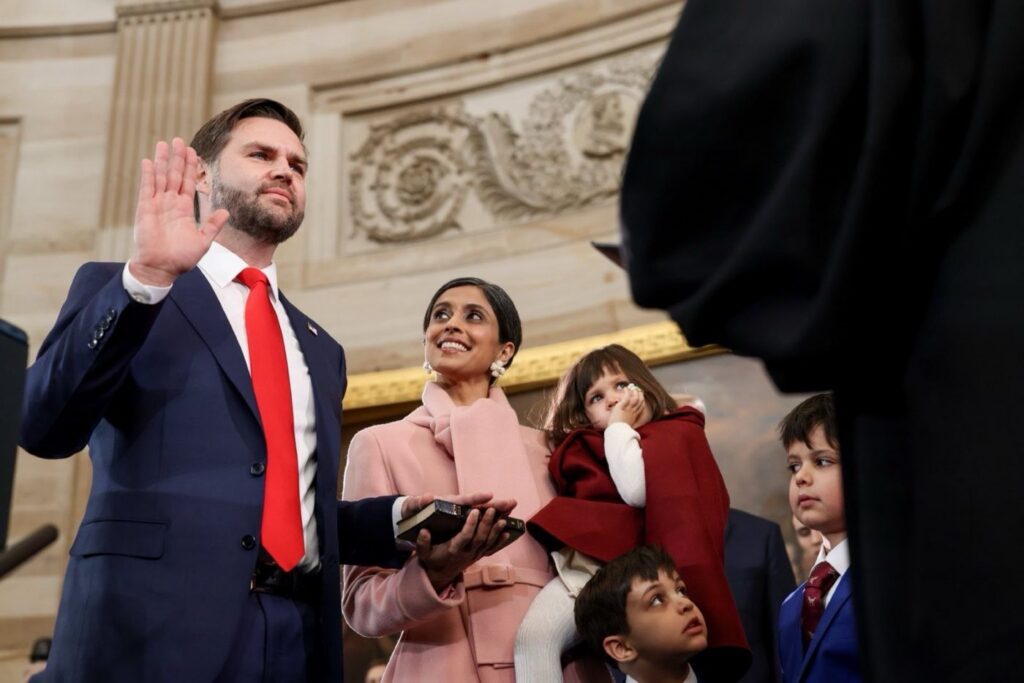
It is impossible to read new books by former vice president Mike Pence and the current holder of that office, J. D. Vance, without seeing the pivotal change that has occurred in the Republican Party. Just as 1972 marked a new era with Democrats toward the end of the Vietnam era, so, too, has 2016 done for Republicans. Although Mike Pence served as Donald Trump’s running mate and second-in-command, it is clear that he remains loyal to the Reagan revolution. Vance, on the other hand, is much younger and owes little fealty to the GOP of the Cold War.
There is also a religious difference evident in the two books. Pence, though raised Catholic, speaks from the heart of the evangelical establishment that reached its peak in the first George W. Bush term (with Bush as its standard-bearer). Vance grew up in a blue-collar version of the evangelical community but has rejected it in favor of his current Catholicism, with economics centered more on Pope Leo XIII’s Rerum Novarum than on Milton Friedman’s Capitalism and Freedom or Frederick Hayek’s The Road to Serfdom.
Vance, the Middle East veteran, along with many of his generation, lost his faith in the idea of America as the Cold War victor bringing the light of democracy and prosperity to the world as a kind of working out of the inevitable laws of history and progress. Indeed, for a time, he lost his faith altogether as he dipped into atheism as a reaction against the evangelicalism he repeatedly characterizes as peddling “fairy tales” in the form of the Christianity he encountered in his rural youth and young adult years.
Pence, a quarter-century older, grew up in a totally different way from Vance, whose Hillbilly Elegy memoir became an American literary sensation, with Netflix treatment to boot. While Vance fought through incredible dysfunction, family addiction, and social pathology with the help of his grandmother, Pence came of age in a solid, church-going family led by a combat veteran. The nation that formed him won WWII and the Cold War. Its ideals served as a sturdy foundation for his whole life. It is unsurprising that Pence’s book serves as a strong defense of the older GOP that relied on rugged individualism bolstered by faith, while Vance is drawn to a common good philosophy more deeply interwoven with Catholic social thought and government intervention.
Pence’s far more settled views surely reflect the solidity of his upbringing and the confidence he developed as he repeatedly rehearsed his Reagan conservatism, first with talk show audiences in Indiana, then as a congressman and governor, and finally as the sort of responsible party man for the Republican establishment in the first Trump administration. Vance, on the other hand, is still a person in the act of becoming. He is often attacked for having been a fierce critic of Trump early on before becoming a strong supporter, a Trump-endorsed senator, and then Trump’s vice president.
Start your day with Public Discourse
Sign up and get our daily essays sent straight to your inbox.Such criticisms may not be entirely fair. Starting with what appears to have been a fairly shallow encounter with evangelicalism and with little more than his grandmother’s stout common sense to guide him, Vance makes it clear in his book that he has been a spiritual and philosophical work in progress. The fact that a blue-collar Ohioan and Middle East military veteran would find himself attracted to Donald Trump’s view of foreign policy and economics is unsurprising. Vance is clear that he was sensitive to the range of acceptable opinions once he attended Yale Law School and that in the early fame of Hillbilly Elegy he sought to strike appropriate notes in his commentary. It can be a difficult thing to have the working out of one’s political judgments occur in full view of everyone.
It is also interesting by way of contrast to see Vance’s attitude toward his courtly predecessor. Pence forthrightly calls himself out in his first congressional run as a “negative campaigner” who vowed never to do it again. While Vance apologizes for having complained in the past about “childless cat ladies,” it is clear from this second memoir that he bridles at tone policing, even from his adopted Catholic Church. This irritation at those who want to officiate manners makes sense in light of Vance’s hard early experiences. He wonders why someone doesn’t take effective action instead of enforcing party rules. What he may not realize is that care in rhetoric sets the stage for real actions and constructive conversation about real solutions. One of the liabilities of the current administration is a failure to understand that politeness maximizes the chance of gaining agreement by avoiding needless hostility.
Vance’s annoyance with those (especially those representing the Catholic Church) who would ask for a more compassionate tone doesn’t add up to a kind of fragility. He returns to the issue more than once and makes it clear that while he resents what he sees as something like virtue-signaling with regard to tone, he craves engagement. When he travels to the Vatican, he clearly hungers for arguments that he can either confront and prevail over or find himself convinced.
One of the liabilities of the current administration is a failure to understand that politeness maximizes the chance of gaining agreement by avoiding needless hostility.
Beside the differences in personalities, it seems to me one of the most noteworthy differences between the two VPs comes down to the faith many of us have had (along with Pence) in the strength of the economics of Hayek and Friedman versus Vance’s view of Rerum Novarum. Those of my generation and Pence’s have believed, with good reason, that free markets have taken us on a happy curve upward into greater human flourishing and that we should not heed the temptation to interfere so much we accidentally end the ride.
But even good macro environments include those who experience them differently. Vance focuses on the plight of his friends, family, and neighbors growing up. He realizes that even as he has ascended, and has done so with a lot of intention and strategy, his community of origin still struggles, still works on holidays, and might do better under a different set of rules.
The debate is worth having. In a rather unlikely turn of events, Donald Trump has succeeded in taking over the labor and American manufacturing advocacy that was once the province of the Democratic Party. Vance has become the most likely next champion for that point of view.
For all of us, one thing remains for our consideration: Rerum Novarum sought to put the Church in a mediating position between those with capital and those who labor. It was right back then to try to help both sides work together without devolving into class war. And it was right for Abraham Kuyper to make similar arguments aiming at harmony from the Protestant side. What we need is not more polarization, but more earnest engagement.