



















While the United States and EU inflation rates are similar, America's inflation is fundamentally different. It is less painful in the short run but more difficult to manage in the long. To curb inflation—and especially inflation expectations—FED Chairman Jerome Powell must act, and quickly.
As conservatives become more interested in family policy, they should avoid two extremes: rebutting any use of government, on the one hand, and on the other hand, assuming that trillions can be spent without negative repercussions. A social insurance model like the Family Security Act 2.0 strikes this balance: it provides modest but worthwhile support and preserves families’ authority to determine their own work-life balance.
The suffering you’ll see as a physician can either harden you and make you into a burned-out machine, or you can allow the vocation to soften you. It can help you cultivate compassion, love, justice, and mercy. Let medicine do the latter of the two for you.
While physicians may have legitimate questions about the new state abortion laws, the organized campaign to attack them as banning sound medical judgment is a disservice to physicians and patients alike.
In light of the controversy generated by law enforcement’s response to the Uvalde shooting, the question of courage and cowardice has been the subject of intense debate in recent weeks. A western novel published in 1940 might offer some helpful and surprisingly relevant ways to navigate this complex moral territory.
The evangelical embrace of natural law must continue to mature, and “hopeful realism” is a meaningful step forward in this respect. However, a postliberal would be quick to detect some slippage in the authors' statements about the most important common political good that must guide any functional society: its religious vision. Additionally, one area for further development in their proposal is a more explicit basis for how their proposal is “evangelical.”
Throughout the twentieth century, American evangelicals have neglected the natural law tradition, leaving us without a serious and coherent grounding for our political deliberations and judgments. We need a theologically grounded framework that articulates our principled and prudential convictions, provides us the language with which to deliberate about them amid disagreement, and helps find commonality around real goods. We believe that a revitalized Augustinian natural law theory can help provide such a framework for evangelical Christians.
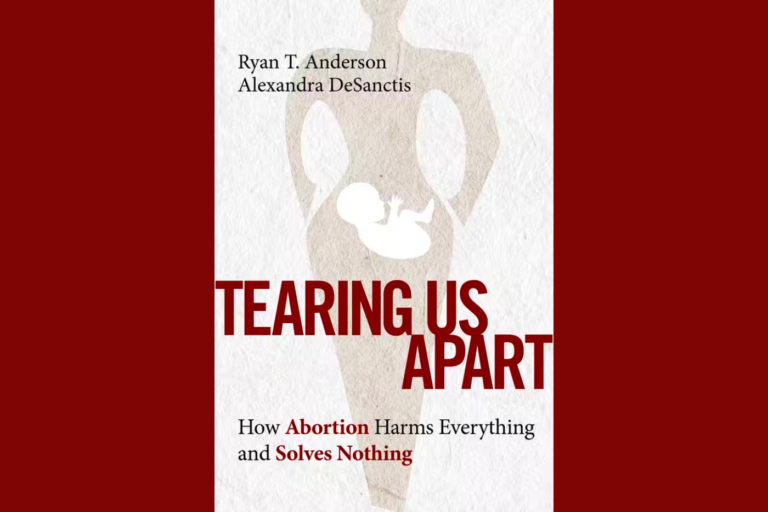
Tearing Us Apart is just the book we need: it understands and works within our current rhetorical and political impulses. Unfortunately, it is silent on specific policies to address how to reduce abortion demand. Nonetheless, with pro-life leaders like Anderson and DeSanctis at the helm, we have every reason to believe that the future of our movement will be guided, not by ideology, but by what will best serve the good of babies, women, and families.
An important new study finds that the informed-consent process that governs “transitioning” is too often more of a box-checking exercise than a serious discussion and deliberation. The study concludes that clinicians in the rapidly growing transgender industry have gone beyond simple negligence or incompetence; instead, they are engaging in demonstrably unethical practices.
In light of both Ukraine’s cultural stance on LGBTQ issues and the data showing drawbacks of same sex parenting, a presidential fiat legalizing same-sex marriage would be an affront to the nation. Furthermore, any capitalizing on Ukraine’s current dependence on the US and EU governments by encouraging its ideological colonization in the utter absence of popular support would be not virtuous but vicious.
In vitro fertilization is likely more threatening to unborn life than abortion. The pro-life movement needs to recognize this reality and form a coherent post-Roe strategy for addressing both abortion and life-negating reproductive technologies.
From the whimsical to the obscure to the most dry-as-dust earnestness, reference books represent our impulse—perhaps our need—to organize the world around us, and even the worlds inside our heads, into some form of order and sharper understanding.
Matthew Continetti’s new book offers an authoritative account of the complex interplay between conservative ideas, politics, and policy over the past century. His telling of conservative history suggests that if we want to know the movement’s future, we should first look to its past.
Administrative rules don’t require broad consensus, so they don’t enjoy the benefits of a diverse group’s deliberations. Instead, they reflect the will of the president or administrators. It falls to the Supreme Court to defend Congress’s authority to legislate against the encroachment of the administrative state. Thankfully, the Supreme Court recently did just this in West Virginia v. Environmental Protection Agency.
Though often unconventional and concerned with ideas outside the mainstream of contemporary political conversations, Michael Oakeshott’s reflections on politics and human conduct continue to provide a profound and humane source of inspiration for western liberalism. In an age in which freedom and individuality are increasingly under threat, his vision of a flourishing human life—discovering and developing individual character in the midst of traditional practices—remains more relevant and necessary than ever.
Perhaps maturity requires moderating our admiration for the intellectuals, the clerks, and the clever types. Surely a person of good judgment, stolid character, and immoveable rectitude is every bit as praiseworthy as the inventive and the quick—and in political and social life far more important.
The prevailing zeitgeist of American medical education is an almost complete and unthinking acceptance of a “woke” mentality. The demonstrations at academic medical centers and medical schools throughout the United States following George Floyd’s killing led to widespread declarations of the need to purge “systemic racism” from American medicine and to adopt “antiracism” as a dominant aspect of the medical ethos.
Genuine cases of conflict between maternal and fetal health raise difficult moral questions, but a necessary starting point is to affirm both that physicians must honor their commitment to the mother’s health and that the law’s just protection of unborn human life should not interfere with that responsibility.
In Carson v. Makin, the Supreme Court held that Maine’s exclusion of faith-based schools from a tuition assistance program for students in rural districts violated the Free Exercise Clause. The case, which is in many ways the culmination of a battle for equal treatment of faith-based schools spanning more than a century and a half, has significant implications for education policy.
Articulating and responding to common misconceptions concerning the ethics of abortion will help to clarify and advance the debate, moving past misleading slogans to engage in a forthright and respectful public dialogue in the wake of Dobbs, and seeking to build a genuine culture of life that supports the needs of both women and children.
With the Dobbs decision, many moms and their babies will no longer bear abortion’s hidden costs. In the longer term, we must make abortion a choice that no woman wants in the first place.
With the overturning of Roe, if we do not take a serious accounting of our approach to disabled lives outside the womb, we stand a huge chance that the lives of unborn disabled children will remain a viable bargaining chip in state legislatures across the country.
Joseph Raz, the master of analytic philosophy of law who died in London last month, argued that law and policy should reflect a vision of the human good, with the good of personal autonomy—enabling people to be “authors of their own lives”—at its heart. He was a true philosopher, a truth-seeker: he had convictions, but he never sought to immunize them against criticism, nor did he allow himself to fall so deeply in love with his opinions that he valued them above truth itself.
Christians today should participate in efforts to preserve our polity and ensure that our laws, policies, and political actions hew as closely to truth as possible in our time and context. But we need to acknowledge the potential limitations of our time and seek ways to make the case for truth in terms that our fellow citizens might accept. We should also recognize that the society for which are striving is unlikely to be much better than what we have had in America. To the extent we desire more we should seek it in the Church.