Pillar

Education & Culture

The fourth pillar, education and culture, is built upon the recognition of two essential realities. First, the Western intellectual tradition requires a dedication to and desire for truth. Second, education takes place not only within colleges and universities but within our broader culture, whose institutions and practices form us as whole persons.


Learn more about Education & Culture: get your free eBook today!

A regime that rejects the primacy of truth and attempts to upend our social nature will inevitably create conditions for civic unrest.
In order to be considered a university at all by those who fancy themselves the arbiters of what counts as knowledge, the Catholic university must abandon its fundamental truth claims and its proper relationship with those entrusted with the proclamation of that truth.
The modern university project, as articulated by the American Association of University Professors, is a project of planned obsolescence. Those who continue to proclaim that the principles of free and open inquiry and the marketplace of ideas are alive and well are fooling only themselves.
A new study being launched by the NIH is intended to produce evidence supporting a particular conclusion: that transgender affirmation therapy is safe and effective for gender-dysphoric youngsters. And once the federal government speaks, states and other institutions will fall in line.
The arrogance of the Jedi and the Sith needs to be replaced with a deep sense of failure and humility, out of which fruitful service and sacrifice can grow. In this way, The Last Jedi is the Star Wars film we need right now, even if it isn’t the one we want or deserve.
The latest Harvey Weinstein allegation reminds us that, around the world and here in the United States, sex trafficking is closer than it appears.
Reason operating without error judges that no human being should ever intend the death of another human being for any reason whatsoever. No achievable good can justify such a choice. And that is the foundation for the case against the death penalty.
It’s three times more likely that you’ll die of lightning than that Aquinas will turn out to be wrong about something. The same cannot be said of New Natural Law philosophy.
While the American regime is often criticized as Hobbesian, the letters of Thomas Jefferson provide evidence that it may be more accurately described as Epicurean.
By making our common humanity irrelevant to the question of identity, Richard Spencer sets himself in diametric opposition to the intellectual roots of the “Western” civilization to which he would lay claim.
The wedding cake is an essential element of a ritual system that expresses the public establishment of a marriage. Its form and ritual use signify the procreative sexual relationship, with its expectation of fertility in the body of the bride, which is being publicly legitimated by the wedding.
Because he accepts a Straussian framework that sees modernity rather than Christianity as the major turning point of Western history, Rod Dreher underestimates the influence of Christian and classical thought on the American founding.
Young people today, especially the ones who are serious about religion and look to the editors of First Things for guidance, must resist the allure of an intellectual Fortress of Solitude where they can sit and feel superior to everyone. Griping about the state of society is a waste of time. Part two of two.
R.R. Reno’s manifesto on capitalism—in which he concludes, among other things, that expanding economic freedom leads to transgenderism—is based on empirically false claims. Part one of a two-part series.
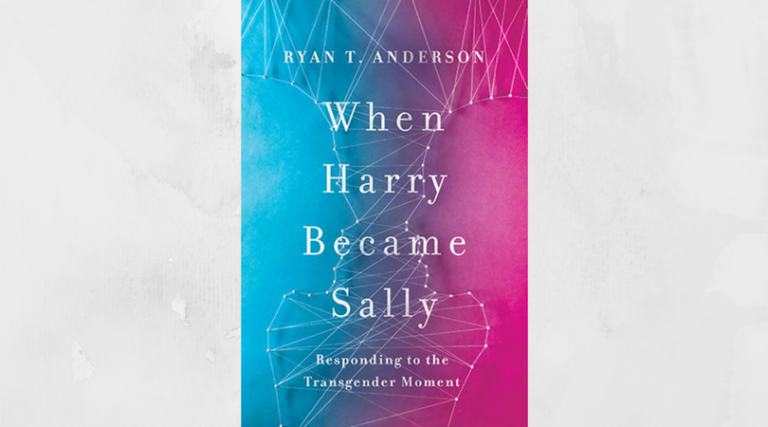
Until policy-makers and the public realize the factual and moral bankruptcy of transgender ideology, pressure will continue to mount to normalize the tragically abnormal.
Leo Strauss’s statements on philosophy do not deny that knowledge is possible. Rather, they emphasize that philosophy—while motivated by awareness of one’s own ignorance—is a way of life teleologically ordered toward knowledge.
New research points to “internalized homophobia” as the problem, not external discrimination.
What Harvey Weinstein is accused of is wrong not only because the victims did not consent but also and more importantly because of what he chose. Sex expresses self-gift, which is why it is such a violation when something that should only be a free gift is stolen by force.
Aquinas taught the principle that a punishment ought to be proportionate to the offense, where death is a proportionate punishment for the gravest crimes.
If E. Christian Brugger is right, then the Church has been teaching grave moral error and badly misunderstanding scripture for two millennia. Nothing less than her very credibility is at stake.
E. Christian Brugger is wrong: neither scripture nor tradition could justify a reversal of the Church’s millennia-old teaching on capital punishment
Pornography rewires its viewers’ brains, distorting the way they interpret the behavior of those around them and making them believe that unacceptable behavior will be welcomed.
There is a genuine tension, not just in Aquinas but in Church teaching more generally, between claims about the intrinsic goodness, sanctity, and inviolability of human life, and claims about political authority to kill. The second in a two-part series.
Arguments against the death penalty can be made not only on the basis of theology but also on the basis of natural law philosophy. The first in a two-part series.

Get your free eBook for The Human Person

"*" indicates required fields

Get your free eBook for Sexuality & Family

Get your free eBook for Politics & Law

Get your free eBook for Education & Culture

Get your free eBook for Business & Economics