Pillar

Education & Culture

The fourth pillar, education and culture, is built upon the recognition of two essential realities. First, the Western intellectual tradition requires a dedication to and desire for truth. Second, education takes place not only within colleges and universities but within our broader culture, whose institutions and practices form us as whole persons.


Learn more about Education & Culture: get your free eBook today!

Mayor de Blasio’s policies keep New York City kids trapped in violent, chronically failing schools.
As George Eliot’s Silas Marner illustrates, the reason parental love can change a person is that it requires constant self-sacrifice. But could this story take place today? It seems far more plausible that a lonely man like Silas would retreat ever more into solitude, abated only by pornography, Tinder, and a loosely bound world of online connections.
The Handmaid’s Tale is at best a thought-provoking literary work, and at worst a straw-man argument against traditionalism and conservative values. Atwood fails to deliver an intelligent critique of conservative Christian values, and her book does not reach the caliber of Orwell’s tales.
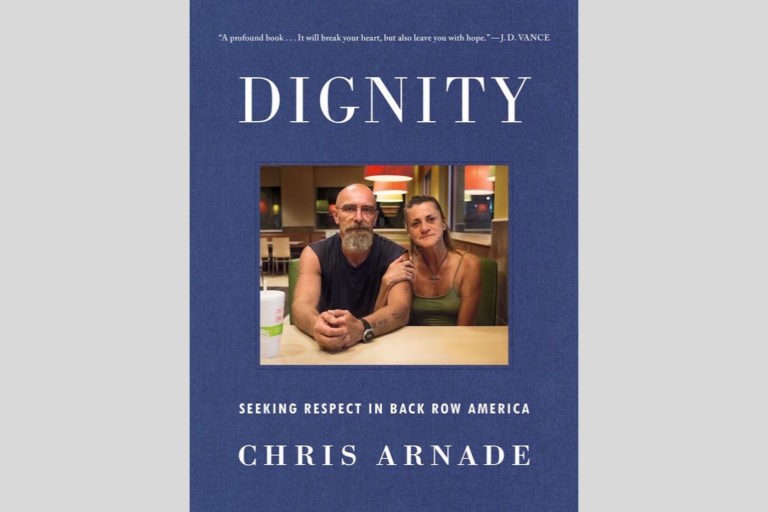
Members of Back Row America are rooted in a particular neighborhood or town that they do not want to abandon in pursuit of the American Dream. Or they are churchgoing Christians who find hope in their faith. But neither place nor faith is part of the mental geography of the Front Row.
Degrading our sense of nationhood by degrading national symbols will not end inequality or injustice. It will only move us closer to a state in which the government can no longer function, because the people behind it no longer perceive themselves all together to be part of a nation with a common purpose.
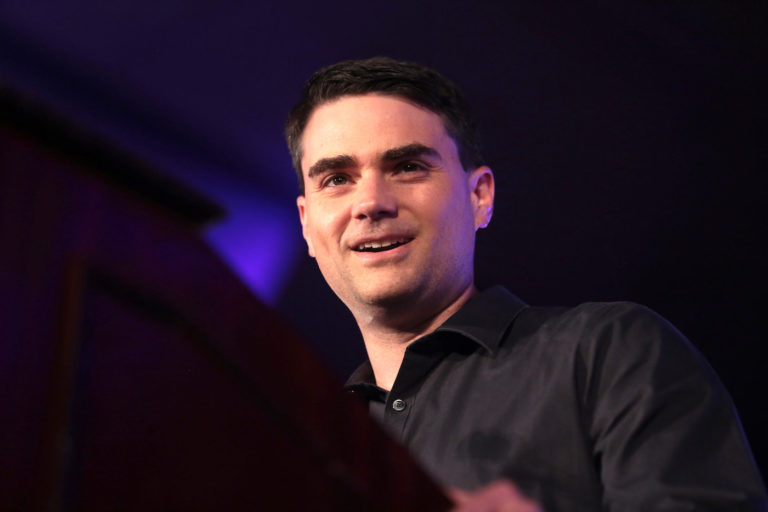
One might expect a book by Ben Shapiro to be about the task of “owning the libs” or “drinking liberal tears.” In fact, the reader comes away with a starkly different impression. In The Right Side of History, Shapiro argues that the cultural and political malaise of contemporary America is due to its being severed from its Judeo-Christian roots.
Faced with a national educational disaster that permanently cripples so many of America’s neediest children’s life chances, it is not “anti-public school” to advocate for voucher experiments. It is true to our republican aspirations to enable at least some of these kids the chance to attend a private school.
Wilfred McClay’s new textbook on American history outshines the competition, thanks to its balanced approach, its superb narrative style, and its reintroduction of topics and themes that have long since fallen from the pages of most classroom editions.
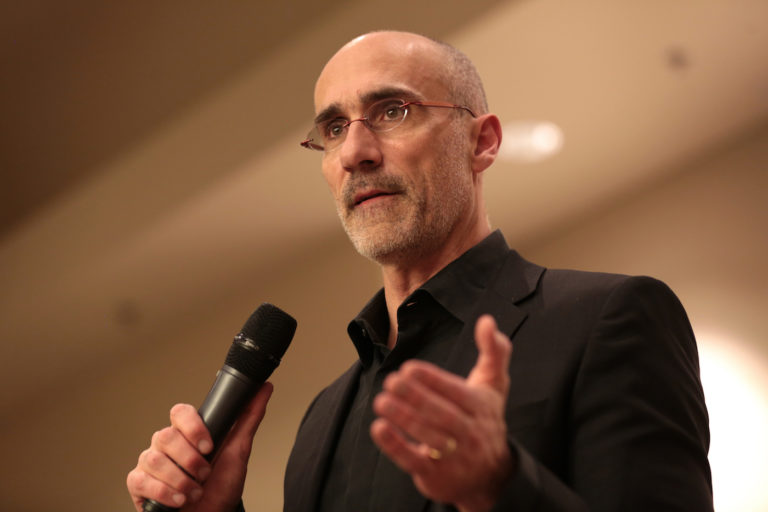
Arthur Brooks is right that we urgently need to learn to disagree better, but he’s wrong about what it will take to do that. Brooks demonstrates just how easy it is to slip from the transcendent and infinitely difficult command that we love our enemies to the comforting illusion that we have no enemies.
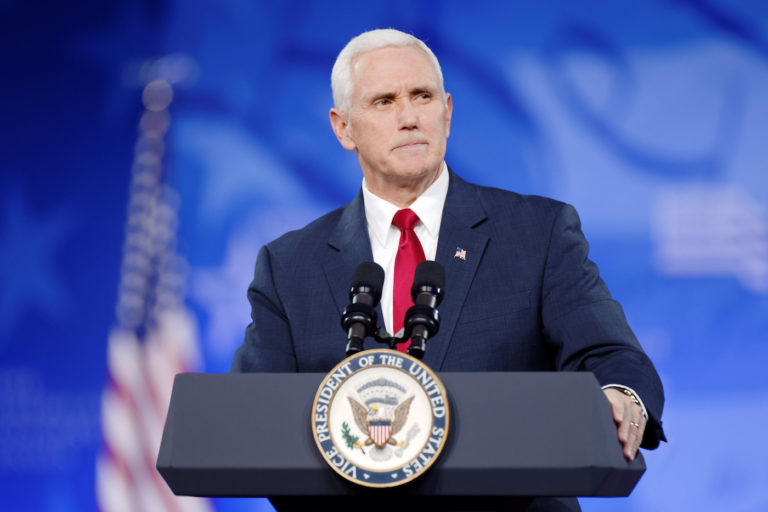
Vice President Mike Pence has been invited to deliver the 2019 commencement address for Taylor University in Upland, Indiana. However, a severe backlash against the former Indiana governor demands that his invitation be rescinded. The accusations against Pence are fallacious, slanderous, and contrary to both a biblical worldview and a liberal-arts education.
The divide between the “two cultures” of the sciences and the humanities is a well-known problem in education. The discipline that we need in order to unify them is natural philosophy.
Christmas and Easter are beautiful seasons that reveal time to be more complex than our everyday linear experience of it. As Christians, we need to remember that YHWH not only speaks through his Word and in his Church, but also through the calendar.
It’s more authentic to stand before a young person and humbly say, “I’ve found something I’m eager to share with you, and I want to provoke you to go on your own journey for the truth,” than to deny that teachers, mentors, and other role models are speaking from tradition with authority.
Both believing and non-believing students of Strauss will find Leo Strauss and His Catholic Readers rewarding.
Technology promises to solve our problems, but it also creates new ones. That’s because we have failed to apply human-centric approaches to technology. We think in terms of productivity instead of human flourishing; connectivity instead of community. As a result, our tech use leaves us worse off than we were before—less free, less rested, less peaceful.
Heather Mac Donald’s The Diversity Delusion is right on point, but it is also biting in tone, brimming with exasperation and anger. Mac Donald is at her finest when she offers an ode to the humanities, reminding the reader of the wonder and sublimity in Shakespeare and Bach, the truth and timelessness in Homer and Plato.
There is a penchant on today’s college campuses for sacrificing hard questions at the altar of political correctness. The university’s repudiation of the Socratic method and preoccupation with genderless pronouns, microaggressions, and safe spaces is not benign. The university should be a sacred place where no question, regardless of its potential to offend, is deemed off-limits.
Although many are dissatisfied with the Vatican’s efforts to mediate Venezuela’s political crisis, Venezuela’s Catholic Church is the one institution that has retained its integrity throughout two decades of a leftist-populist tyranny. What might this mean for a post-dictatorship Venezuela?
Thanks to the work of sociologist Mark Regnerus, a prominent peer-reviewed journal has retracted a deeply flawed study on how social stigma affects the life expectancy of sexual minorities. This failure of peer review isn’t an isolated case: the more social science research supports the dogmas of identity politics, the less closely it is examined, and the more enthusiastically it is promoted.
Cultural conservatives face a time when it is not simply a question of debating the nature of our culture on some commonly agreed foundation. It is a time when we face the complete transformation of our culture into an anti-culture.
For many college students today, to say that man is made for the knowledge (and perhaps even love) of God suggests that those who do not acknowledge God are somehow inadequate, incompetent, or ignorant. For them, such a claim amounts to condescension. This generation distances itself both from the vitriol and virulence of “the new atheists” and the naivete and fundamentalism of religionists in the pursuit of otherwise serene and humane existence.
What started as a rebellion against bourgeois conformity and oppressive technocracy ultimately ushered an age of triumphant individualism and economic globalization. The rediscovery of Marxism by the young rebels of the sixties started a long-term transformation of the left from advocate of the working class to political home of the professional elites. How did that happen?
The story of Sohrab Ahmari is one of extremes. By turns, he was a rebel, Iranian expat, an atheist, a bohemian dissident, an anti-Mormon provocateur, a communist, a lawyer, a teacher, a libertine, and finally, a Christian.
Why are progressives so intent on winning control of the public square? In his new book, Steven Smith argues that they are motivated by the same battle that was waged in ancient Rome: Paganism vs. Christianity, immanence vs. transcendence.

Get your free eBook for The Human Person

"*" indicates required fields

Get your free eBook for Sexuality & Family

Get your free eBook for Politics & Law

Get your free eBook for Education & Culture

Get your free eBook for Business & Economics