Pillar

Education & Culture

The fourth pillar, education and culture, is built upon the recognition of two essential realities. First, the Western intellectual tradition requires a dedication to and desire for truth. Second, education takes place not only within colleges and universities but within our broader culture, whose institutions and practices form us as whole persons.


Learn more about Education & Culture: get your free eBook today!

Fifty years after Altamont, no clear-eyed observer of American culture can doubt that the demonic spirit of 1969 is still very much in the air in our country. This is how the evil of cultural destruction presents itself. It would be so easy to turn aside from it if all collapsed into ugly, nauseating chaos instantly as soon as the old cultural rules and restrictions were abandoned. But such things take time to materialize in their full wreckage.
Despair is the unforgivable sin, for the despairing conclude that God will not or cannot act, that the universe is fundamentally unfriendly and inhospitable to the true, good, and beautiful, and that humanity has lost the imago Dei. To judge in this way is to deny the goodness of the world and its Creator and sustainer, and that is the sin of all sins.
Faith and family: for many of us, these are not only the most important parts of the Christmas season. They’re also the things that make life most worth living.
The team at Public Discourse doesn’t pretend to have all the answers, but we do think we’re asking the right questions, and getting the right thinkers to propose some of the answers. That’s one thing that we hope will always be our hallmark: thoughtful, reasoned discourse, which is rigorous yet still accessible to the educated layman.
Christmas isn’t tasteful, isn’t simple, isn’t clean, isn’t elegant. Give me the tacky and the exuberant and the wild, to represent the impossibly boisterous fact that God has intruded in this world.
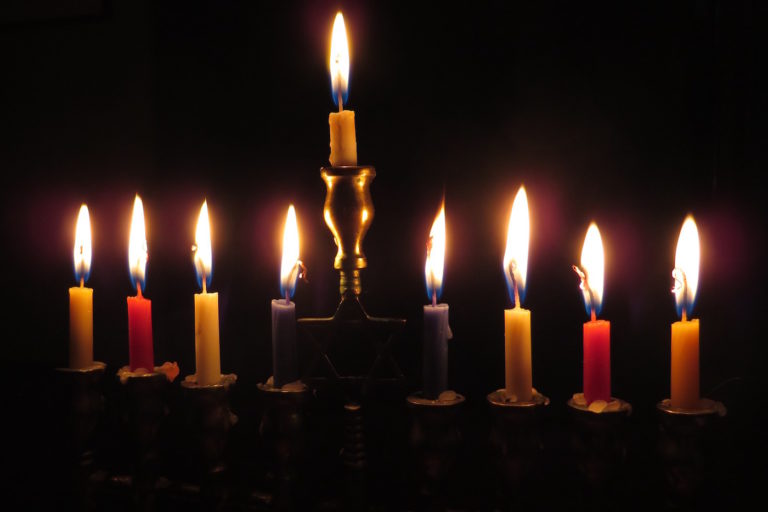
In the popular imagination, both Jewish and Gentile, the story of Chanukah is the saga of outnumbered but plucky Jews battling the more numerous and nefarious Greeks and their alien culture. In truth, it’s about much more than that.
Unless they acknowledge a divine transcendence, our universities, like our culture at large, are sentenced to pointless “debate,” full of sound and fury, no matter how free our speech is. The marketplace of ideas alone cannot save education.
Mark Hall’s new book adduces solid evidence to dispel many contemporary myths concerning religion and the American founding. Let us finally be done with false claims that the founders were deists, or that they were hostile to religion and wanted to exclude it from public life.
A new book argues that fundraising is not an independent activity external to the purpose of a non-profit, but an integral part of the existence and mission of the organization. Rather than becoming a class of experts, fundraisers should be well-formed persons and citizens, who can learn the craft of fundraising and practice it in a manner that supports rather than undermines the free and relational nature of civil society.
We stewards of the western tradition have good answers for what makes life worth living. If only we could be imaginative enough to give new voice to those ancient truths and avoid the stultifying fate of pampered souls.
There are reasons to care which denizens of the wasteland hold political authority, but rejuvenating the wasteland is the more important task. Without recognizing the decadence of our culture, denouncing (or defending) the latest tweet from the president is just a desultory wind swirling dust and ashes.
In her new book, Mary Eberstadt argues that today’s identity politics arose from the deep anthropological wound slit open by the sexual revolution. The ascent of identity politics reveals that people are having an identity crisis, and they are having an identity crisis because the sexual revolution resulted in family—and, by extension, individual—breakdown.
Father Theodore Hesburgh was a dedicated priest and a leader who possessed enormous ambition, charm, intelligence, and dedication. But for all his many gifts, Father Hesburgh lacked the vision and imagination necessary to realize the goal of making Notre Dame into a great Catholic university in the modern world.
Don’t delay your life. Don’t wait until you get a job, then tenure, to do the normal things that make life sweet, like marrying and having children. Remember the time-worn observation: “Life is what happens while you’re busy making other plans.” Professors who build their career around their own ego and cutthroat ambition tend to shrivel into something you don’t want to be.
As you enter into the medical profession, I encourage you to “start with the end in mind” by studying the Hippocratic Oath. The oath articulates the true aim of medicine, guiding physicians to provide treatments that align with the purpose of medicine and so are right for a doctor to do, and to refuse to provide treatments that go against this purpose and are wrong for a doctor to do.
New teachers need concrete examples from their teaching communities to help them manage their classrooms well and begin building experience and expertise. Returning teachers need opportunities for discussion within their communities to help them reflect on the experience and expertise they have already gained.
Law students shouldn’t be content with shallow conceptions of law. Instead, they should look deeper, asking questions about the nature and destiny of the human person, and the connection between our human nature and the legal enterprise.
Some prejudices are good to have, some are bad, some are indifferent. Acquiring an education is learning to discriminate the good prejudices one carries about from the bad ones—to keep the former, as confirmed by knowledge, and discard the latter, as condemned by knowledge.
If questions of ultimate meaning and purpose are shuttled to the side, as they are in so many of our schools and colleges, the various disciplines and domains of knowledge can never attain a unifying vision.
John Hughes’s classic film, Ferris Bueller’s Day Off, confronts current schemes of “free college” with a perennial human problem: What is God calling you to do?
With the help of memes, ironic satire has upended public morality, and without sound morals, hyperbole and reality, irony and sincerity, become indistinguishable.
David Novak is the only prominent Jewish natural law thinker in the world today. His work will be essential for that part of the Orthodox Jewish community that wishes to engage with our changing culture. In particular, for a defense of Orthodox Judaism in the modern world, it matters immensely that we understand the Jewish view of sex and sexuality to be a matter of mishpat, in the rational realm, the realm of natural law.
The cathedral of Notre-Dame de Paris is not simply an illustration in an architectural history textbook whose value is limited to documenting a style that was popular between 1190 and 1425. Rather, it is evidence of a way of conceiving and making buildings embedded in a culture and a religious faith that retains a hold on our imaginations and affections.
Wilfred McClay rightly senses that part of our current political confusion results from a lack of a common historical narrative, an ability to talk about the American past coherently. In our current moment there is thus a need to recapture important stories and narratives about America.

Get your free eBook for The Human Person

"*" indicates required fields

Get your free eBook for Sexuality & Family

Get your free eBook for Politics & Law

Get your free eBook for Education & Culture

Get your free eBook for Business & Economics