Pillar

Politics & Law

The third pillar of a decent society is a just system of politics and law. Such a government does not bind all persons, families, institutions of civil society, and actors in the marketplace to itself as subservient features of an all-pervading authority. Instead, it honors and protects the inherent equal dignity of all persons, safeguards the family as the primary school of virtue, and seeks justice through the rule of law.


Learn more about Politics & Law: get your free eBook today!

For the nineteenth-century Italian Jesuit Luigi Taparelli, social justice is not about redistributive justice by government fiat. Nor is it linked to some idea of absolute social or economic equality, as in progressive parlance. Instead, social justice according to Taparelli must be grounded in the principle of subsidiarity and linked to a theological understanding of economics.
The law must stand above the powerful, and we should worry when the law is suspended or disregarded. But where is the law to be found? Most of the law consists of important fictions which live in the minds of lawyers. But what makes the fiction plausible? And how is the law’s benefit to be assessed unless we measure it against fixed, non-conventional, non-fictional standards of justice?
Veronica Roberts Ogle’s 2020 book, Politics and the Earthly City in Augustine’s City of God, shows that Augustine’s critique of the earthly takes place within a broader sacramental vision. He aims at purging amor sui and orienting it toward amor Dei, cleansing our souls of the lust for securitas. Politics can only be improved by personal responses to grace—which no political institution can hope to generate. Improvement of political spaces must occur beyond politics.
In the first part of this essay, I showed how the CCP persecutes individuals, and discussed the CCP’s structural control of the government and the nation. In this second part, I will compare the U.S. democratic system with the CCP regime to more clearly demonstrate how one-party rule results in authoritarianism.
The CCP regularly employs violent tactics to persecute and silence its opponents and operates with impunity as a shadow power. China’s political structures enable it to maintain monolithic control of the nation. By discussing my own experience under the CCP and shedding light on its opaque structures, I hope to show that comparing the CCP’s authoritarian regime with democratic governance is like comparing barbarism with civilization: there is no comparison.
Democracy Rules (2021) is Jan-Werner Müller’s attempt to explain populist authoritarianism, while at the same time setting out what he believes are the true pillars of liberal democracy. But he does so, understanding that democracy always operates under the handicap of uncertainty.
Today’s progressive nationalism is secular, yet it also relies on popular adherence to the civil religion of the left. There are two prominent manifestations of this civil religion—critical race theory’s (CRT) philosophy of history and the LGBTQ movement’s anthropology. We see evidence of this secularized-yet-religious nationalism in many places—media, bureaucracy, Hollywood—but perhaps it is most readily apparent in education.
Allen C. Guelzo has written a perceptive character study (and military evaluation) of Robert E. Lee that is alert to the many contradictions that seem to pepper his life. What emerges is a portrait not unlike the one peering off the dust jacket: thoughtful and appealing, yet facing two directions at once.
Conservatives may hope that liberalism’s better angels prevail. But the ravages of ideological liberalism, especially the damage done by the sexual revolution to family and community, require active redress. Conservatives, drawing on the wisdom and traditions we have sustained (and which have sustained us), must help our culture relearn essential parts of being human.
Did Lincoln regard the Constitution as “broken” and therefore in need of replacement? Or did he believe that the Declaration of Independence represented America’s aspiration to end slavery, and infused the Constitution with this same aspiration?
We are increasingly becoming afflicted by the who/whom logic of Lenin. For Lenin, when it comes to political aggression, what matters is who performs the action and upon whom it is performed. But, in reality, the whom you attack is a who in reality. Just as you are a self, so too are they a self.
Where there is a mutual commitment to truth and truth-seeking, relationships can be built between religious believers and secularists, and they can indeed reason together. The minimum condition is this: interlocutors, however wide and deep their substantive philosophical or other differences, need to share the conviction that business between them is to be conducted in the proper currency of intellectual discourse—namely, reasons, evidence, and arguments.
“Much American (and British) media depiction of faith—sadly, but perhaps inevitably – tends to be primary colored, inadequately nuanced, and at odds with what I have found to be the case from my fifty years’ engagement with the United States.” An interview with the British historian of America, Richard Carwardine.
If we think there’s too much government regulation, then the authentically conservative solution is not to say, “Well, let’s just try to operate a landscape of isolated individuals jostling in a competitively economic marketplace,” but “Let’s create institutions of countervailing power so that where exploitation is happening, the people themselves are equipped to resist it, and the government doesn’t need to intervene to fix it.” If designed correctly, a system of sectoral labor unions can actually help achieve the conservative goal of limited government.
Sunday marks exactly three full decades after the fall of the Soviet Union. This anniversary arrives at a portentous time when Marxist critiques of capitalism is becoming relevant again. Marx’s legacy is hard to pin down because his influence is paradoxical. The measures Marx influenced “tamed” the excesses of laissez-faire capitalism and removed the need for revolution; yet his influence has led to the fulfillment of considerable portion of his programme.
The texts I reflect on illuminate core themes of Public Discourse’s work: cultivating a proper understanding of reason, appreciating the indispensability of moral formation, and framing law around eternal moral truths. I was deeply honored and delighted when R. J. Snell and the current editorial team invited me to join them as a contributing editor, and I look forward to more conversations to come.
Plaintiffs have filed lawsuits arguing that mandates without religious exemptions violate their free exercise of religion. Given the thorny legal questions involved, and the possibility of inflaming the polarized situation further, the Supreme Court will likely allow the issue to percolate in the lower courts and resist the invitation to rule on whether the First Amendment requires religious exemptions to COVID-19 vaccines.
Chief Judge Jeffrey Sutton’s new book, Who Decides?, provides a powerful argument for ordinary people who feel powerless in their ability to affect the course of national politics. State constitutions provide an alternative venue for meaningful political change and are an important way to exercise constitutional self-government.
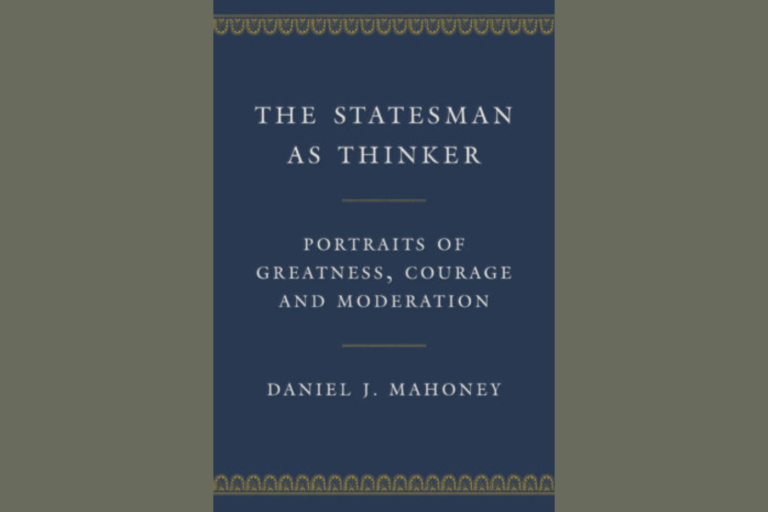
In his recent book, Glenn Ellmers argues that the political philosopher Harry V. Jaffa can help us meet the manifold challenges of the crisis of the West. Jaffa’s teachings on statesmanship and prudence provide a path to reverse America’s decline.
When it comes to climate change, liberals are correct. Yet they fail to see how the same arguments they use for climate action—acting in the face of uncertainty, limiting individual choice for the common good—can also be used to justify a bit of soft social conservatism.
Let Casey stand, and its abortion license fall.
The day you pass pro-life legislation, if you’re trying to win people over, should also be the day that you are passing new spending bills to support adoption, to support pregnant mothers—to support, not just crisis pregnancy centers, but crisis first-two-years-of-life centers! And that doesn’t have to mean bureaucratic welfare-state spending. But it means some kind of spending, in a way that I think many people active in the pro-life movement are comfortable with. Many people in the Republican Party institutionally are obviously not.
In Part I of this article, we established that many of the reasons some Jewish Americans passionately oppose overturning of Roe v. Wade are either overblown or baseless. Today, we highlight one of the ways in which overturning Roe will help to foster a political culture of federalism and subsidiarity that benefits religious minorities.
This two-part article addresses how American Jews should think about looming changes in the Supreme Court’s abortion jurisprudence. Today, the authors discuss why many fears commonly expressed by Jews regarding a post-Roe world are overblown or outright false. Tomorrow, they will explain some of the under-appreciated ways that overturning Roe will benefit vulnerable religious minorities.

Get your free eBook for The Human Person

"*" indicates required fields

Get your free eBook for Sexuality & Family

Get your free eBook for Politics & Law

Get your free eBook for Education & Culture

Get your free eBook for Business & Economics