Pillar

Politics & Law

The third pillar of a decent society is a just system of politics and law. Such a government does not bind all persons, families, institutions of civil society, and actors in the marketplace to itself as subservient features of an all-pervading authority. Instead, it honors and protects the inherent equal dignity of all persons, safeguards the family as the primary school of virtue, and seeks justice through the rule of law.

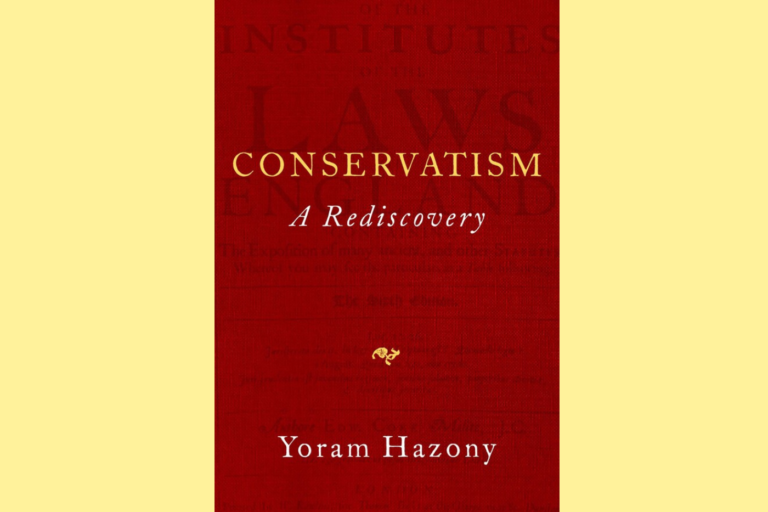
Learn more about Politics & Law: get your free eBook today!

The recent defeat of a pro-life constitutional amendment in Kansas was not a consequence of strategic overreach, nor was it a rebuke of Dobbs. In fact, it followed from the difficulty of communicating complex legal and political principles, as well as navigating the fear and distortion generated by abortion advocates and their media allies. To help secure a pro-life future, we must learn the correct lessons of the Kansas loss, including the need to harness the emotional power of truthful narrative to shape political choices.
Traditional conservatives and others committed to the principles of limited government have nothing to fear from natural law-based accounts of the political common good. In fact, natural law accounts offer the strongest principled basis for defending liberty and limited government by showing how such values are themselves core aspects of the common good.
The only way that we can really meaningfully grapple with the Supreme Court's legitimacy is to ask: what was it actually built to do? Roe was wrong. It had become the political equivalent of a black hole, totally devoid of substance, but with such immense gravity that it distorts everything around it. Abortion, of course, isn’t going away as a political issue. The difference now will be that instead of having debates about Roe, we’ll debate about abortion.
Harry Jaffa and Allan Bloom represent two ways of understanding the political philosophy of Leo Strauss, particularly in relation to the concept of classical natural right. The creative tension between Jaffa and Bloom, as well as their respective students, has produced some of the finest scholarship of the last half century or more.
In The Statesman as Thinker, Mahoney seeks to restore principled statesmanship through portraits of six figures who combined political authority with uncommon reflection: Edmund Burke, Alexis de Tocqueville, Abraham Lincoln, Winston Churchill, Charles de Gaulle, and Václav Havel.
Augustine’s message about the two cities in City of God has important implications for Christian political engagement today. By resisting a facile sorting of the good from the bad, he reminds his Christian readers that their own transformation is far from complete and so helps them work for earthly peace in a spirit of humility.
As conservatives become more interested in family policy, they should avoid two extremes: rebutting any use of government, on the one hand, and on the other hand, assuming that trillions can be spent without negative repercussions. A social insurance model like the Family Security Act 2.0 strikes this balance: it provides modest but worthwhile support and preserves families’ authority to determine their own work-life balance.
While physicians may have legitimate questions about the new state abortion laws, the organized campaign to attack them as banning sound medical judgment is a disservice to physicians and patients alike.
The evangelical embrace of natural law must continue to mature, and “hopeful realism” is a meaningful step forward in this respect. However, a postliberal would be quick to detect some slippage in the authors' statements about the most important common political good that must guide any functional society: its religious vision. Additionally, one area for further development in their proposal is a more explicit basis for how their proposal is “evangelical.”
Throughout the twentieth century, American evangelicals have neglected the natural law tradition, leaving us without a serious and coherent grounding for our political deliberations and judgments. We need a theologically grounded framework that articulates our principled and prudential convictions, provides us the language with which to deliberate about them amid disagreement, and helps find commonality around real goods. We believe that a revitalized Augustinian natural law theory can help provide such a framework for evangelical Christians.
Matthew Continetti’s new book offers an authoritative account of the complex interplay between conservative ideas, politics, and policy over the past century. His telling of conservative history suggests that if we want to know the movement’s future, we should first look to its past.
Administrative rules don’t require broad consensus, so they don’t enjoy the benefits of a diverse group’s deliberations. Instead, they reflect the will of the president or administrators. It falls to the Supreme Court to defend Congress’s authority to legislate against the encroachment of the administrative state. Thankfully, the Supreme Court recently did just this in West Virginia v. Environmental Protection Agency.
Though often unconventional and concerned with ideas outside the mainstream of contemporary political conversations, Michael Oakeshott’s reflections on politics and human conduct continue to provide a profound and humane source of inspiration for western liberalism. In an age in which freedom and individuality are increasingly under threat, his vision of a flourishing human life—discovering and developing individual character in the midst of traditional practices—remains more relevant and necessary than ever.
In Carson v. Makin, the Supreme Court held that Maine’s exclusion of faith-based schools from a tuition assistance program for students in rural districts violated the Free Exercise Clause. The case, which is in many ways the culmination of a battle for equal treatment of faith-based schools spanning more than a century and a half, has significant implications for education policy.
Christians today should participate in efforts to preserve our polity and ensure that our laws, policies, and political actions hew as closely to truth as possible in our time and context. But we need to acknowledge the potential limitations of our time and seek ways to make the case for truth in terms that our fellow citizens might accept. We should also recognize that the society for which are striving is unlikely to be much better than what we have had in America. To the extent we desire more we should seek it in the Church.
Dobbs may be the most important, magnificent, rightly decided Supreme Court case of all time. It is restorative of constitutional principle. It upholds the values of representative, democratic self-government, and the rule of law, at the same time that it supports the protection of fundamental human rights. It is literally a matter of life and death. It is potentially transformative of American society, for the better. It is a rare act of judicial courage and principle. In every way, Dobbs is a truly great decision.
The past half century has seen the breakdown of institutional Christianity on which Jacques Maritain’s political project relied. Nonetheless, the limits of his thought do not vitiate the valuable insights Maritain offers for Christian politics in the twenty-first century. He reminds us that politics is about how to order our life together, not just creating ideals or defeating our enemies. He teaches us that we can order a society toward the temporal truths of Christianity, but that the temporal power of the state is no substitute for the spiritual power of the faith.
Today, Jacques Maritain’s optimistic vision of Christian liberalism is often contested or dismissed as outdated, but a revival of his emphasis on Christian participation in society and politics is urgently needed—and is in many ways already in evidence in Christian political activity in America.
While some legal scholars have criticized the recently leaked draft Dobbs majority opinion on the basis that it is not originalist, they are overlooking two important points—originalism contains a place for stare decisis (i.e., legal precedent) and American constitutional practice is currently an eclectic mix of originalist and nonoriginalist aspects.
In a post-Roe America in which the question of abortion will likely be in the hands of citizens and state lawmakers, it will be particularly important for Kansans to undo their supreme court’s recent error of removing the legal foundation for basic regulations on abortion.
A Minnesota law professor’s attack on the draft Dobbs opinion seems based more on desperation than scholarship. This and other misguided efforts to demonize critics of Roe need to be refuted so we can focus our attention on the real issue of the ugly realities of abortion.
The aim of our Constitution is to secure freedom in America by securing rights. The aim of American foreign policy should be to secure freedom at home, with a view to opportunities and threats abroad. We must always ask: what’s the best mix of military might, economic power, diplomacy, and championing of human rights that enables us to secure freedom at home and maintain a free and open international order?
In their rigorous sociological account of Christianity in America today, George Yancey and Ashlee Quosigk provide many important insights, particularly in relation to progressive Christians, though overall the book simply confirms the enduring truth that Christians have always disagreed among themselves about faith and politics.
Josh Craddock’s vision for a post-Roe legislative agenda imaginatively builds on and renews decades of pro-life thinking, but it risks generating resistance within the conservative legal movement. There may be an alternative, more disarming path that conveys to the public the need for Congress to act to protect human life in the womb.

Get your free eBook for The Human Person

"*" indicates required fields

Get your free eBook for Sexuality & Family

Get your free eBook for Politics & Law

Get your free eBook for Education & Culture

Get your free eBook for Business & Economics