Pillar

The Human Person

The first pillar of a decent society is respect for the human person, which recognizes that all individual human beings have dignity simply because of the kind of being they are: animals whose rational faculties allow them to know, love, reason, and communicate. It also recognizes that human beings are persons, members of the human family who flourish in a community that respects their fundamental rights and who long to discover transcendent truths about the nature of reality.


Learn more about the Human Person: get your free eBook today!

We can value the strengths and perspectives of those with disabilities and their loved ones while affirming objective reality and universal human dignity.
Why Young People Are Avoiding Dating ... And What We Can Do About It 
A culture that teaches girls to silence their pain, medicate their cycles, and dismiss the body’s signals is a culture that will inevitably reap infertility, despair, and declining birthrates. A culture that teaches body literacy, by contrast, will raise young people who see their fertility as a vital sign of health and an essential part of their future.
If the goal of medicine is to protect and restore life, then our efforts and investments should flow to therapies that treat the sick, not to technologies that eliminate them before they are born. 
There appears to be an intractable choice between family separation, on one hand, and a nation that does not enforce its own laws or protect its own borders, on the other. How to proceed? 
We do not need experts to tell us how to get our kids out of the machine.  
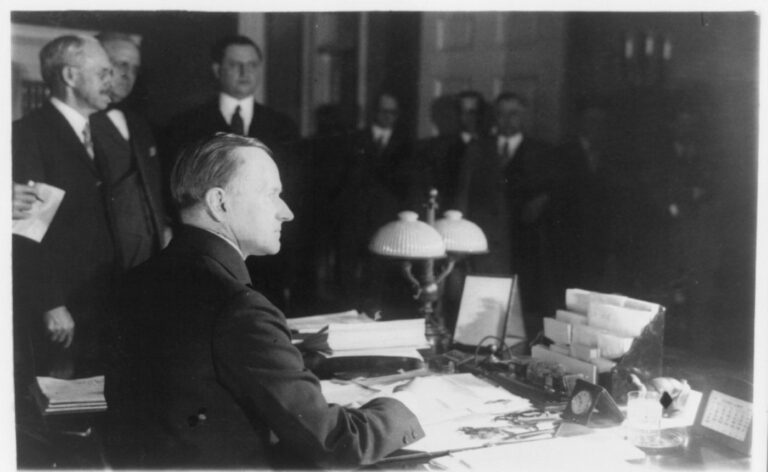
Henry Ford sought to mainstream anti-Jewish sentiment in the United States. In a 1925 address, Coolidge decisively broke with Ford’s movement. 
What place smartphones have in our future is uncertain, but whatever it is, all generations should be alert to the problem.
It would be perverse to charge all fulfillment theology with antisemitism. Many reject Christian Zionism for the plausible (but unfounded) reasons described in Mattson’s piece, and many are clearly philo-Semitic. But it might not be a bad idea for some of them to ask what W. D. Davies and other theologians started asking in the 1970s: “How did Christian Europe come to hate Jews?” 
What we need is a restoration of virtue in our land, in order to tame the strong gods and ensure that their power serves the good—so that the return to reality is marked not by domination, but by integrity, not by chaos, but by character. 
Before we indulge in more time online, it is worth considering whether the images flashing on that screen are ultimately pointing us toward the humanity and healing power of Christ or a disfigured version of the kind of body a technocratic culture wishes us to have.
We are not machines and cannot be well formed by them either. Human formation should be primarily human—even if it’s easier and faster to dole out our questions to a machine.
Right-wing young men see a politics and culture that celebrates every identity but theirs, cultivates a totalitarian ideological culture that directly undermines their beliefs, desires, and life goals, and is set to leave them significantly worse off—socially, economically, culturally, spiritually—than their grandparents. Any successful attempt to reach these young men will need to seriously address these deeply rooted sentiments. 
Let us do our duty. Let us slam shut and then nail shut the Overton Window on anti-Semitism and thereby help give our country a new birth of freedom rightly understood.  
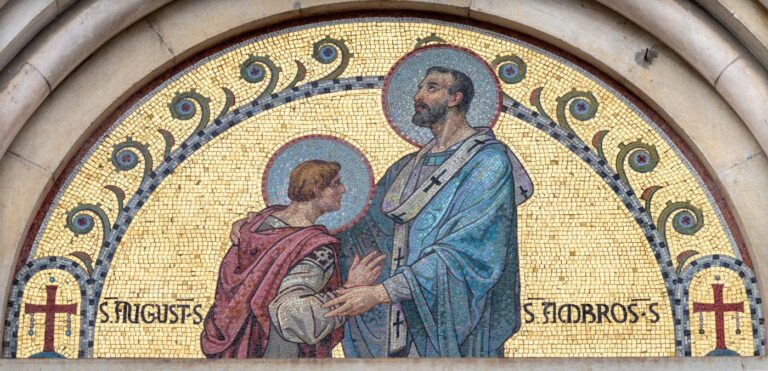
What is the nature of human dignity? What is it to act justly towards another human being? For Augustine, the answer is that justice towards another human being is a matter of recognizing God’s image in them, and all that follows from that, the deep solidarity and communion that arises from this.
The physician-assisted suicide debate is not a discussion about legalizing suicide or even about granting people the legal ability to assist in another’s suicide. Rather, the physician-assisted suicide movement is about an alleged “right” to end one’s life with the help of licensed medical practitioners, whose field is predicated on preserving life.  
There is not—in literature or in life—the well-formed male equivalent of an Anne of Green Gables or a Jo March. Those girls live to read. For boys, it works best the other way around.
The real work of healing consists not in closing off the body as a personal project but in opening our body to healthy relationships we can have with each other, our environment, and ultimately the highest vocations of love and worship.
What might have seemed like the next progressive triumph-in-waiting is instead running off the rails. How? Why?
Death Revisionism—including the kind Drs. Jauhar, Patel, and Smith propose—is not an ethically viable option. Of that, I think, we can be relatively confident. Of the options that remain, however, there is not one that asserts itself as the obvious alternative.
I agree with Professor Tollefsen that we should seek a morally consistent approach to organ donation, and one that does not involve intentional killing. I also agree that this leads us to the conclusion that existing criteria for ethical organ donation after cardiac death are untenable. These patients don’t seem to be dead in any metaphysical sense and so it is difficult to say that the Dead Donor Rule is being respected in these cases.  
Our public policy should be based on the biological truth about death, and the moral truths governing permissible and impermissible actions. We should not let policy desires drive our factual claims about when death takes place. 
Whatever else one might say about the therapy bans in question, they undeniably burden the free exercise of religion for same-sex-attracted or gender-confused persons who seek not to identify with or live according to those conditions.
The whole world is God’s creation, an expression of his love. The truth about ourselves as dependent creatures who he loves, whom he sent his Son to redeem, is out there for us. We can blind ourselves to it, we can ignore it, but it’s very loud. And the more we help each other see it, the happier we will ultimately be. 

Get your free eBook for The Human Person

"*" indicates required fields

Get your free eBook for Sexuality & Family

Get your free eBook for Politics & Law

Get your free eBook for Education & Culture

Get your free eBook for Business & Economics