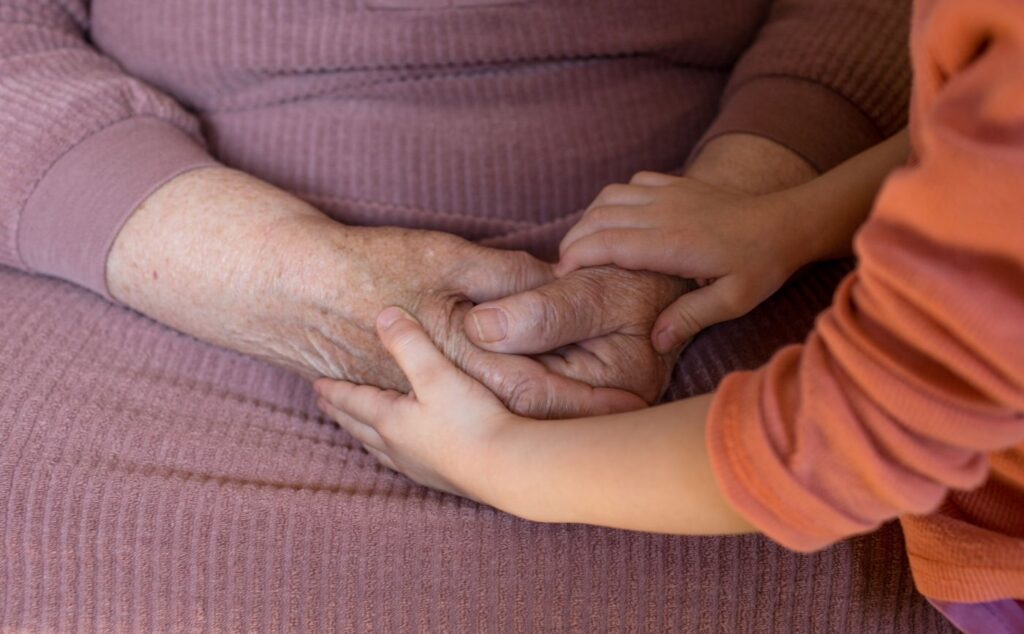
In this month’s Q&A, Public Discourse’s managing editor, Alexandra Davis, sits down with author and speaker Leah Libresco Sargeant to discuss her new book, The Dignity of Dependence: A Feminist Manifesto (which will be released next week by Notre Dame Press). The two discuss why our society has lost sight of, and appreciation for, our fundamental dependence on one another, and why we will never truly flourish as individuals and as a society until we understand our dependence as an intrinsic part of our humanity.
Alexandra Davis: Leah, thank you so much for speaking with me today. I loved the book. I think it will be extremely influential to so many, especially now, when so many are lonely and profoundly confused about what makes life fulfilling. Why did you write the book, and why now?
Leah Libresco Sargeant: I was interested in this issue of dependence in light of the full flowering of the second-wave feminism I grew up with and a desire to fill in the gaps of what it left out. There are a lot of definitions of feminism, but I think one of the most basic is that the world should be welcoming to women as women and that it isn’t a fair or feminist world when either women are completely unwelcome or women are welcome only insofar as we find ways to pass ourselves off as men and think of ourselves internally as falling short of being a “normal” human being . . . which is to say, a man.
I think that critique comes out in a lot of different places in different parts of the very fractious feminist movement. But I am interested in the pro-life feminist critique that when you take women’s fertility as a threat to our flourishing, you are once again saying that it is fundamentally bad to be a woman and that to live well in the world, it’s a woman’s job to solve the problem of being a woman, even if it takes violence to do it.
AD: That’s helpful framing, because you start the book with a chapter about how the world is “the wrong shape” for women. To illustrate, you talk about things like medication dosing, crash test standards for cars, and even the heights of countertops being designed for the typical man, who’s generally taller than the average woman. And in this chapter is this arresting quote that “in a world that prizes autonomy as the acme of human achievement, women will always feel our claim to be fully human is tenuous.” Can you say more about that and share why you chose to open the book this way?
Start your day with Public Discourse
Sign up and get our daily essays sent straight to your inbox.LLS: Yes; I think what you see is that there are a lot of ways we talk about ordinary parts of human life—being pregnant, being a pre-born infant, being a post-born infant, being elderly, being sick, being disabled—as though they are interruptions from our “real life.” I’m as guilty of this as anyone. I have moments when if I’m going through a period of illness, I say, “Oh, I ‘barely existed’ last week. I was just lying down and feverish.”
One thing I come back to is a remark by Father Richard John Neuhaus. He is talking about how people complain that an infant in the womb doesn’t “look like” a human being. He says, “This is what a human being looks like when they’re this age. It’s what you looked like. It’s what I looked like.” I have to keep reminding myself when I’m sick, when I’m very nauseated from being pregnant, when I’m with someone who’s old, that these states aren’t interruptions from being human. It isn’t this “training wheels” stage where you’re getting ready to be fully human. This is what a human being looks like when they’re sick, when they’re pregnant, when they’re old.
I think we wind up with this very narrow image of being human that’s a thirty-five-year-old, able-bodied man and think that, if you want to live a full human life, you’ve got to first pretend that man was never a baby (which would be very embarrassing to him). And you kind of have to root for him to be hit by a bus before he’s forty because otherwise, at some point, once again, he’ll be reminded that he’s an embodied person who is fragile. You can’t have a philosophy of life that says it’s good to be hit by a bus before you’re forty.
AD: How did we get here? It seems like this is a relatively recent development, right?
LLS: I think it has always been a temptation for human beings to hate being human, to hate being created, to resent our dependence on each other and on God. But the form of our self-hatred changes in different eras. It’s much less common in our day to abandon or expose infants, to treat them as so marginally human that it is entirely their father’s decision whether they live or die. Though, it’s not completely unpracticed in our day.
I was reading in the book After the Spike on population dynamics, which discusses a hospital in India that cares for premature or underweight infants. They use a “code pink” to signal to nurses that there’s a family trying to take home a baby girl against medical advice, because they just don’t think it’s worth the effort to save her life.
So it’s not unprecedented in our day, but I think the way we express this discomfort with being human (and hatred of being human) shifts. I think the Sexual Revolution framed pregnancy as something we opt into only in a time, place, and manner that accords with everything else in life. Only you are in charge of that. That was the promise. Then the Pill changed the sense of who’s responsible: you hear that even among conservatives, the sense of, “Well, if a woman got pregnant when she was poor, why should anyone else help? She made this choice.”
AD: You go on to say in the book that not only can we not avoid our own neediness, but that we shouldn’t want to. Why?
LLS: If we think of our need as a necessary evil, we say, “Unfortunately, human beings are limited. Unfortunately, we have periods of illness or pregnancy or infancy. But maybe one day we’ll get past that.” First of all, it’s pretty obvious that only some of these things are possible to “get past,” and anything else is delusional. We won’t “get past” infancy at any point in our development. We can and should strive to cure and ameliorate disease, but infancy isn’t a problem that can be cured, and aging, similarly, isn’t something that can be fixed. We think about how we can best accompany someone through the difficulties of aging and the work of dying, but we cannot cure those things, and we shouldn’t try and absent the person from them.
From a secular point of view, if you resent being human, especially the parts that aren’t changeable, then you’re just inculcating unhappiness instead of trying to live within who you actually are. But for Christians, there’s a different perspective: we are made to be dependent on God. Even that thirty-five-year-old, right before he’s hit by the bus, is not an independent, autonomous man. He is still radically dependent on God, moment to moment. And if we spend our life cultivating resentment of all the ways we need other people or feeling shame about it, we have no way to relate to God, except by resenting him or being ashamed of his love.
We think about how we can best accompany someone through the difficulties of aging and the work of dying, but we cannot cure those things, and we shouldn’t try and absent the person from them.
AD: This reminds me of another part of your book where you talk about the concept of “open-handed curiosity.” It’s this posture of approaching life’s inevitable periods of dependence with a spirit of curiosity and receptivity instead of resentment.
We hear so much about our culture’s epidemic of anxiety, fear, and lack of hope. Do you think that this open-handed curiosity could ameliorate some of our cultural and individual anxiety?
LLS: I hope so. I think this is part of what attracts people, I think more often men, to Stoicism as a philosophy to help them live well. I don’t think it has the fullness of truth, but I think it has one very important part of truth, which is that we don’t need to know the whole future of our relationship and our loves and our bodies to be grateful for what we have now and to live fully. But actually, in some ways, we do know the future. We will lose all of these things, right? We’ll lose them by dying if not by anything else. But Stoicism doesn’t say, “therefore, you should have no relationships with people.”
The actual historical Stoics had families, loved their children, and thought, “One day they will die, or I will. I should love them fully now in a way that isn’t threatened by that fact.” People might think that means loving people less, but I think you’re freer to love when you love truthfully. Saying, “I’m well now, I’m loved by people, but my worth doesn’t depend on what I can do for them, and I won’t be able to do things for them forever,” is all helpful to loving confidently.
The Stoics have their own meditations of just sitting around and thinking, “One day, my child who embraced me will be dead,” which is true. And it’s helpful to know that that’s true, but it’s not the only thing that’s helpful. It’s also important to ask for help before you need it. So when you’re sick, when you’re in trouble, when you’re tired, when you’re lonely, ask friends to come over because you need them. Ask them to bring dinner even if you haven’t just had a baby. By doing this, you get the feedback of, “When I need things from my friends, they don’t hate me,” which is probably already true.
But I think people don’t get that feedback if you say, “Okay, I’m really sick, I’m tired, I’m going to DoorDash tonight because I can’t make dinner,” versus saying, “I’m going to ask a friend to bring me food.” And it means you’re not getting that lived experience of knowing, “My friends love me even when I’m sick. My friends love me even when I ask them to do favors for me.” If you don’t get that feedback, I think it does fuel anxiety that maybe that’s not true, because you’re not receiving any evidence that it’s not true.
AD: This makes me think of a phrase you used later in the book: “the intimacy of imbalance.” It’s this idea that we need to restore an economy of unbalanced, uncalculated giving: bringing a friend a meal, even if she’s not in a position to return that favor, or, like you said, asking for help from a friend, knowing that, for a time, you cannot return that favor. It’s the imbalance that fuels intimacy and makes the relationships more than merely transactional, right?
LLS: That’s right. There’s nothing intrinsically wrong with going out to dinner with friends and using Venmo to split the bill. But if you approach most relationships by asking, “What do we owe each other? What makes us even?” it’s important to remember that part of the point of being “even” is that there’s nothing left to settle. I’m “even” when I go to a store and pay for a book. I have the book, they have the money, I don’t know the bookseller’s name, and we’re done. But with friends, there should be a sense that someone owes the other something. You have a sense of unfinishedness, even if you don’t even remember who owes more.
In that chapter, I talk about a friend I told, “Look, we have dinner every month. We usually split the bill. Could I treat you this time, and you treat me next time? And we just won’t worry about it if some of the dinners are a little more expensive.” We just know that part of being friends is that we’ll keep having dinners and keep doing things for each other, and we’re not going to keep strict accounts.
AD: It’s interesting because throughout the book you talk about the idea of exposure to risk. This is a silly example, but I was thinking, if you offer to pay for someone’s dinner, you expose yourself to the risk that maybe they’ll pick the filet mignon instead of the chicken. But that applies on a broader scale, too. You talk about this concept of exposing yourself to catastrophe and how opening ourselves to this kind of imbalance in relationships can feel very dangerous.
LLS: I think that’s part of what makes it intimate. If I meet someone for the first time, I don’t say, “Let me pick this up. You’ll get it next time,” because we don’t know there will be a next time. We’re acquaintances, we’re polite to each other, but we’re not trusting each other like we would among friends. We don’t expect this to be a five-year relationship.
It’s good to think that when I do certain things with friends, it’s really different, and it includes the kind of risk that trust can support in a way it doesn’t with acquaintances.
AD: Our society isn’t really structured for this kind of uncalculated giving, it seems. How can we change that, both from a political standpoint and an interpersonal one?
LLS: I’ll start from the back and go in reverse. Interpersonally, the countercultural thing is asking people for help for needs you could manage on your own (or that you could pay someone to manage for you). I think what often happens if you don’t ask for those smaller needs, in those moments when you’re genuinely in great need, you don’t have that history of small asks to fall back on to, pushing your thought of, “Well, this is unprecedented. How could I ask someone to come over to drive me home from surgery?” But if you have asked someone, “Could you watch my kids for an hour?” you have more of a sense of, “We’ve trusted each other with small things, so maybe now I can make this bigger request.”
So, proactively ask for help. And I do think it’s important that it’s asking for help, not just offering help. It’s much easier for people who feel ashamed of need to decline your offers of help. When you ask for help and you put yourself in the weaker position, as we all are in sometimes, your friend learns that you don’t think this is something to be ashamed of, and they’re much more likely to ask you later.
That’s the personal piece. I think one of the biggest current political, cultural questions about this is the question of euthanasia. The majority of people who seek to kill themselves through euthanasia specifically cite that they feel like they’re a burden to other people, much more than they cite pain. And I think continuing to try to keep euthanasia illegal and to speak frankly about how it cuts against human dignity, not just at the end of life but throughout life, is important. Asking how long you have to be a burden on someone else before you’re a legitimate target for killing is a real problem.
We should continue to make common alliance with disability activists as well as pro-life activists here because it makes a lot of sense that if people spent their whole life both ashamed of need and trying not to burden others, then when they come to the end of life, which they certainly will, they’ll be unprepared for this as a category of relationship and seek to spare the people they love by killing themselves.
We also need to think about how to tell the truth about who human beings are, and to make that truth ever clearer. You can look at things like maternity leave: we still have no national maternity leave policy or funding. States have been building this up a little, which is great, but fundamentally, we’re not telling the truth about who women are, what babies are, and what pregnancy is if there’s no assumption that women need a lot of time to recover from birth and care for their babies. Six weeks is the medical recommendation for when you might be able to pick up a car seat, and then maybe you can go back to work if you’re also capable of picking up a car seat. But it’s fundamentally untruthful to say that a woman and baby are fully ready to separate at six weeks, even if the delivery was uncomplicated. A work world that doesn’t account for that isn’t a truthful or humane one.
But in the book I also highlight one other public policy issue: our system of disability help, SSI, assumes that if you have severe physical needs, if you’re on disability and you don’t have a strong work history, possibly because you’ve been disabled for a long time, you should be required to immiserate yourself. There are savings and asset caps that say you can’t have more than $2,000 to your name if you’re going to be on disability. But more than that, I think it’s cruel that if your family brings you meals, that’s deducted from your disability. That for anyone else to care for you in some sense cancels out what you might be entitled to under your disability benefit. Plus, that just means the state is then deeply interested in logistics like, “Has anyone brought you meals recently? Does your mother let you stay in her house?”
The meal thing is getting cleaned up little by little, but it’s still the case that if you, as a disabled adult, live with your mother, our government wants you to figure out what your imputed rent is and deduct it from your benefits. It’s just this hostility toward family care, seeing that as always competitive with government benefits, and we have to see those as lying more naturally alongside each other.
We need to think about how to tell the truth about who human beings are, and to make that truth ever clearer.
AD: I’d like to turn to an issue that so many are worried about now, and for good reason: the birth rate and population decline. You get into this toward the end of the book.
Especially in socially conservative circles, there are many different ideas about how to address this issue. How might a new way of understanding and appreciating our dependence affect how we approach the issue?
LLS: Two things. One is that we still have a gap between how many children women say they want and how many they actually have. So when we ask, “Is there a problem with birth rates?” I think it’s important to say, “This isn’t just a problem for Social Security or demographic balance. It’s a problem because women say they want more children than they’re able to have.” So improving birth rates is not a matter of tricking people or coercing them into having more kids. It’s about figuring out what the roadblocks are for them having the kids they want and having the marriages they want: a lot of our fertility crisis is driven by the decline in marriage.
So that’s thing one, but then you’ll ask, “Okay, well, what are those roadblocks and what is going on here?” I think it is a real problem that it’s hard to have leave after having a baby. And if you conceptualize that whole period of pregnancy and even your children’s youth, which is taking you away from what we call “normal life,” that’s hard.
In prosperous countries the opportunity cost of having kids goes up. There’s more prosperity, higher wages, more leisure time. Kids are always going to mean you have less of those things. Even in a world that has parental leave, it means you’ll have less of those things. And so the question is, how do we value what we’re getting in exchange? I think that means that not only do we try to blunt some of those costs where we can, but we also have to push for a culture that thinks children are valuable as they are, that thinks slowing down with them is a return to a more human way of living than some of the forms of frenetic leisure that are constantly available to us.
Loving people who are small, who have blowouts, who are cranky, hopefully makes me more prepared to love my mom when she’s dying. I’m getting this constant training in how to love someone who has strong physical and emotional needs that they can’t meet themselves. And that prepares me better, not only to be a mom, but to be a daughter.
AD: Yes. If we view pregnancy at the very outset as an aberration and an inconvenience, as something that pulls us away from “normal life,” what kind of preparation is that for parenthood and then the rest of life?
LLS: Exactly. I think it’s also the case that having children is good for your marriage, not just in the obvious sense of you love someone, you want more of them, then you make more of them. You have this project you’re fully invested in together. But there are a lot of ways in which having a baby, recovering from having a baby, puts big physical burdens on me, and then my husband cares for me.
When we were in the early part of our marriage and more able to do whatever we wanted, we also loved each other, obviously, but the way we showed our love to each other was different. It was often taking on weird, insane projects that weren’t children, but it was easier in our marriage to balance out, to be “even.” Like, “I’ll do this, you do that.” We split things. When I’m pregnant, we don’t balance things in the same way. But it’s really obvious that loving someone does not mean being even with them all the time. It means asking for help a lot. And I think that’s good for your marriage long-term. Having a really long period of always asking “are we even?” I think, will make it hard when something happens that means you will never be even. And it’s not just on the woman’s side: a husband can get sick, lose his job. Starting a marriage from the outset with a sense of asymmetry can be helpful.
AD: As a final word, I want to ask if you think there is hope for us. In our brokenness, can we restore a healthy sense of dependence and truly see and love the vulnerable while embracing our own weakness?
LLS: Yes! Here’s where I’m an optimist, and this is informed partly by me being someone who used to be an atheist and pro-choice and is now Catholic and pro-life. How can you not think the odds are always loaded in favor of the truth, even when it’s a hard truth?
I think one of the great things about children is that they are the easiest people to love in the middle of their dependence and incontinence. They are also good witnesses for who we all are: when you hold someone who can’t take care of himself, you might realize, “I don’t despise this baby for being a baby. Is it possible God does not despise me for struggling with sin?” The more we put people around babies, the more everyone learns to love the elderly, to love the disabled, and to love themselves, but we have to make that connection explicit.
The whole world is God’s creation, an expression of his love. The truth about ourselves as dependent creatures who he loves, whom he sent his Son to redeem, is out there for us. We can blind ourselves to it, we can ignore it, but it’s very loud. And the more we help each other see it, the happier we will ultimately be.
Image licensed via Adobe Stock.