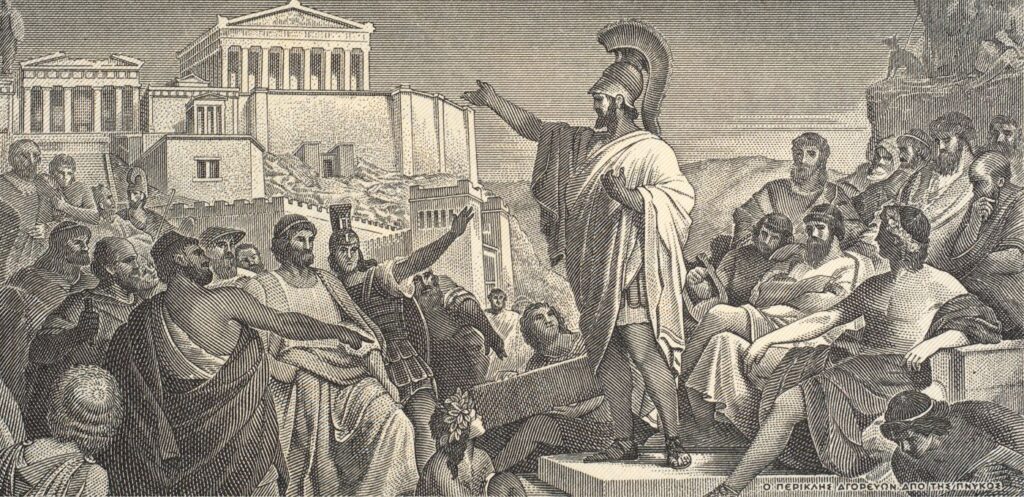
The modern left seems to exist in a state of historical weightlessness. The left sees the past much as Hillary Clinton viewed Trump voters: as a “basket of deplorables,” an accumulation of embarrassing prejudices, violence physical and symbolic, and insidious systems of oppression and exclusion. On balance, it considers the past to be a liability, a hurdle to overcome, rather than a basic feature of the human condition, with which we are fated to wrestle.
It is striking that when liberals (for the purpose of this essay, I will overlook the distinctions between the left, liberalism, and progressivism) use terms like “fascism” or “kings” to denounce the modern right, they use such terms as abstractly as possible, as if they were atemporal categories rather than complex historical realities. Because many liberals are well educated—indeed, holding a college degree may now be the left’s defining feature—they are admittedly often well-versed in history. Many enjoy mocking the historical ignorance of MAGA supporters. Yet while the left may have historical knowledge, it has little sense of the past.
While it may be in the left’s nature to look toward the future, it has not always had such a dim view of the past. A left that developed a renewed appreciation for the past would have a rich political vision, deeper connection with popular traditions, and a more grounded set of values.
What makes the left so uncomfortable about the past? The German philosopher Walter Benjamin wrote in 1940 that “there is no document of civilization which is not at the same time a document of barbarism.” The left has largely embraced this view. History has become a moral terrain pitting good guys against bad guys, oppressors against oppressed. This might sound like Marxism—The Communist Manifesto describes “the history of all hitherto existing society” as a conflict between “oppressor and oppressed”—but progressive history is quite different. While Marxism sees history as following a pattern, its conviction that human beings are fundamentally shaped by economic systems made it necessary to understand how these systems worked in their own time, resulting in a genuine appreciation for history. The progressive view tends to flatten history, embracing a decidedly modern variation on an old aphorism (referenced but rejected by Arnold Toynbee): “history is just one damn form of oppression after another.”
The problem with this outlook is not that it’s entirely wrong—properly done, it can yield real insight—but that it can easily devolve into a caricature of itself, in which a genuine appreciation for the historical factors that define the constraints under which actors operate is reduced to a facile quest for repression and exclusion and the validation of the “agency” of any marginalized groups. It is characteristic of this view that even when it considers moments of genuine historical emancipation, like the civil rights movement, there is a premium on unearthing how even champions of social justice had groups they marginalized. This approach can have a pointillist effect, as it makes major trends and structures fuzzy and focuses attention on an infinite array of oppressive acts. But it also makes the past distasteful, except for those rare crusaders who are valued precisely because they seem to have transcended their limited historical horizons. The English historian E. P. Thompson famously spoke of rescuing people from the past (specifically the emerging industrial class, in his case) from the “enormous condescension of posterity.” For contemporary progressives, the whole point of history is that it provides an opportunity to display such condescension.
Start your day with Public Discourse
Sign up and get our daily essays sent straight to your inbox.There are many ways in which the left might profit from deeper engagement with the past. First, the left needs to rediscover “big picture” historical thinking (what historians sometimes call “metanarratives”). The reason is clear: historical direction straddles temporality; more prosaically, visions about the present and future are shaped by one’s understanding of the past. Part of the reason Marxism held such sway over the left for so long was that it was based on a compelling historical justification of the workers’ movement’s importance. Not only did Marxism make the struggle between the proletariat and capitalists the climax of history, when exploitation and alienation would end once and for all, but it premised this argument on a philosophy of history stretching back to society’s origins. In this vein, Arthur Koestler recalled his first experience reading Marx in the 1930s: “To say that one had ‘seen the light’ is a poor description of the rapture which only the convert knows … the whole universe falls into pattern like the stray pieces of a jigsaw puzzle assembled by magic at one stroke.”
This concern with historical processes was not confined to the revolutionary left alone. In the mid-twentieth century, American academics rubbed the radical edge off Marxism and turned it into “modernization theory,” which sought to understand the historical circumstances in which societies become capitalist and democratic. These views shaped the outlook of intellectuals close to the Democratic Party, such as Walt Rostow, the author of The Stages of Economic Growth (1960). When Tony Blair was founding New Labour in the 1990s, he drew heavily on the work of Anthony Giddens, a sociologist who theorized the advent of an age of “reflective modernity.”
Though all these historical theories have their weaknesses, they nevertheless helped to define a political vision. Knowing where you have come from tells you where you are going. The workers’ revolution was the culmination of millennia of class conflict; the story of Western industrialization could be generalized on a global scale; and the sense that the “first modernity” of the industrial age was waning drove what became known as Third Wave politics. Today’s left has no sense of the past because it no longer has an overarching political vision. Its obsession with a medley of social justice issues is just a fig leaf for its lack of a coherent political agenda.
But a historical sense alone may not be enough. The left also needs to recover a sense of the past as past, of the past as tradition. In earlier times, the left had a much clearer sense that so-called “progress” was a mixed bag. It referred, of course, to the longing for a more egalitarian society and the hope that the meek would inherit the earth. But progress was also a slogan brandished by bureaucratic and capitalist elites to introduce labor-replacing machinery and reforms that tore into traditional solidarities in the name of generalizing market relations.
A left that developed a renewed appreciation for the past would have a rich political vision, deeper connection with popular traditions, and a more grounded set of values.
Confronted with the transformations brought by the industrial revolution, the workers’ movement often invoked memories of earlier periods, when work was based on craftsmanship, guild organization, and communal values. In The Communist Manifesto, Marx and Engels recognize that “conservation of the old modes of production in unaltered form, was … the first condition of existence for all earlier industrial classes.” This is why the French philosopher Jean-Claude Michéa insists that any genuinely populist or socialist movement that claims to be emancipatory must have a “conservative moment”—that is, a stage when its priority is shoring up its achievements and doubling down on conditions that have benefited ordinary people, and, by the same token, questioning the embrace of reckless change.
E. P. Thompson reminds us of how the English working class, in resisting emergent capitalism, repeatedly drew on such traditional values as community, moral economy, and cultivation of an autonomous workers’ culture. Such insights inform Michéa’s view that the hope for genuine social change is hopeless without recourse to humanity’s “vast anthropological, moral, and linguistic legacy, the forgetting or refusal of which has always led ‘revolutionary’ intellectuals to build the most perverse and stifling political systems imaginable.” The left has lost touch with its origins precisely because it is steeped in intellectual conceits that seem radical but have little resonance with working-class and populist values.
In The True and Only Heaven, Christopher Lasch makes a compelling distinction between memory and nostalgia. Memory, he argues, is an attitude that sees the past as spilling over into the present and even the future. It emphasizes “our continuing indebtedness to a past the formative influence of which lives on in our patterns of speech, our gestures, our standards of honor, our expectations, our basic disposition toward the world around us.” Nostalgia, by contrast, is a longing for lost innocence that occurs when one views the past from a superior vantage point—an idealized past that “stands outside time, frozen in unchanging perfection.” Nostalgia, in short, is a progressive conceit. “The more emphatically the modern age insisted on its own wisdom, experience, and maturity,” Lasch observes, “the more appealing allegedly simple, unsophisticated times appear in retrospect.”
The contemporary left may not have much nostalgia for a specific historical moment, but it appears to believe in an atemporal condition of purity or innocence, existing in “unchanging perfection,” from which oppression and prejudice have been forever banished. And it is precisely from this perspective that it seeks to judge the past. A left that appreciated the struggles for democracy, labor rights, and civil rights as experiences that drew on tradition to achieve a better future might be able to articulate something like a coherent political vision. And it might regard the past—as well as people—with less enormous condescension.