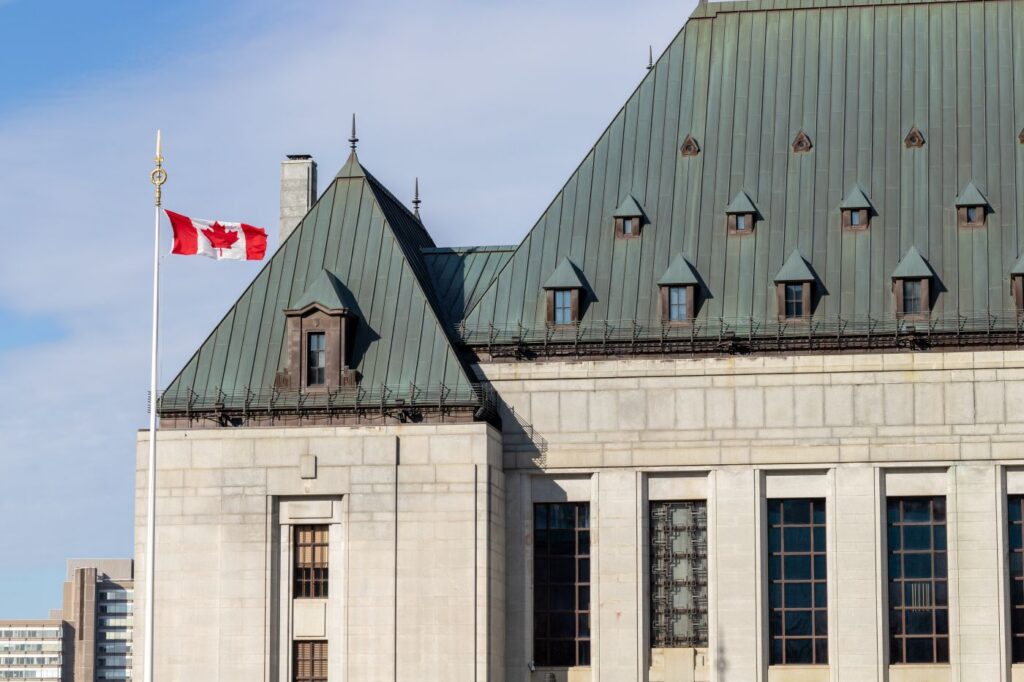
On March 23–26 of this year, Canada’s Supreme Court held hearings on whether federal and provincial legislatures can override the Charter of Rights and Freedoms guaranteed in its 1982 Constitution. The UK is also currently roiled by debates over whether it should continue to defer to rulings by the European Court of Human Rights or revert to the centuries-old supremacy of Parliament as the ultimate guarantor of rights.
Of course, at least since Marbury v. Madison, Americans have usually held that we should defer to courts, especially the Supreme Court, as the primary definers and defenders of rights. These disputes in other English-speaking countries might seem very removed from typical Americans’ concerns. Nonetheless, the disputes in the UK and Canada can illuminate how rights might properly be defined and protected in diverse political orders, including by legislative branches.
The UK and the European Court of Human Rights
Perhaps even more than the U.S., the UK is currently divided over control of illegal immigration. It is attempting to deal with a massive influx of people arriving by boat across the English Channel. This situation is exacerbated in that, while the U.S. can, to a large degree, block its southern border, it is more difficult to know what to do about people arriving in flimsy, small boats. They cannot simply be left adrift offshore, and humanitarian considerations suggest that they should be allowed to land and be accommodated in some form.
When the UK was part of the European Union, it could try to address this as an internal EU matter, especially since most arrivals are coming from France. But after Brexit, that option is closed; the UK is no longer party to the Dublin regulation, which had allowed it to return asylum seekers to the first safe EU country they reached.
Start your day with Public Discourse
Sign up and get our daily essays sent straight to your inbox.However, while no longer part of the EU, the UK is still a party to the European Convention of Human Rights, which is adjudicated by the European Court of Human Rights (ECHR). Many complain that the Court’s expansive rulings are now unduly restricting the UK’s ability to address immigration and other issues. More broadly, the complaint is that the ECHR fundamentally undermines the UK’s national sovereignty.
There are several contested Convention articles. One of the most cited is Article 8, the “Right to Family Life.” This article guarantees a right to “respect for … private and family life,” which can only be infringed when there are other vital interests at stake. Critics argue that foreign criminals and illegal migrants are using this article to block deportations by claiming that their removal would disproportionately interfere with their domestic ties. Some politicians describe the interpretation of this right as “extravagant” and far beyond its original meaning.
Consequently, there is a strong push for the UK to leave the Convention. This is led by the insurgent Reform Party, but is also supported by Tory leader Kemi Badenoch and, though often silently, by many others. This has, in turn, produced a determined and sometimes fevered reaction by ECHR supporters.
There are many sober arguments against leaving the Convention. One is that leaving may threaten the Good Friday agreement on the status of Northern Ireland, thus destabilizing the established peace process and perhaps sparking legal challenges from the Irish Republic. Another is that the actual effects of the Court’s restrictions on deportation are in fact quite minimal.
UK actors have waded into the issue in, of course, The Guardian. Stephen Fry, who has played a Cambridge-educated lawyer on television, has at least the virtue of being a Cambridge-educated lawyer. But, alas, Joanna Lumley, despite her many undoubted virtues, can make no such claim. Same for Monty Python’s Michael Palin. The actors maintained that “the European Convention on Human Rights (ECHR) and the UN Convention against torture are at the heart of [Britain’s] legacy. … Any attempt at undermining their universal protections is an affront to us all and a threat to the security of each and every one of us.”
More substantially, Baroness Hale of Richmond, the first female president of the Supreme Court of the United Kingdom, has said that calls to quit the Convention were “troubling” and “unnecessary,” and argued that it is not the primary barrier to deportations.
On the political front, Prime Minister Keir Starmer, a former human rights lawyer, has consistently opposed withdrawal, stating starkly and strangely that there is “no British security without Europe.” The head of the Liberal Democrats, Sir Ed Davey, has also fiercely criticized the conservative pivot toward withdrawal, stating that it would align the UK with authoritarian regimes such as Russia.
Putting Starmer’s and Davey’s themes even more starkly, human rights lawyer Mark Guthrie, addressing the International Bar Association, stated that leaving the Convention would mean that the UK would join Belarus and Russia as the only other European states that are not members. Hence, these countries would become the UK’s “bedfellows” and thus withdrawal would cause the Kingdom to lose “all moral authority to promote and protect human rights globally.” The UK would become “neither … a democracy nor uphold the rule of law.”
But these latter criticisms confuse substantive protection of human rights with adherence to one particular legal mechanism for such protection: withdrawing from the Convention would of course put the UK in the same camp as non-members Belarus and Russia. But it would also put it in the same camp of nonmembers that includes the U.S., Canada, Australia, New Zealand, Japan, and, indeed, most of the world’s countries—free or not.
The UK incorporated the European Convention on Human Rights only via the Human Rights Act 1998, which came into force in October 2000. Are we seriously to believe that there were no substantive protections of human rights in the UK before 2000? That without them, the UK would simply to revert to being akin to Belarus and Russia?
International courts and charters are one way of defending rights, and they may not always be the best instruments. For example, most obviously, substantive protection of human rights in Ukraine depends more on the bravery and ingenuity of its soldiers together with weapons shipments from the West than it does from any court.
Here I take no position on whether adherence to the Convention has deleterious effects on UK immigration or any other policy, nor whether UK withdrawal from the Court would be a net good. But we should not think that the ECHR is a sine qua non of protecting substantive human rights in the UK.
Canada’s Notwithstanding Clause
Canada’s Constitution Act, 1982 enshrines a Charter of Rights and Freedoms that includes freedom of conscience, religion, thought, belief, expression, press, peaceful assembly, and association. Also protected are rights of political participation, mobility, security of the person, and protection from unreasonable searches. But, unlike the U.S., Canada has constitutional provisions that can limit the Charter’s reach. The Preamble to the 1982 Act declares it “similar in Principle to that of the United Kingdom,” thus allowing for the primacy of parliament. While the U.S. added the Bill of Rights to the Constitution to help persuade the states to ratify it, Canada did the opposite and limited the reach of its Charter to help persuade the provinces to accept it.
The Constitution Act contains two provisions that can limit both the Charter and the powers of the judiciary. Under a “limitations clause,” the Supreme Court may conduct a “proportionality review” and perhaps accept legislated limits of listed rights if it judges that the limitation is motivated by a “pressing and substantial objective” that can be “demonstrably justified in a free and democratic society.” The Court has used this clause to uphold laws limiting “hate speech,” “obscenity,” and drug possession that might otherwise violate Charter rights.
Another limit is a “notwithstanding” clause. This allows Parliament or a provincial legislature to pass laws that override some Charter rights by including in the law a provision stating that the legislation will come into force “notwithstanding” the fact that it might violate the Charter. In 2019, Quebec invoked this clause to defend a law prohibiting some public sector workers from wearing religious symbols at work. On April 2, 2026, it invoked the clause to pass Bill 9, a law that, among other things, bans public prayer.
Legislatures must renew the notwithstanding clause every five years or it lapses. Quebec did not agree to the 1982 Constitution Act itself and then used the clause to defend all its legislation until December 2, 1985. On that date, a new party was elected as the provincial government and did not renew the use of the clause. Hence the Charter could invalidate the previously exempted laws.
Despite these limits on the use of the clause, those accustomed to jurisdictions where courts have the final say may find these two provisions unnervingly arbitrary. However, as noted, courts and bills of rights are only two among many methods of protecting substantive rights and may not always be the best ones.
Currently, the notwithstanding clause itself is being challenged before the Canadian Supreme Court. The Canadian federal government is arguing that the clause’s effect was intended to be temporary, especially since it must be renewed every five years. But it maintains that if the clause is used continually, as Quebec has used it, then this would be tantamount to an illegitimate amendment to the Constitution itself, thus causing “irreparable impairment” of otherwise protected rights. This might produce a legal conundrum if a province used the clause to circumvent a possible Supreme Court ruling limiting its use. That I leave to constitutional lawyers.
There are also arguments like those in the UK claiming that the use of the “limitations” and “notwithstanding” clauses necessarily undermines fundamental rights and leaves Canada in, if not quite the same league as Belarus and Russia, at least lesser company.
However, in contrast to the U.S., where the Bill of Rights was added in order to entice the states to support the Constitution’s ratification, Canada placed limits on its Charter of Rights and Freedom to gain the provinces’ necessary support to ratify its new Constitution. These limits were expressly intended to allow elected representatives a role in demarcating rights. And, of course, Canada had been protecting rights long before the new Charter came into force. Circumscribing the power of courts is not the same as denying rights; it is a balancing project about who gets to say what those rights are.
The apparently alien discussions in the UK and Canada are not so far from us as we might like to think.
Substantive Rights in America
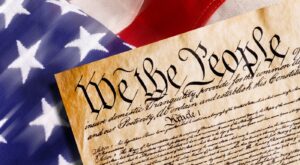
These disputes might seem very far from American concerns. But we can recall that, despite the ringing appeals to natural rights in the Declaration of Independence, there was no Bill of Rights in the original Constitution.
The drafters believed that the constitutional arrangements that they had already provided—the constitutional order itself, democratic elections, division of powers, and federalism—were sufficient to protect natural rights. They were also concerned that if certain rights were enumerated, then any unenumerated rights might be left open to government abuse.
Thus, the apparently alien discussions in the UK and Canada are not so far from us as we might like to think, and they can illuminate the conundrums involved in deciding which organ of government should protect which rights.
Justice Amy Coney Barrett famously opined that Justice Ketanji Brown Jackson exaggerated the proper role of the court and thus was decrying “an imperial Executive while embracing an imperial Judiciary.” Not only can executives be imperial and overbearing, but legislatures and judiciaries can, too. The division of powers and deference between branches of government are themselves key safeguards of rights, something the drafters of the U.S. Constitution well recognized.