Recently I was interviewed by Ryan Shinkel of the James Madison Program at Princeton for the program’s podcast, “Madison’s Notes.” Ryan had read some of my columns here on the subject of movies and wanted my thoughts on film as we approach the semiquincentennial—America’s 250th birthday. Our conversation was an enjoyable ramble, a bit unfocused at times, but it gave me some jumping-off points for this column.
Several countries can stake their claims for the technical inventions that gave rise to the motion picture at the end of the nineteenth century, and for the innovations in the twentieth that made the technology a medium for storytelling. In the United States, the gravitation of the burgeoning business of filmmaking to Hollywood by 1920 gave rise to a dominating aggregation of talent and money in one highly competitive industry town. By the time “talkies” hit theaters in the late 1920s, Hollywood studios were already producing hundreds of feature films each year, supplemented by “shorts,” cartoons, serials, travelogues, and newsreels. For all these feature films, Hollywood needed material, and plenty of it. The great American myth factory needed a supply of myths.
The studios could of course mine various literary traditions—histories, novels, short stories, plays, ancient legends and sagas—but for American audiences, screenwriters could turn also to the country’s inherited mythology. A myth is not entirely a fiction, certainly not a simple untruth; it is a tale that tells us something true about ourselves, however much it may float free of verifiable facts or scant inconvenient ones. And the myth par excellence of the United States is the frontier.
The historical case for centrality of the American frontier was famously put forward by Frederick Jackson Turner, and on a memorable occasion. The American Historical Association met in July 1893 at the World’s Columbian Exposition in Chicago (commemorating the 400th anniversary of Columbus’s first landing in the Americas). There, Turner, a University of Wisconsin professor, read the paper that made his reputation, “The Significance of the Frontier in American History,” later included in his collected essays. In the decades that followed, Turner’s thesis underwent some rough treatment in American historiography, but the essay still has much to say to us about the geographic, material, and demographic forces that shaped the American experience.
For one thing, the way Americans use the word “frontier” changed its meaning in our variant of the English language. As Turner observed, for Europeans a “frontier” is “a fortified boundary line running through dense populations”—in short, an international border, and no more than that. For the American, it is what “lies at the hither edge of free land,” and “the meeting point between savagery and civilization.” The American frontier, at first just inland from the Atlantic coast, was, until Turner’s own day, a dynamic line running roughly north–south and steadily moving westward. This was, he argued, “a steady movement away from the influence of Europe, a steady growth of independence on American lines.”
Start your day with Public Discourse
Sign up and get our daily essays sent straight to your inbox.Turner traces the various stages of the American frontier according to “natural boundary lines” on the continent: first the “fall lines” of the eastern rivers in the Atlantic watersheds; then the Appalachian ranges; then the Mississippi, and then the Missouri; then “the line of the arid lands” followed by the Rockies. This steady advance of the frontier “promoted the formation of a composite nationality for the American people,” Turner says. “But the most important effect of the frontier has been the promotion of democracy,” for “the frontier is productive of individualism,” and “produces antipathy to control.” Indeed, he remarks, “to the frontier the American intellect owes its striking characteristics”:
That coarseness and strength combined with acuteness and inquisitiveness; that practical, inventive turn of mind, quick to find expedients; that masterful grasp of material things, lacking in the artistic but powerful to effect great ends; that restless, nervous energy; that dominant individualism, working for good and for evil, and withal that buoyancy and exuberance which comes with freedom—these are traits of the frontier, or traits called out elsewhere because of the existence of the frontier.
There is much truth in Turner’s frontier thesis. Even in the Declaration of Independence, whose semiquincentennial we celebrate this year, the American gaze to the west can already be glimpsed. In the catalogue of grievances against King George III, the Declaration complains of his hampering our westward development, refusing “Laws for the Accommodation of large Districts of People, unless those People would relinquish the Right of Representation in the Legislature.” He was charged with hampering American efforts to encourage the immigration and naturalization of foreigners, particularly in “new Appropriations of Lands.” And the king had “endeavoured to bring on the Inhabitants of our Frontiers, the merciless Indian Savages,” making the westward venture of American pioneers mortally dangerous. What a later generation would call, for good or ill, our “manifest destiny” to occupy the breadth of the continent was made possible by the revolution proclaimed to the world in 1776.
From American literature’s beginnings, its touchstone was the frontier, and the type of human being it shapes. On the very first page of James Fenimore Cooper’s 1826 novel The Last of the Mohicans—set in the days of the pre-revolutionary French and Indian War and memorably filmed with Randolph Scott as Hawkeye in 1936 and with Daniel Day-Lewis in 1992—we encounter “the toils and dangers of the wilderness” faced by the “hardy colonist,” whose troubles are caused in part by “the cold and selfish policy of the distant monarchs of Europe.” Mark Twain, whose brutal takedown of Cooper is one of the most hilariously vicious essays ever written, was equally drawn to the frontier in his life and his art. He has his boy hero Huck Finn (never, alas, done justice on film) tell the reader at the end of his adventure that “I reckon I got to light out for the Territory”—the frontier beyond the states admitted to the Union thus far—“ahead of the rest, because Aunt Sally she’s going to adopt me and sivilize me and I can’t stand it.” And no one depicted more vividly than Willa Cather the trials faced by the sodbusters of the northern plains, in O Pioneers! and other early works.
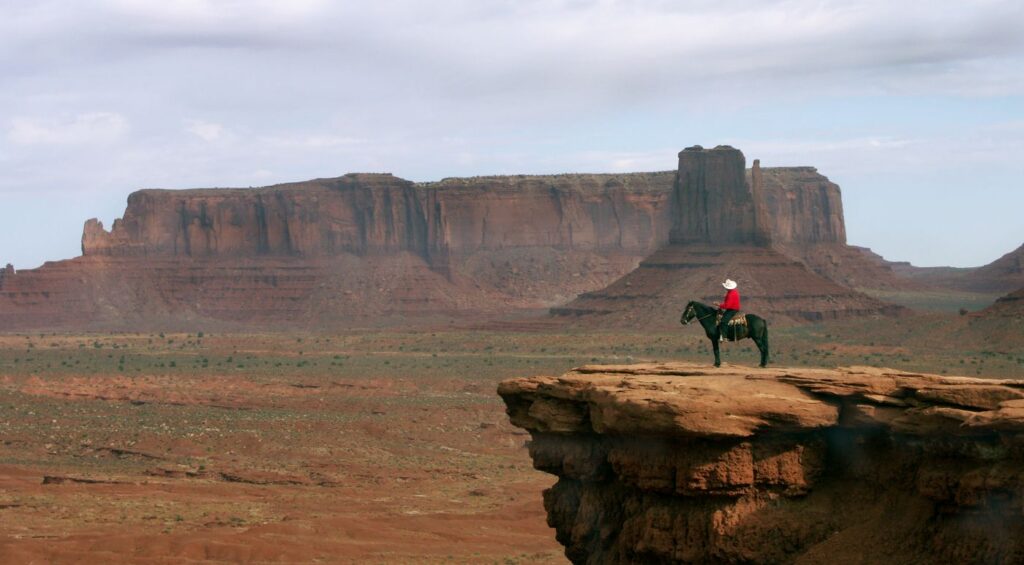
When Frederick Jackson Turner gave his paper in Chicago in the summer of 1893, he noted at the outset that the superintendent of the U.S. census had declared the American frontier “closed” as of 1890. There were still unsettled pockets of territory, and the “Indian lands” besides, but no longer was there a continuous “frontier line” marking an outer edge of American civilization. And no one beats the Americans in the swiftness with which they turn their past into legend. Just a few months after Turner’s lecture, in November 1893, Owen Wister published the first of several magazine stories that he would gather into his 1902 novel The Virginian. He is often credited with starting the entire genre of “the western,” soon taken up by Zane Grey, whose greatest success came in Riders of the Purple Sage (1912). Both novels would be filmed multiple times—notably with Joel McCrea as the Virginian in 1946, and George Montgomery as Grey’s gunman Lassiter in 1941. From Wister and Grey to Louis L’Amour, Larry McMurtry, and even Cormac McCarthy, the genre has featured cowboys and Indians, lawmen and outlaws, gamblers and saloonkeepers, ranchers and farmers. And the great vistas of the west—the cattle ranges on the plains, the sagebrush deserts, the mountains and canyons—are the vivid backdrop, a testing ground for both the endurance of the individual and the building of new communities.
For the Hollywood studios, the western was meat and drink from the beginning. Southern California supplied the terrain for location shoots, and the cowboy fiction of novels and magazine stories supplied the material, to which the industry’s screenwriters added their own original stories. The genre had everything that action-oriented cinema needs—heroes and villains, menacing “savages” in the native tribes, damsels in distress, the thrill of horses in motion, shootouts in the dusty main street, the satisfaction of swift justice done without the creaking wheels of the law. The culture of the western movie was like watching Hobbes’s “war of all against all” turn by fits and starts toward Locke’s social compact, where property claims are settled and the rule of law prevails. (Never mind that the native American participants in the wars of the West largely suffered the fate of Cooper’s Mohicans.)
By the early 1930s, the western genre had reached saturation levels in Hollywood, seeming so exhausted and hackneyed that it was largely relegated to the “B” pictures, the shorter features of no more than an hour or so in length that were shown before the “A” pictures with top billing. Westerns were now just the “oaters” or “horse operas” that critics ignored, though they gave actors, directors, and writers steady employment. It was the great director John Ford who revived the western as serious “A” picture material when he made Stagecoach in 1939, lifting the “B” picture cowboy actor John Wayne to the front rank of Hollywood stars overnight. Suddenly every big director and actor in Hollywood wanted to do westerns again, and the genre became a mainstay of the movies until another phase of exhaustion in the 1970s.
Now that pioneering spirit seems revived once more with the Artemis program for returning to the moon.
James Stewart’s 1950s westerns with Anthony Mann; the launch of Sam Peckinpah’s career with Ride the High Country; even the “spaghetti westerns” made in Europe by Sergio Leone that turned Clint Eastwood into a movie star (which are objectively terrible films but you can’t turn away once you start watching)—all these mined the mother lode until it was played out a second time. Yet every couple of generations the western is revived again. And there are whole slabs of American popular culture that are permanently inflected by the legends and looks of the western genre. There isn’t a particularly good reason, after all, why the country music industry located in the rolling green hills of central Tennessee should be peopled by performers in cowboy boots and hats, looking ready for a dusty cattle drive up the Chisholm Trail.
Recall, though, that Professor Turner spoke of typically American features of mind and character that owed something to the frontier experience. He nowhere uses the phrase “rugged individualism” but he means something like it. And in American cinema, the western hero who is the self-reliant loner, cutting corners with the law but with his own unimpeachable ethics, reappears as the film noir private detective—think of Sam Spade and Philip Marlowe, urban cowboys of the modern West if there ever were any.
Finally, think of how the can-do spirit of the American frontier was invoked in our political life explicitly by John F. Kennedy, who referred in his acceptance speech at the 1960 Democratic convention to a “New Frontier” confronting Americans. The concept was something of a hodgepodge, but from Kennedy’s passing reference to “uncharted areas of science and space” would come his administration’s ambitious pledge to put a man on the moon within the decade. Just another frontier for us Americans, no? And recall the voiceover of William Shatner over the opening credits of the original Star Trek series from that decade: “Space, the final frontier.” Wasn’t there always something of the cowboy in Captain James T. Kirk?
Now that pioneering spirit seems revived once more with the Artemis program for returning to the moon. As our country marks its 250th birthday, and as we look to colonize an extraterrestrial orb, the western-become-science fiction appears to be on the way to becoming fact. I wonder what Frederick Jackson Turner would make of it.