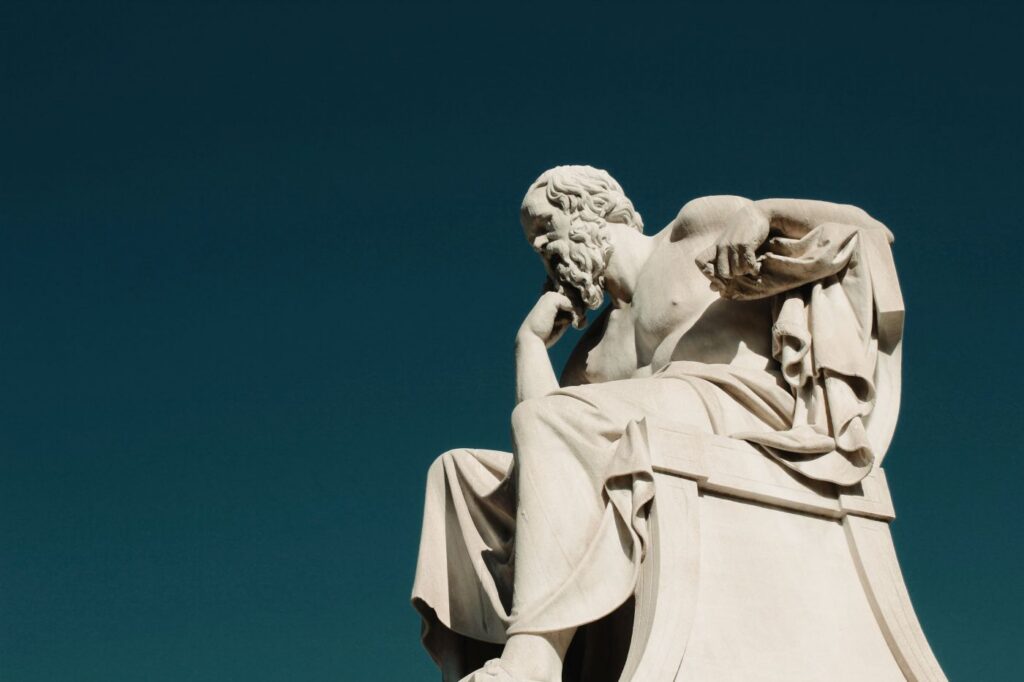
It would be an exaggeration to say that the origin of philosophy, or the love of wisdom, is identical to the origin of philology, the love of words. But the philosopher to whom the tradition of Western philosophy traces its origins, Socrates, was rather fond of catalyzing philosophical reflection by asking his often-perturbed interlocutors to define the precise meaning of words. His “method” was based on taking words that everyone thought they understood, like “justice,” “friendship,” or “the good,” and proving through cross-examination that despite their beliefs to the contrary, no one was quite sure what they meant.
In recent decades, many have committed themselves to the recovery and practice of classical education. It has until recently been a close-knit affair, but in the last half decade the growth and success of the movement has prompted those outside to ask those inside what, precisely, the thing is. Socrates’s method, his elenchus, was very good at demonstrating ignorance and producing aporia, the state of unknowing that is the necessary precondition for serious philosophical investigation. But it did not generally produce the sort of finality that the tradition assigned to the practice of “definition.” That task was left to Aristotle, who taught his students that to define and so to know a thing perfectly, one must first account for its genus and then for its species.
As a historian, I would be remiss to attempt to define what classical education ought to be. That is a task best left to philosophers. But I am on more solid ground in defining what it has been. And, in Aristotelian fashion, we must first know what “education” is before we can begin to understand what its “classical” form might be.
This task is harder than it might at first appear, since the English word “education” encompasses a far broader semantic range than equivalent and more specific words would in Greek, Latin, or German, the three languages and cultures that have done the most to define education and inspire educational programs in the West.
Aristotle generally has us start from those things that are most apparent and proceed to those most hidden. The species of this form of education, that is, that which appears to us first and helps us distinguish it, is “classical,” and this term is fairly easy to define. The “classics” are not the oldest examples of things but rather their best instantiated forms. They are the golden mean between the naïve and often clumsy grasping at forms that characterizes the archaic and the overly self-conscious and mannerist forms of the Baroque. Their exemplary character is tied to a regime of technical training whose goal is the moral and productive formation of practitioners. Their mastery of the canons and arts makes them capable of matching or exceeding, of emulating, the classics that they imitate.
Start your day with Public Discourse
Sign up and get our daily essays sent straight to your inbox.Defining the genus is a greater challenge. Let us begin to define “education” by examining what cultural practices went by that name in ancient Greek. Most readers will have heard or read the term “paideia” and think it means “education,” which it does and does not. Etymologically, paideia consists of the root paid, meaning “child” and the suffix eia, which indicates an abstract noun. The resulting form means “childrearing” in its broadest sense, which is why Plato and Plutarch consider paideia not only to encompass classroom instruction in formal subjects over an extended period during childhood, but also such matters as nutrition, eugenics, and courtship. The existence of a public interest in fostering and regulating the former has been uncontroversial for at least most of the last two hundred years, but the attempts of totalitarian states to imitate Plato’s Republic in their minute management of the latter have widely been regarded as moral outrages.
So, we think we have at least accounted for Greek, but we forget that our notion of ancient Greece (probably rightly) tends to equate “Greek” with “Athenian.” We must also account for the childrearing regime of Athens’s great rival, Sparta, which called its system agoge. This term derives from a root meaning “to drive” and is more often found in contexts referring to animal husbandry than childrearing. It would not be far wrong to state that the Spartans did in fact regard their offspring more as cattle than as children, seeking to ensure the survival of the fittest, the improvement of stock through selective breeding and the abandonment of the weak, and using the literal stimulus of cattle prods to drive their charges forward and out rather than rearing them upward by reaching, nurturing, and lifting.
We must first know what “education” is before we can begin to understand what its “classical” form might be.
The Spartan portion of the Greek legacy has suffered from a bit more than a half-century of oblivion, but it was central to the educational planners who designed and implemented the national systems of education of the late nineteenth and early twentieth centuries. Coupled with Lord Baden-Powell’s scouting movement, such systems prepared physically fit and patriotic recruits to fight in two world wars before the malaise and cynicism of the latter twentieth century made such mass projects seem dangerous, at least in Western democracies.
The peculiar genius of ancient Greece was to seek and find pure expressions of abstract ideals and then to exhaust successive cultural and political forms in the attempt to realize them. Their successors, the Romans, respected their achievements but were themselves masters of articulating stable, mixed forms that proved more enduring and resilient than the clear but brittle achievements of the Greeks. Like many Americans today, they considered most aspects of childrearing to be a family affair. Like us, too, they were largely willing to accept inequality of both starting position and outcome as the cost of liberty and conscience in those matters that belonged to the family. Their form of education, institutio, began at the “age of letters,” which they considered to be seven or eight, was widely available but not compulsory, and was, on the whole, ruthlessly meritocratic. It focused on the practice of oratory and the mastery of Latin, a language that, like standard American English, was always distinct from the vernacular.
With the exception of Julius Caesar, who tradition claimed was a descendent of Aeneas, nearly all of the Latin classical authors were not properly Roman. Due to his lack of Roman roots, Cicero was derided as a “novus homo,” an upstart provincial. Vergil, the prince of poets, and Livy, the greatest Roman historian, both hailed from Cisalpine Gaul. Seneca the philosopher and Lucan the poet were Spanish. The greatest of Christian Latinists, Augustine, was born in a small North African town as a native speaker of Punic who had to learn Latin at school.
As Rémi Brague reminds us, Rome developed an “eccentric culture” that made the amalgam of Hellenic and Jewish cultures possible in a medium of Roman legal and institutional life. This eccentric culture spread primarily by means of schooling, which existed as a private-public partnership stretching from York to Beirut. The Middle Ages and early modern period kept this system largely intact, and Christian monks and missionaries took it to lands on which Roman soldiers had never marched. By the early eighteenth century, schools using essentially the same curricula and practice could be found on every continent from Mexico City through Moscow to Manila.
The progress of enlightenment and the growth of national interests challenged this enduring form of education from the eighteenth century onward. The Prussians created the Urtyp of American public education through a dialogue between Bildung and Erziehung. The former is a loan translation of the Latin formatio and implies a process of bringing the raw material of potential humanity into conformity with a definite goal by means of a specifically calibrated system, both determined and funded by the state. The latter translates the Latin educatio and is a broader system of childrearing that functions as a public-private partnership.
The nineteenth century saw these two terms compete as models of education in the emergent German state as it traced a path between loose confederation and unitary nation. The energy and initiative lay mostly with Bildung, and its triumph was symbolized by the Weimar constitution’s prohibition on homeschooling, which endures today. Bildung achieved a pathological totality in the succeeding decade and subsumed Erziehung with disastrous results. In the sequel, transcendent ends have largely been abandoned as the state no longer seeks to build a nation but rather to train workers and increase its tax base.
After the American Civil War, progressive Americans went to Germany and often to Prussia to earn the then-new doctoral degree and learn from the Prussians how to forge a unified and useful national identity in the midst of overwhelming diversity. They imported an early form of this system in the last quarter of the nineteenth century, calling it “education,” a term not much used in English before 1750 and then explosively from their time onward. They granted posterity a schizophrenic dual system of education, one traditional, liberal, private, and religiously affiliated, and the other progressive, technical, public, and secular. Recent experience indicates that this uneasy marriage of Erziehung and Bildung is breaking down and many are embracing school choice.
It is exceedingly difficult to predict which word or combination of words will be most commensurate with the system or systems of education that emerge from the ongoing project of redefinition, but if I have not provided an answer to what the ideal form ought to be, I hope to have at least provided a guide to how we might accurately describe these ideals as we seek to actualize them.