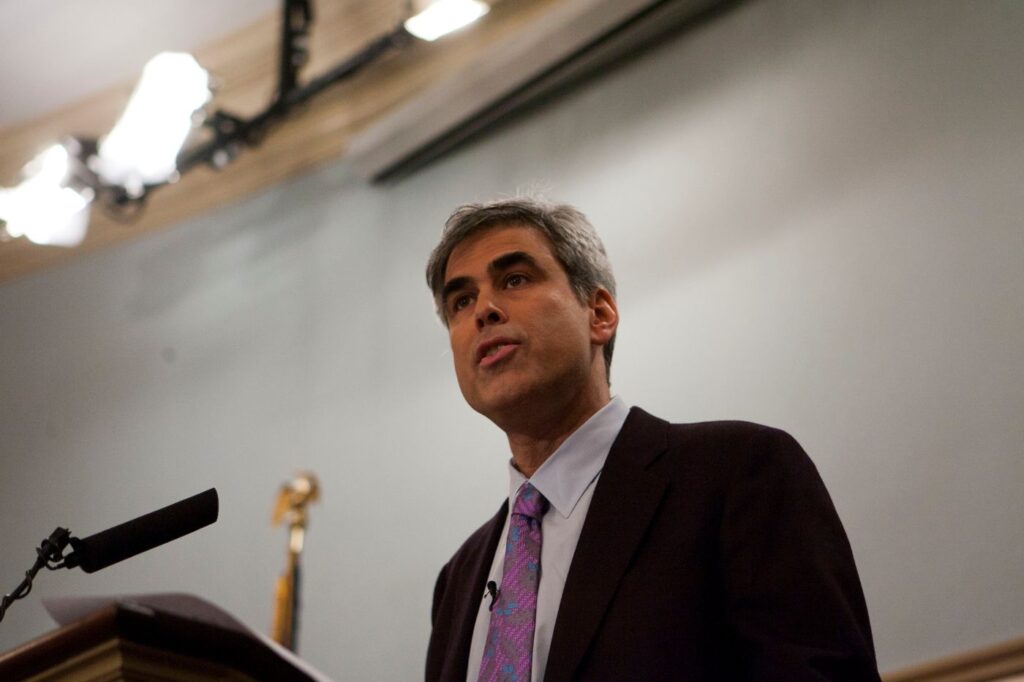
For several years I’ve worked in public health to address our country’s growing youth mental health crisis, and much of this work has been done in partnership with a local public school district. Back in the summer of 2024, the topic of Jonathan Haidt’s book The Anxious Generation was brought up during a regular meeting with school leadership, and it generated considerable discussion.
Up to that point, our conversations were primarily focused on expanding access to therapists in the school or mental health–related educational programing. Our discussion of Haidt’s book significantly shifted our course. The primary cause of our youth mental health epidemic, argues Haidt, is not a lack of access to professional therapists or an economic downturn, but rather, in a word, a stolen childhood—whether through the decline of “free play” (especially throughout the 1990s–2000s) or addiction to social media and the toxic environment therein (especially throughout the 2010s). As his argument goes, the two actually go hand in hand.
When it was published in 2024, The Anxious Generation struck a chord with parents, educational leaders, and all those across the country who were concerned about the mental health of our youngest generations. The story that Haidt tells is well written, well researched, and witty. And Haidt is, no doubt about it, an excellent speaker. I agree with basically everything he says or writes, and he has crafted an excellent narrative to think through this topic. He has even come up with a handy set of practical suggestions to “end the phone based childhood”—no smartphones before high school, no social media before age sixteen, phone‐free schools, and more independence, free play, and responsibility in the real world. His advocacy on this topic even led to appearances before the Senate Judiciary Committee.
Since becoming more involved with the “phone free movement”—a revolt against all things digital tech by Mama Bears across the country—I have found that Haidt’s brand is coveted. His organization has produced innumerable resources on this topic, and I can imagine he gives presentations on the theme a dozen times every week. He is largely responsible for the wave of “phone-free school” legislation that started sweeping the country in 2023. Advocates are desperate for him to speak to their legislators, their school boards, and probably, if they could, their own kids. “Finally,” I can imagine mothers of sixth graders everywhere saying, “someone is telling the story of what we’ve been suffering from every day.” Within the movement, having a member from Haidt’s team support the “cause” of your group is considered the gold standard to legitimize your efforts. He has become an “icon in the parenting world.”
And yet, what I would like to say to members of the Senate Judiciary Committee, school boards across the country, and parents of middle-schoolers everywhere, is that we do not need Jonathan Haidt to tell us how to get our kids out of the machine.
Start your day with Public Discourse
Sign up and get our daily essays sent straight to your inbox.I know this from firsthand experience. In response to the original discussion about The Anxious Generation, I offered to conduct a short presentation on the major themes of the book. The presentation was received well, and one member of the collaborative, the superintendent of one of the representative school districts, asked me to give a similar presentation to members of his school leadership and parent advisory groups.
When speaking with parents about the potential negative effects of social media on youth mental health, it would have been easy to present them with all the same graphs and social scientific studies Haidt shared. For instance, it would be easy to tell them that, on average, more than three hours a day on social media is statistically associated with a higher likelihood of depression among adolescents. This has been empirically demonstrated as more common for girls than boys, and for time spent on platforms such as TikTok (passive reception of videos) as opposed to Reddit (active engagement with words). The former Surgeon General’s advisory on the topic, another touchstone in the movement, is full of such evidence from the social sciences.
And yet herein lies immense irony. The highly technical collection and sharing of this evidence is predicated on the basic assumption that individual parents are otherwise ill-equipped to discern when their child’s engagement on social media has made them depressed (including the factors—age, sex, content—that make them most depressed). At the most extreme, studies that produce the “three hours” statistic presume parents don’t know their children at all and, further, that they must make decisions for their children based on the outcome of some statistical analysis based on data from kids that, paradoxically, are also unknown to them.
As I have experienced it, when one talks to actual parents, most (perhaps all) know that their child—this child, the one in front of their eyes daily, the one that they have intimately observed since their birth—is addicted to social media, and that it is bad for their mental health (among other parts of their life). Because it is their child, they know what their behavior and mood were like before they signed up for TikTok, and they can see firsthand the changes to their behavior and mood afterwards. There is no need for statistical controls or sophisticated computational models to help them discern this difference. Jonathan Haidt and company, while helpful, are not required. What is required, rather, is the courage and patience to look.
Further, from all the focus groups I’ve participated in, discussions about why this is happening to their child and what to do about it are best done with other parents going through the same experiences, as opposed to fully delegating this work to a remote social scientist who has no direct connection with the families reading his work. When these parents I’ve spoken with were allowed to openly discuss what social media were doing to their kids, the basic situation was quickly discerned, and some practical, ground-up solutions were often identified. No “evidence-based recommendations” are needed. Further, the kinds of solutions identified are rarely limited to mere “risk management practices,” (e.g., cut off TikTok after three hours) but tended toward environmental reform—the kinds of practices, policies, and cultural habits that can be changed to reduce the risk of this harm for those vulnerable to otherwise inhabiting a world constantly subjected to it (e.g., several neighborhood groups are bringing back landlines). The best part of any presentation I’ve given was when my presentation on “the evidence” stopped, and discussion between parents and teachers—the messy work of politics—began. I’ve seen it happen many times.
The “problem,” of course, is not Jonathan Haidt, or any individual well-meaning public health scientist. I think Haidt, the former Surgeon General, and every other representative of the scientific establishment who has advocated for a tech-minimal childhood, deserve recognition. They are using their platform to advance a cause I strongly believe in.
And yet there is a deeper problem with our dependence on their involvement that often goes unaddressed (perhaps because they have been helpful in this movement). As my example suggests, the overwhelming influence of Haidt and company reveals the great difficulty people can have with opening their eyes to the world right in front of them without some highly technical apparatus—e.g., a social scientist, or the findings from some empirical study—telling them what they see.
A dependence on the kind of technical expertise that Haidt represents is admittedly tempting; it provides a kind of shortcut to bypass personal judgment, and one that our culture broadly celebrates and endorses. It is far easier to delegate one’s opinions to “this study” or “that expert,” as opposed to doing the work to discern whether either is necessary. This is especially the case for public leaders who are often desperate to base their decision on anything that is not their personal judgment of the situation, lest they appear “subjective” or “unscientific” (all the while abandoning, in principle, why they were elected).
And yet, without the involvement of a technical apparatus, regular people of goodwill are often encouraged to better understand the reality of the situation right in front of them, trust their judgments about what they see, and join with others seeking to do the same. This pattern should form the bedrock of our civic involvement.
I have read much of what those at the Anxious Generation (and similar advocacy organizations) have developed, and, it is safe to say, none of it requires a PhD or university position to design. To recognize signs of anxiety and depression among your kids following their uptake of social media, video games, or engagement with the digital world more broadly, should be a basic practice for parents. Further, to join with others who recognize the same and subsequently come up with some strategies to address the problem should also be basic practice for members of a community who wish to work toward their common good. “Basic” does not mean “easy,” but it does mean that we should be able to expect this of the “average” parent and citizen. To presume that the presentations and “resources” produced by Haidt and others are necessary is to implicitly diminish this responsibility. The delegation of these basic human capacities to “expert judgment” might be understandable for situations that are technically complicated (is my water contaminated with PFAS to the point that it’s not safe to drink?), but it is absurd to think it is necessary for assessing the well-being of one’s own children when they’re absorbed in their devices for seven hours a day. The difference between these two instances is the difference between the appropriate use of technical expertise within a narrow scope of practical necessity, and the encroachment of expertise beyond this limit.
What we all want is not merely a world in which we are not addicted to our digital appendages, but rather, one that is thoroughly human.
As critiques of technology constantly remind us, one of the core vices of a technocratic society is its tendency—whether by force or choice, often a bit of both—to delegate every aspect of life (education, cooking, cleaning, entertainment, and ultimately, parenting) to some technical apparatus. “The disease of the modern character is specialization,” Wendell Berry writes, and yet “a system of specialization requires the abdication to specialists of various competences and responsibilities that were once personal and universal.” The historian Christopher Lasch, for his part, was especially critical of the “helping professions” (e.g., social work, psychology, and counseling) that tended to disempower people by a “transferral of functions,” whereby responsibility for personal well-being is shifted away from themselves and their communities (especially the family) into the hands of professionals. These are clearly the conditions that give rise to Haidt’s overwhelming success.
Thus, a posture that tends to look for guidance from the heights of the scientific establishment (a technical apparatus par excellence) is not unrelated to a posture that is tempted to delegate other human capacities to other technical apparatuses—e.g., smartphones. It is, at base, the same attraction to the machine, and therefore calls for the same kind of limits.
I’m optimistic that advocates of the phone-free movement would resonate with the spirit of this critique. What we all want is not merely a world in which we are not addicted to our digital appendages, but rather, one that is thoroughly human—that is, one that depends on and reinforces the strengths of real human community, including the strength of parent-child relationships at the core of it all. Every time parents sit down to patiently observe how the digital environment is affecting the health of their child and sufficiently trust what they see to make a decision about how to improve that environment, a more human world has been built.
This is the conclusion, I would hope, that Haidt himself would embrace.
Image licensed via Wikimedia Commons. Image resized.