Editors’ note: This essay is adapted from a lecture given at St. Gregory the Great Catholic Church in Hamilton Square, New Jersey, on May 19, 2026.
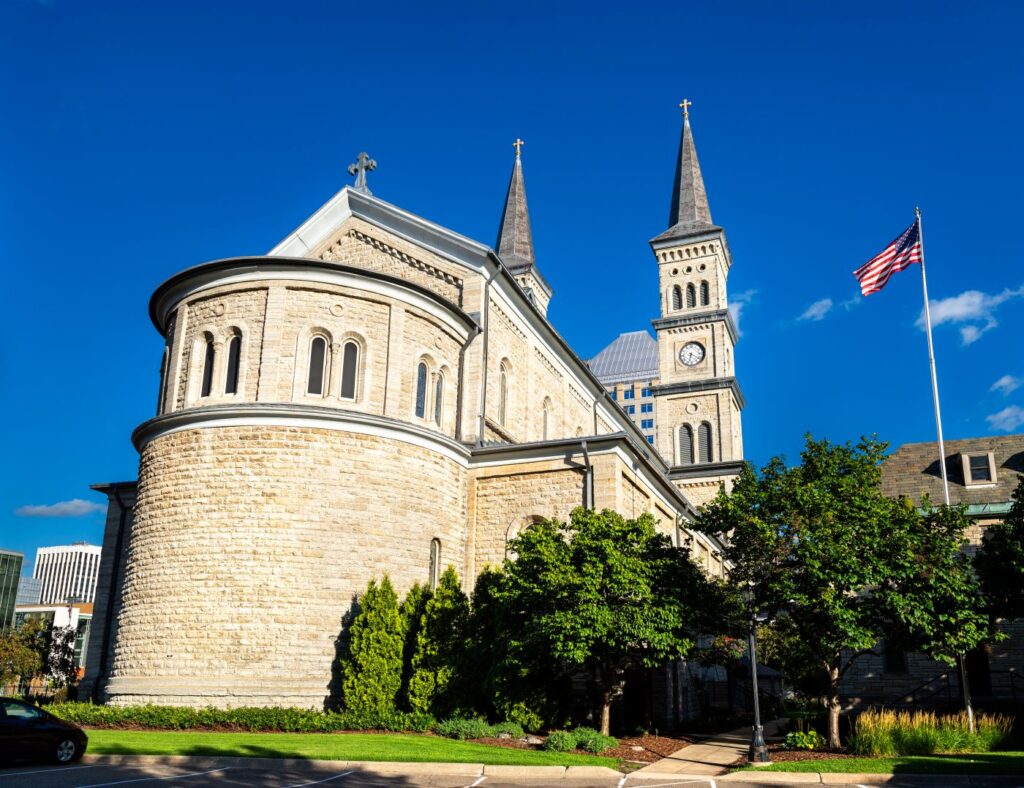
At every meeting of our Knights of Columbus council here at St. Gregory the Great, we open with two ceremonial recitations—first a prayer, then the Pledge of Allegiance to the American flag. From their beginnings, the Knights have been both a Catholic and a patriotic fraternal order; the choice of Columbus’s name was a deliberate one, intended to honor the Catholic discoverer of the Americas and to signal to our fellow citizens—who likewise honored Columbus—that we Catholics were no less American than they are. In 1882, when the Knights were founded, the problem of anti-Catholic prejudice on the part of the Protestant majority was a very real one, and Knights of Columbus was a reply to that—one part historical pleading, one part proud defiance.
But in 2026, my title may seem strange. Is there anyone who thinks Catholics shouldn’t celebrate the 250th anniversary of our country’s founding in 1776? Anyone, that is, who believes that the Catholic faith and American patriotism are incompatible with each other?
There are such people, on the left and the right. On the left there are secularists and progressives who lean heavily on a reading of America’s founding principles as Enlightenment ideas, products of the Age of Reason. For them the emblematic figure of the American founding has always been Thomas Jefferson—or at least he was the emblematic figure until his reputation was tarnished by the charge that he had fathered children by one of his slaves, Sally Hemings (who was herself the half-sister of Jefferson’s late wife, Martha—they having a father in common who did the very thing most historians now think Jefferson did too). Our view of Jefferson is very mixed now, compared to a half century ago. Yet if his ideas can be separated from his alleged deeds, those ideas remain at the heart of the secular Enlightenment reading of our founding.
That reading is simply this: that America’s novus ordo seclorum—new order of the ages—had “burst the chains of monkish ignorance,” in Jefferson’s colorful expression. Church and state were to have a “wall of separation” between them (Jefferson again). Human reason, not ancient dogmas, was to govern human affairs. Everyone’s conscience would be free, to pursue happiness as each sees fit, by the pure light of reason. In 1822, Jefferson wrote in a letter that “I trust that there is not a young man now living in the U.S. who will not die an Unitarian”—that is, as a fully deistic rationalist, shedding the trappings of the Trinity, and miracles, and sacraments.
Start your day with Public Discourse
Sign up and get our daily essays sent straight to your inbox.This prediction, needless to say, did not come to pass. Yet in the two centuries since Jefferson wrote those words, the secularist left has continued to believe that progress means the death of biblical religion—and that this is the true working-out of the Enlightenment for which Jefferson spoke, and that they see embedded in our founding.
On the right, a strange mirror image emerges. Here we find critics and adversaries of Enlightenment thought, including Catholic ones, who take essentially the same view of a fundamental opposition between Christian faith and Enlightenment liberalism, but take the side of Christianity against the American founding. One prominent example would be Notre Dame political science professor Patrick Deneen, who describes the principles that undergird the American founding as a “war against nature,” a rejection of everything that ancient philosophy and the Church had taught Western man about virtue and the purposes of political life. For Deneen, every particle of the decadence that afflicts us today—the radical individualism, the degeneration of liberty into license, the soulless consumerism, the authoritarian state that tramples true virtue and religion underfoot—all of that is traceable to the choices of the American founders in adopting the political doctrines that came to be known as liberalism.
From this point of view, the 250th anniversary of the Declaration of Independence is an occasion for mourning, not for celebration. One may say that if both the secularists of the left and the traditionalists of the right are correct about the conflict between the American founding’s Enlightenment liberalism and the teachings of the Christian faith, at least the traditionalists are choosing the right alternative in that opposition.
But they are both wrong. There is no fundamental incompatibility; the founders of our country (Jefferson’s idiosyncrasies notwithstanding) saw none; and they were correct—neither should we. What then is a better reading of our founding, especially of the Declaration of Independence whose quarter-millennium birthday we celebrate this year?
The Declaration was a group product, a statement of the Continental Congress, whose members included Anglicans, Unitarians, Quakers, Baptists, Presbyterians (including the lone ordained minister, John Witherspoon of Princeton), and one Catholic, Charles Carroll of Maryland. The document drafted by Jefferson and revised by the Congress referred to God four times: 1) in the opening paragraph’s reference to “the Laws of Nature and of Nature’s God”; 2) in the core statement of the Revolution’s principles, which said human beings are “endowed by their Creator with certain unalienable Rights”; 3) in an appeal near the end to “the supreme Judge of the World” to recognize the justice of the Revolution; and 4) in a closing pledge that declared the signers’ “firm reliance on the Protection of Divine Providence.”
Thus we have God as lawgiver, as creator of the world and of the human race, as judge of our actions, and as protector of those with justice on their side. This is an active God, not a mere watchmaker who wound up the world and let it go. This is the God who reveals himself in scripture; where else would people learn of these attributes?
And I mention only now the wellspring principle from which everything else flows in the Declaration, the first of the truths held to be self-evident (even before we are told of our endowment with unalienable rights): “that all men are created equal.” There’s that creator God, implied already. More importantly, the equal dignity of all human beings, as creatures of one creator, is the foundation of all our political principles. America, and the West in general, owe this idea to the Church—that man is imago Dei, made in the image of God: “male and female he created them.”
For all the wisdom and virtue we might derive from the classical inheritance of ancient Greek and Roman philosophy, there is nothing like this teaching of equal human dignity until the truths about the human person, taught first to the Jews by the God of Abraham and Moses, are universalized with the Incarnation and carried by the apostles, in the Great Commission, to the gentiles as well. To compress two millennia of civilization to a few words: No Christianity? Then no dignity for women, or for children, or for the unborn. No sacramental character to lifelong marriage. No abolition of slavery; no moral crusade against racial bigotry. No universal human rights transcending race and culture.
And certainly no American Revolution. No liberalism, in the classical meaning of that term referring to the principles of a free society: a state limited in power, governing in justice and representing the people, honoring the conscience, making a free space in society for the voluntary actions of individuals and families in their churches, their economic enterprises, their creativity and education in propagating ideas.
The liberalism of the American founding is not simply the working out of one great thinker’s ideas—say, of the Englishman John Locke, for all his undeniable influence. It is rather an amalgam, a compound of modern political theories (of Locke, of Algernon Sidney, of Montesquieu); of the English common law inheritance (the government of laws, not of men, as taught by Coke and Blackstone); of lessons from ancient republicanism (the histories of Greece and Rome, the philosophies of Aristotle and Cicero); and, unquestionably, of ancient Christian teachings: the imago Dei, the Golden Rule, the Ten Commandments, the love of neighbor, the Sermon on the Mount, the parables of the prodigal son and the good Samaritan, the distinction between the things of God and the things of Caesar. As more than one scholar has shown, the most frequently cited work by far, in political writings in the period of the Revolution and the founding, was the Bible.
To this, a gimlet-eyed Catholic might reply: Yes, fine, but isn’t the Christian element in the American founding distinctively Protestant, and weren’t the Protestants of that day distinctively anti-Catholic?
My answer to that is that yes, the Christianity of the American founding is Protestant, predominantly so; but no, that founding is not in principle anti-Catholic. Here we must distinguish between principles and prejudices. Catholics in America have often been on the receiving end of bigotry—an ugly streak of American nativism that crested in the nineteenth century when waves of Catholic immigrants arrived on these shores, first the Irish and Germans before the Civil War, then the Italians, Poles, Slovaks and others afterward.
But our best response to prejudice from our Protestant fellow citizens who wanted to claim “Americanism” for themselves has never been to respond in kind, or to shelter in Catholic ghettos and feel excluded. It has been to claim our rightful place in the community, on principle. We have reminded our fellow Americans that there is nothing in our country’s founding principles that a Catholic cannot affirm, as much as any other Christian. Abraham Lincoln knew this well, abhorring anti-Catholic and anti-immigrant sentiment, and saying that immigrants who attached themselves to the principles of the Declaration of Independence were “blood of the blood, and flesh of the flesh of the men who wrote” it.
It is also important to remind ourselves that Catholics were not latecomers to the American party, but were there at the beginning. While Catholics became a significant proportion of the U.S. population only in the second quarter of the nineteenth century, and took until 1900 to become the single largest church in America, “we” were here, in small numbers but with disproportionate influence, from early colonial days.
I’m referring to the Maryland colony. Created by a charter granted to the Catholic nobleman George Calvert, Lord Baltimore in 1632—and subsequently to his son Cecilius Calvert, the first “proprietor”—the colony was not in fact named for the Virgin Mary, but for Queen Henrietta Maria, the French Catholic wife of King Charles I. Just as the Massachusetts Bay colony was a Puritan refuge, Maryland became a refuge of sorts for English Catholics in the seventeenth century, and was a mission field for the Jesuits. Though Catholics were never a majority in the colony, they nonetheless substantially controlled the politics of Maryland for several decades, due to the authority of the Calverts as proprietors and governors, and to the power of the great landowners seated in the colonial assembly, who were overwhelmingly wealthy Catholics.
The Catholics of Maryland held power until what English history calls the Glorious Revolution of 1688–89, an almost bloodless coup that swept the Catholic King James II from the throne and replaced him with his Protestant daughter Mary and her Dutch husband William. To abbreviate the impact of that event in Maryland: the colony’s original charter was not long afterward suspended, in 1692 a new Protestant majority in the Maryland assembly effectively made the Church of England the established church, and in 1704 the public celebration of the Catholic Mass was forbidden. During these years, Catholics were barred from public office, the practice of law, and militia service. They were disadvantaged in these and other ways until the American Revolution. They were not hunted as fugitives from the law, but they went from favored elite to beleaguered minority, and were barred from officially serving the colony they’d founded.
But I have skipped over a signal event that occurred during the Catholic heyday of the mid-seventeenth century. The Maryland colony was the first community in America to enact a law protecting freedom of conscience for every sect of Christianity. The demographics of the colony made this at least prudent—Catholic elite governing Protestant majority—and there were features of the law that we would say violated the freedom of speech. People could be fined for saying insulting things about other Christians’ churches! But the 1649 Act Concerning Religion, as it was called, nevertheless laid down a very American marker for genuine religious freedom that was the first of its kind, and far in advance of anything similar in Great Britain.
After the Protestant takeover of Maryland at the turn of the eighteenth century, Protestant–Catholic relations blew hot and cold over the decades prior to the Revolution. For the most part Catholics kept the faith under trying conditions, though a few became Anglicans under duress. Events both in and beyond the American colonies had an impact on the lives of Maryland Catholics and their status with their Protestant neighbors—such as the 1745 Jacobite Rising in Scotland that attempted to put a Catholic Stuart back on the British throne; the French and Indian War (1754–63), pitting Britain and her colonies against a Catholic power; and the Quebec Act of 1774, by which Britain tolerated Catholicism in the French-Canadian province it had won in that war. (This even merited an oblique mention in the Declaration of Independence’s complaints against the Crown.)
But as Maura Jane Farrelly concludes in her book Papist Patriots (from which I have taken the foregoing history of Maryland), when the revolutionary crisis came in the 1770s, “Maryland’s Catholics were the colonists most prepared to accept the cultural and psychological implications of independence from England.” Whether in or out of power in the colony they had founded, she argues, the Catholic community had been “self-consciously defining itself for several generations” as distinctively American—suspicious of the British government, opposed to its established church, dedicated to liberty, and especially attached to religious freedom. And the fervor of the Revolution was incompatible with religious rivalry and prejudice. In a revealing sign of progress, the first governor of Maryland under its new, post-independence state constitution—a constitution that restored the religious freedom first enacted in 1649—was a Catholic convert, Thomas Sim Lee.
In the period of the Revolution and the founding, by far the leading Catholic family in Maryland was the Carrolls, originally hailing from Ireland, not England. John Carroll, trained in Europe to be a Jesuit priest, became the first bishop in the new United States (and founded Georgetown University as well). John’s cousin Charles Carroll, probably the wealthiest man in America at the time, signed the Declaration of Independence on behalf of Maryland, and John’s elder brother Daniel Carroll signed the Constitution. Charles, who was later one of Maryland’s first senators, died in 1832 at age 95 as the last surviving signer of the Declaration. Daniel, who was one of the state’s first members of the House of Representatives, was also one of the first commissioners of the District of Columbia, responsible for supervising the design of the nation’s capital.
All three of these Carrolls were on good terms with fellow patriots from other states, including George Washington. In fact, Washington, not one of the era’s greatest thinkers but certainly its greatest statesman, is a bellwether of sorts: watch his behavior and you see a model of the emerging American character. As early as 1774, when serving as a delegate to the First Continental Congress, Washington attended a Catholic Mass in Philadelphia; he did so again during the Constitutional Convention in 1787. While commanding the Continental Army during the Revolution, desiring to draw sympathizers to the American cause among the French Catholics of Canada, Washington in 1775 banned the celebration among the troops of Guy Fawkes Day, an anti-Catholic British holiday (November 5) commemorating the foiled attempt by a handful of English Catholics to blow up the Parliament during a state appearance of King James I in 1605. Also, in March 1780, upon hearing news of resistance to British authority in Ireland, General Washington gave the troops a holiday for St. Patrick’s Day celebrations. And lest we forget, Catholic France came to the aid of the American Revolution; Washington would never forget how indispensable France’s army and navy were to winning our independence.
Many Americans know of George Washington’s famous letter as the new president to the Jewish congregation of Newport, Rhode Island. (All my Jewish friends know it well.) In this public letter of August 1790, Washington tells his readers that America is not a land of mere “toleration,” where some people’s religious faith is practiced at the “indulgence” of others. It is a land where “liberty of conscience” is enjoyed by all, as one of their “inherent natural rights.”
This was not the only such letter by the first president. Many of the leaders of America’s minority religions had written congratulatory open letters to Washington when he became president—the Jews, the Baptists, and also the Catholics. John Carroll, now the country’s first bishop, was joined by fellow priests and Catholic laymen in addressing such a letter to Washington, and the president replied to them too, in March 1790. Here is some of his closing:
As mankind become more liberal they will be more apt to allow, that all those who conduct themselves as worthy members of the Community are equally entitled to the protection of civil Government. I hope ever to see America among the foremost nations in examples of justice and liberality. And I presume that your fellow-citizens will not forget the patriotic part which you took in the accomplishment of their Revolution, and the establishment of their Government: or the important assistance which they received from a nation in which the Roman Catholic faith is professed.
… And may the members of your Society in America, animated alone by the pure spirit of Christianity, and still conducting themselves as the faithful subjects of our free Government, enjoy every temporal and spiritual felicity.
In such accents as these, we see the unself-conscious belief on the part of our founders that what the visiting Frenchman Alexis de Tocqueville would later call “the spirit of liberty” and “the spirit of religion” were not just fully compatible but mutually reinforcing, and indispensable to one another. “Despotism can do without faith,” Tocqueville wrote, “but freedom cannot.” Precisely because a free society relies less on compulsion, permitting each person to chart his own course in life, religious faith is vitally important: where “the political bond is relaxed,” the “moral bond” must be “tightened.”
Tocqueville, himself a faithful Catholic, observed that his fellow Catholics in America were “the most republican and democratic class there is in the United States.” Catholicism, in his view, was favorable to democracy because its dogmas inclined people to see one another as equals. And in the American situation—in the 1830s when he was here and immigration was on the rise— Catholics were mostly poor and still a minority, and so they were naturally drawn “to carry the idea of equality of conditions into the political world.”
What Tocqueville was observing a half century after our founding, in the contrast between America and his native France, returns us to an earlier point I made that can be more fully developed now: the Enlightenment was not a single thing, but multiple things, branches of modernity that took very different forms. The historian Gertrude Himmelfarb wrote that there were really three Enlightenments: the British, the French, and the American. The French was the most radical—in its egalitarianism, in its radical rejection of religion in the name of reason, and in its centralization of power in the state. The British was more conservative, dedicated to reforms that preserved the “social virtues.” And the American Enlightenment was the most dedicated to liberty, and at the same time the most religious of the three. Catholicism was not outside the frame of this picture, but squarely inside it. Notre Dame theologian Ulrich Lehner has written of The Catholic Enlightenment, bringing to light forgotten currents of European thought in which Catholics argued for freedom, progress, and self-government.
Fast forward now to the middle of the twentieth century. In the aftermath of the Second World War and the Holocaust, the United Nations adopted the Universal Declaration of Human Rights. The committee that produced it included two notable Catholics: the Lebanese academic Charles Malik and the French philosopher Jacques Maritain. And the resulting document, which speaks of equality, freedom, reason, and conscience, would have been impossible to conceive without the framework of Catholic ideas of natural law, subsidiarity, and solidarity.
Freedom and faith are interdependent; each supports the other, and each is harmed in the other’s absence.
But it’s also a very American document, whose model is obviously our Declaration of Independence—though it goes well beyond that model in its catalogue of human rights. Perhaps inspired by these Catholic-inflected developments in world affairs, the American Jesuit priest John Courtney Murray published a book in 1960 whose title comes from the Declaration of Independence: We Hold These Truths: Catholic Reflections on the American Proposition. Murray argued that the American creed, and the political order based on it, were fully consistent with Catholic natural law teaching. Paraphrasing Pope Pius XII, he wrote: “government is not a judge of religious truth; parliaments are not to play the theologian.” Just a few years later, Fr. Murray would play a leading role in drafting Dignitatis humanae, the Second Vatican Council’s Declaration on Religious Freedom.
Here things get rather interesting. Fr. Murray, as a student of the American founding, was aware of a famous document—he cites it in his book—written by James Madison in the 1785 struggle in Virginia over religious freedom. Titled Memorial and Remonstrance Against Religious Assessments, this pamphlet by Madison was a protest against a proposed law to use state funds to pay clergymen. Typical of Madison, he went all the way down to first principles to make his case, beginning with the argument that every person’s religion must be “left to the conviction and conscience” of that person. This he called an “unalienable right,” something inseparable from our being. Why? “[B]ecause the opinions of men, depending only on the evidence contemplated by their own minds[,] cannot follow the dictates of other men.” And our right to religious freedom springs from our “duty towards the Creator.”
Now listen for the echoes of Madison, 180 years later at Vatican II in Dignitatis humanae: “men should act on their own judgment, enjoying and making use of a responsible freedom, not driven by coercion but motivated by a sense of duty. … [I]t is upon the human conscience that these obligations fall and exert their binding force. The truth cannot impose itself except by virtue of its own truth, as it makes its entrance into the mind at once quietly and with power.” Madison and the Council Fathers are both saying, in other words, that strictly speaking, coercion cannot generate authentic religious faith; the body may be compelled to bend, but the mind cannot be compelled to believe.
James Madison was not, from all we know, a devout man. He was not as disdainful of traditional faith as his friend Thomas Jefferson. Although he had studied theology at Princeton under its Calvinist president John Witherspoon, staying for an extra year after earning his degree, as Princeton’s first “graduate student,” at best he was a casual Anglican. But here in 1785, in an argument that would be woven into Catholic doctrine almost two centuries later, he is making a case for religious freedom that is unmistakably Christian in origin.
The great historian of Christianity Robert Louis Wilken, in his book Liberty in the Things of God: The Christian Origins of Religious Freedom, traces the Enlightenment doctrines of religious freedom not to secular modern philosophers who wanted to make men indifferent to faith—to tear down religion in general and Christianity in particular—but to ancient Christian teachers and Church Fathers like Tertullian and Lactantius. The works of these early Christians were known to thinkers like John Locke and statesmen like Jefferson and Madison. And Tertullian and Lactantius were not anomalous figures when they argued that “it is not part of religion to coerce religious practice” (Tertullian) and “religion cannot be imposed by force” (Lactantius). They were echoing Peter and the apostles in Acts 5:29, when replying to the high priests who commanded them to cease their preaching: “We must obey God rather than men.” The apostles were of course following the example of their Master, who said (Mark 12:17), “Render unto Caesar the things that are Caesar’s, and to God the things that are God’s.”
From the Gospel, to Acts, to the Church Fathers, to the doctrine of the two swords and the freedom of the Church, to the recognition in modern times of the freedom of conscience as an unalienable right at the foundation of a free society: the very ideas of human equality, freedom, and limited government would never have borne the fruit we see in American society without the Christian—and Catholic—intellectual tradition supplying the argument. It was a natural development of Catholic doctrine to place religious liberty explicitly in the Church’s political and social teaching six decades ago—and an American priest who had studied our founding was one of those to get it done.
Freedom and faith are interdependent; each supports the other, and each is harmed in the other’s absence. Bishop John Carroll knew this, as did his brother Daniel who signed the Constitution, and his cousin Charles who signed the Declaration. America’s bishops today, I’m happy to say, appear to know it too. The USCCB is all in on celebrating the semiquincentennial, with a website of essays and reflections titled with that familiar American phrase, We Hold These Truths. Like the Carrolls of the eighteenth century, like Fr. Michael McGivney who founded the Knights of Columbus, our bishops know that no one has better cause than America’s Catholics to say again, “We hold these Truths to be self-evident, that all Men are created equal, that they are endowed by their Creator with certain unalienable Rights, that among these are Life, Liberty, and the Pursuit of Happiness.”