It is commonplace in the academy, particularly in the humanistic disciplines where interpretations of the past are the academic’s meat and drink, that schools of thought arise around the teaching and legacy of influential scholars, carried on by their books and their students. It is efficient but unfortunate that academic programs dominated by particular schools of thought often pay little if any attention to rival schools. Today, for instance, there are many politics departments where political theory is dominated by followers of John Rawls, and the “Rawlsian” perspective is practically all that one learns. I, on the other hand, encountered the work of Leo Strauss and his students as a college freshman, and went on to study with others in that school as a graduate student. The “Straussians” equipped me and my classmates for scholarship and teaching in the field, and paid no attention to the thought of Rawls. (Not quite true: some of them did so, with what appeared to be decisive critiques).
Another school of thought, with which my classmates and I had little contact during our education, was the one led and inspired by Eric Voegelin, a German political theorist born in 1901 who spent most of his life in Austria until the Anschluss of 1938 that annexed that country to Nazi Germany. Voegelin, like Strauss and many other dissident scholars (but unlike Strauss a Christian, not a Jew), made his way to the United States, where he taught chiefly at Louisiana State University. He spent the 1960s back in Germany, teaching in Munich, but then returned to the U.S. and spent his final years at the Hoover Institution; he died in 1985.
I said above that we Straussians-in-training had little contact with Voegelin’s thought, not none. What we did learn about him was couched respectfully (unlike, say, what we learned about Rawls). For Strauss and Voegelin were for some time friendly correspondents, commenting on one another’s work and that of their contemporaries (what they had to say about Karl Popper was not, um, complimentary). They did not ultimately see eye to eye, but their perspectives on the modern predicament were distinctly simpatico. Over the years, therefore, I collected about a dozen of Voegelin’s books, including his magnum opus, the five-volume Order and History. Yet delving seriously into his work always remained on my “I’ll get around to it someday” agenda. Recently I decided it was time to give him a closer look, starting with two of his shortest, most accessible books.
It is Voegelin who gives me my title, “Don’t immanentize the eschaton!” Rendered thus as a slogan, this was something of a catchphrase among young conservatives decades ago—at once a mockery of sloganeering and a kind of recognition sign among cognoscenti, for the very abstruseness of the expression rendered it impenetrable to the uninitiated. It appears to have been coined, tongue in cheek, by William F. Buckley, Jr. (at least it appears in a 1966 book of his). Buckley, the impish impresario of American conservatism, seemed to know everyone, read everything, and go everywhere in his tireless work of defending America and the West. Certainly he knew the work of the man whose thought was summarized in the slogan, for he included Voegelin (as he did Strauss as well) in his 1970 anthology of American conservative thought.
Buckley’s catchphrase about the eschaton is generally attributed to Voegelin’s 1952 book The New Science of Politics, but it does not appear verbatim in that work. The idea is there, in sentences such as this: “The attempt at constructing an eidos of history will lead into the fallacious immanentization of the Christian eschaton.” What is he saying here? Voegelin’s New Science, based on lectures given at the University of Chicago, is an attempt to give an account of “representation” as the author understands that concept. At times he means just what any political scientist might mean by representation—the work of one who speaks and acts for a political community. But Voegelin abstracts much more from the concept, taking in a sweeping history from ancient times to modernity. He observes that “the early empires, Near Eastern as well as Far Eastern, understood themselves as representatives of a transcendent order, of the order of the cosmos.” A claim about “cosmological truth” was at the heart, for instance, of Babylonian politics. With the emergence of philosophy in Athens, an “anthropological truth”—an account of man’s nature as a political animal—came to be represented in Western political life, and, with Christianity, a “soteriological truth,” regarding the saving power of Christ to redeem the human race.
Start your day with Public Discourse
Sign up and get our daily essays sent straight to your inbox.But here is the crucial point for Voegelin: “What made Christianity so dangerous [to pagan Rome] was its uncompromising, radical de-divinization of the world.” Politics—the city of man—was, in the Christian worldview, nothing sacred. Political life occurred in the “profane sphere of history in which empires rise and fall,” in contrast to “sacred history which culminates in the appearance of Christ and the establishment of the church.” Sacred history from the founding of the church onward has a known endpoint in the second coming of Christ, an “eschatological fulfillment. Profane history, on the other hand, has no such direction.” This much Voegelin drew heavily from St. Augustine.
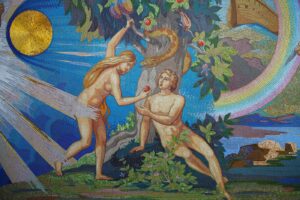
Modern political thought, according to Voegelin—especially since Hegel in the early nineteenth century—had erased the Augustinian distinction between sacred and profane history. Cities and empires, nations and states, moved in a stream of history that could be viewed as an intelligible process, each age bringing us closer to the fulfillment of human destiny. This conflation of profane history with sacred history is what Voegelin meant by the “fallacious immanentization of the Christian eschaton.” The eschaton, the last judgment, is an event we cannot see coming: “you know neither the day nor the hour,” says Jesus in Matthew 25:13. But the gnostic (from the Greek gnosis, knowledge) claims a special insight into its arrival, and thus makes a claim of its immanence, its here-and-nowness in past and present events and its knowable realization just over the horizon.
In his New Science, Voegelin does not offer a discussion of the ancient gnostic religion in any of its variants (including its heretical Christian form), though he does point readers to the classic work of Hans Jonas on the subject. What he does claim is that its peculiarly modern manifestation can be seen in or traced to the medieval thinker Joachim of Flora, who he says was the first to sketch a history of mankind in ages that unfold “as intelligible increases of spiritual fulfillment.” It is unclear, to me at any rate, whether Voegelin is making a strong claim regarding Joachim’s influence on later political thinkers, which strikes me as doubtful (and is certainly not established in New Science), or is instead simply identifying Joachim as the first exemplar of a perennial temptation to confound the profane and the sacred in an attempt to fix our place in history and to guide our next steps in its progress.
The gnostic par excellence is thus the ideologue, the revolutionary, the restless system-builder who disdains the world that history has flung him into.
If the latter is his claim, I think the case is very strong. “Uncertainty,” he writes, “is the very essence of Christianity.” But the gnostic philosopher of history is certain he knows just where we are, whither we must go, and how to guide our steps on the way. “Certainties, now, are in demand,” Voegelin says, and the gnostic has them aplenty. What was, in Joachim, a Christian heresy manifests itself in modern movements of thought that present themselves as agnostic or even atheist—Marxism and Nazism are both examples for Voegelin—yet they plainly make salvific claims about history and the coming achievement of utopia, in the idyll of postrevolutionary communism or the world dominance of the Aryans in the thousand-year Reich. As Voegelin puts it in his New Science, “the totalitarianism of our time must be understood as journey’s end of the Gnostic search for a civil theology.”
Voegelin returned to these themes in the 1960s in a briefer collection of lectures and essays, Science, Politics and Gnosticism. In some respects he clarified his argument here and made it more direct. He strengthened the linkage to ancient Gnosticism by observing its “central element,” the view of “the world as an alien place into which man has strayed and from which he must find his way back to the other world of his origin.” This, Voegelin said, contrasted with the “well-ordered” world “in which Hellenic man felt at home,” and “the Judaeo-Christian world that God created and found good.” The gnostic mindset rebels against the world as it is, and its “aim always is destruction of the old world and passage to the new.”
The gnostic par excellence is thus the ideologue, the revolutionary, the restless system-builder who disdains the world that history has flung him into. “In the clash between system and reality” for the ideologue, “reality must give way.” If this “requires the decapitation of being—the murder of God,” so be it. The ideologue’s system will make do with “ersatz religion.” Is it a “fact that the world is intrinsically poorly organized”? We can fix that. We will help history along, believing that a “salvational act is possible through man’s own effort.” In “the positivist superman of Comte, the communist superman of Marx, and the Dionysian superman of Nietzsche,” Voegelin saw the poisonous affinities of all gnostic projects.
As you can see from the quotations I’ve chosen, Voegelin was capable of striking turns of phrase and bold arguments. It is easy to see what was attractive about his work for a Christian conservative like Bill Buckley. What I have not perhaps conveyed is the remarkable compactness of his work, the allusions and abstractions of his prose, and his cultivation of a kind of technical vocabulary all his own that can be a bit daunting. Sometimes a reader coming to Voegelin for the first time must stop, go back a paragraph or two, and reread. But the reader’s concentrated attention is rewarded. After a while one finds oneself in Voegelin’s groove, so to speak, and the argument builds a momentum of persuasive force. Is his explanation of modern politics the last word on the subject? I don’t think so, but there is profound weight to it.
Now, am I ready to tackle Eric Voegelin’s acknowledged masterwork Order and History, beginning with the five hundred pages of Israel and Revelation? Yes, I believe so . . . but not right away!
Image licensed via Adobe Stock.