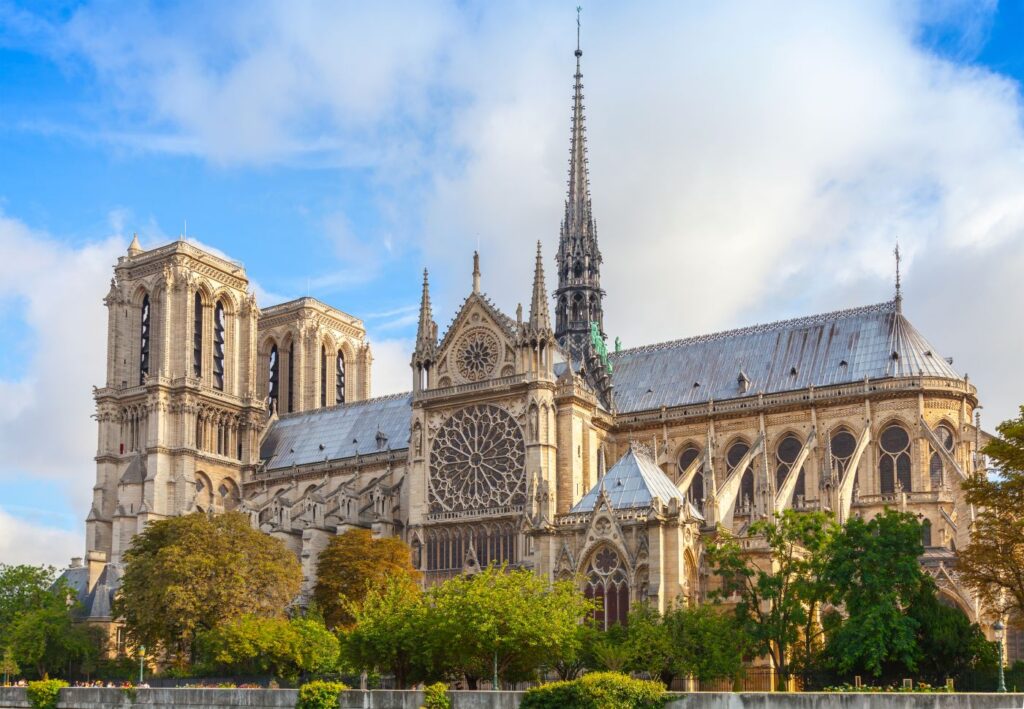
In one of his most underrated but magisterial works, Perictione in Colophon: Reflections on the Aesthetic Way of Life (2000), Roger Scruton provides a blueprint of what constitutes true and timeless architecture. This is not a book of conventional philosophy, but a literary masterpiece that, in fictional form, describes the world in which we now live. Elsewhere, he describes that world as one of “normal nihilism.” Who, gazing around our city streets, would not agree with him? We have, as it were, normalized nihilism to the point where alienation from the world has become the rule for most people.
There are many reasons for this, but one of the primary causes, according to Scruton, is that we have forgotten how to build in accordance with time-honored values. He goes further, arguing that we must understand the human urge to build in religious rather than in secular terms. That is because, as he writes:
The stone of the temple is the earthly translation of God’s immortality, which is in turn the symbol of a community and its will to live. The temple, like the liturgy, is forever, and the community contains not the living only, but also the dead and the unborn. And the dead are protected by the temple, which immortalises them in stone. This is what you understand instinctively when you see religious architecture. And it is the sentiment from which cities grow—the tribe’s will to permanence.
In glaring contrast, architectural functionalism “hurts both the eye and the soul, for it speaks not of us and our right of dwelling.” Hence, functional buildings “are perceived as a desecration: nothing of the sacred remains in them.” Scruton’s point is that the way we build has consequences far beyond those of conflicting tastes. Whereas innovation in music, painting, and poetry does not directly affect how we live, architecture most certainly does. It is very much a public art centrally bound up with our self-understanding. Put simply, change the way you build, and you change the self-image and values of a people.
That is why innovation in sacred architecture is such moral vandalism. As Scruton explains, stone symbolizes permanence, whereas wood, for example, is prone to decay. The stone of the temple speaks of our longing to exist beyond the moment, but a wooden structure, or one that detracts from the eternal in favor of the transient, seeks only to unsettle, alienate, or render homeless those who must abide within its walls. In other words, if you want to understand one of the root causes of our crisis of faith in the West, look no further than the wave of architectural desecration that swept across the Christian world over the past fifty years.
Start your day with Public Discourse
Sign up and get our daily essays sent straight to your inbox.Long before Scruton, Georg Wilhelm Friedrich Hegel saw this with perspicacity. For him, we come to understand our world by engaging with it. Think of a child seeking to venture beyond his mother’s arms. He grapples with things, trying to make sense of them. He strives to build with blocks or alien objects that, when configured according to the child’s imaginative requirements, acquire meaning. By shaping the world in his own image and likeness, the infant identifies with it, thereby overcoming his natural estrangement from the surrounding and threatening environment. Such is the process that we call “education,” and it enables us to feel totally at home in the world. That is because, having shaped the world in our own image, we perceive it as familiar and worthy of respect and love. Just as when we decorate our homes, we see our little patch of the world imbued with consciousness, one that smiles back at us with a human face.
The stone of the temple speaks of the community’s will to exist, but also of our longing to belong. As Hegel puts it, we can only truly feel at home when God has been given a home among us. Its beauty should signify that it is that “point of intersection of the timeless with time,” thereby connecting us to the living, the dead, and the unborn—what Edmund Burke called the “great primeval contract of eternal society.” Indeed, the whole point of the sacred space is to have communion with our divine source, to realize that “Christ is all and in all.” Thus, the face of the world acquires a divine radiance that reconciles heaven and earth.
We might say that the fundamental objective of architecture is to reconcile: a beautifully planned village will always have a church that celebrates the reconciliation between God and man that was won on Calvary. Moreover, its streets will be lined with houses that symbolize identity amid difference. In other words, to build in defiance of the street is to shatter identity in favor of difference. It is to alienate neighbor from neighbor and to champion the “I” over the “we.” It is to scream that my taste far outweighs the importance of living in harmony with those who share a common homestead. It is to opt for estrangement over belonging, disruption over reconciliation, and ego over community.
Consider now what happens when we build a church, or indeed any sacred space, in defiance of the settled community that surrounds it. Think of what happens when it is built not to last but to shock, not to reconcile but to disorient, not to exhibit sacred beauty but to expand the cult of ugliness beyond the precincts of the mall. Comprising materials that will not survive a few generations, it cannot immortalize anything, least of all the dead. Functionalism emphasizes mortality, and, thus, when people are forced to worship in a place predicated on the temporal rather than the eternal, their deepest longings remain unfulfilled.
Furthermore, having no sense of the sacred, they remain alienated from their divine origin. That is so because functionalism is faceless. It neither smiles nor saves, but mires us in a purgatory of the passing, where beauty has no place. And, where beauty is absent, we cannot truly belong.
Sacred architecture speaks to us of beauty, truth, and goodness. It reminds us that we belong to something greater than ourselves, that we are in the world but not entirely of it. It stands before us, not in a posture of power or condemnation, but as an invitation to dwell in harmony with absent generations. However, in an age of individualism and egotism, when selfishness has usurped sacrifice as the guiding scruple of the good life, that invitation is routinely snubbed. What use do we have of ancient buildings that draw us into the drama of salvation when it is no longer Christ who lives but I who must save myself? The functional cathedral, for example, is an expression of detachment from the unborn and the dead, but also from the face of God that sacred architecture sought to reveal in stone, glass, mouldings, ornament, and the liturgy of divine love.
Indeed, I would go so far as to say that the entire theology of salvation is perfectly conveyed in a classically built cathedral or church. That is why, in comments that are more pertinent than ever, Cardinal Joseph Ratzinger (the future Pope Benedict XVI) would say in 1985:
As the Old Testament speaks of the Temple, the Church is to be the place of “glory” and, as such, too, the place where mankind’s cry of distress is brought to the ear of God. The Church must not settle down with what is merely comfortable and serviceable at the parish level; she must arouse the voice of the cosmos and, by glorifying the Creator, elicit the glory of the cosmos itself, making it too glorious, beautiful, habitable and beloved.
He concludes, “No. Christians must not be too easily satisfied. They must make their Church into a place where beauty—and hence truth—is at home. Without this the world will become the first circle of hell.” Prophetic words, that, sadly, have all but come to pass.
If functionalism and unbridled innovation in sacred architecture confuse and alienate those who must endure it, it is because a church, properly conceived, is ordered to the altar of salvation, the divine presence, and the sacramental reality of the faith. It speaks to us in symbolic language of a world redeemed, of Christ in us, the hope of glory. It binds us to the saints, to those yet to come, and reminds us of our dependence on what eternally sustains us. In it, we can feel fully at home because the truth of who we are has been tangibly conveyed. Thus, we instinctively fall to our knees, knowing that our natural estrangement has been overcome, and that we are no longer aliens to ourselves.
Sacred architecture speaks to us of beauty, truth, and goodness. It reminds us that we belong to something greater than ourselves, that we are in the world but not of it.
However, when the functional eclipses the transcendental, disbelief and disorientation become the norm. I cited many examples of this in my book Why Be a Catholic? and all served the same end: spiritual homelessness. First, in functionally designed churches, it is unclear where the sanctuary begins and ends. What was meant to be the “Holy of Holies” is now a partially raised platform that fails to demarcate the sacred from the profane. In some cases, you cannot kneel; in others, you don’t know where to genuflect because there is no evidence of a tabernacle. A lack of beauty and solid structure detaches the worshiper from the Communion of Saints, from the sacred patrimony handed down by the “anonymous forces of history” and sealed with the blood of the martyrs. Is it any wonder that this leads to spiritual blindness and amnesia? Is it any wonder that it renders unsatisfied our spiritual longings and evicts us from the “homeland of the soul”?
Once again, this is not simply a matter of changing tastes. If anything, it is a total transformation of how we experience meaning and how we understand ourselves in relation to the eternal and the temporal. It is to prioritize one man’s vision over the language of truth defined over generations and given witness in concrete form in the Church. If, as Scruton says, this hurts the eye and the soul, it is because it speaks “not of us … but of them. It is they who built these things, for inscrutable purposes that lie beyond our sympathies.” There is, he continues, an “idea behind all this, and it is not hard to define it: ‘Let nothing be sacred: neither God nor man.’”
The greatest contribution that the Church has made to civilization is its beauty. This, however, is not a mere aesthetic bequest, but something that reveals the glory of God and, in so doing, permits us to be “partakers of the divine nature.” Through it, we are reconciled to time and eternity. We look upon the face of God and, in so doing, we see that the wound of Eden has been healed through the Blood of the Lamb. Or, as Scruton remarks, it “conveys an idea of permanence, of life removed from the world of decay and transformation—in short, of life become divine.”
Let us, therefore, cherish our sacred buildings cast in stone. Without them, we are cut adrift from all that we live and long for. We remain strangers to ourselves, to our neighbors, and to God. And when that happens, we are condemned to a prison house of darkness where light from that other sphere never shines. Such is a life guided only by the fleeting whims of the age, a life that has become blind to the design of the temple: “columns, arches, and the lamp that burns forever.”