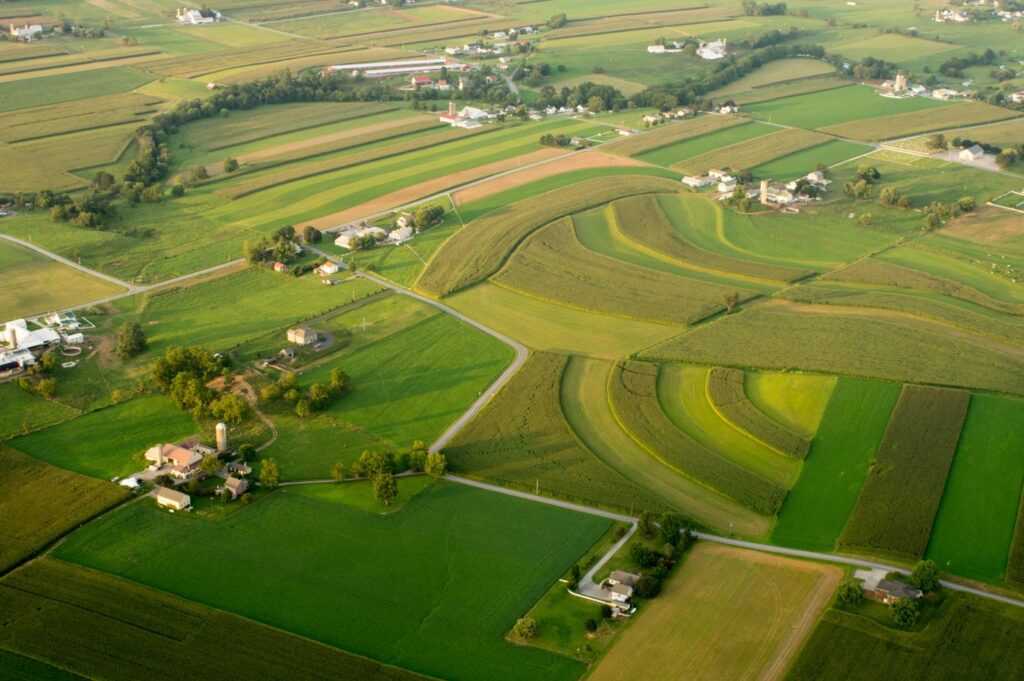
The word data originates from the Latin dare, which means “to give.” Dare gave rise to the word datum, meaning “thing given,” in the 1600s. From this, the modern data emerged. It is a great irony then, that the proposed hyperscale AI data centers that are spreading across rural America, should they be built, will be created by way of taking rather than giving: specifically, large corporations are taking local resources to manage and store global information that is not always explicitly given.
If this sounds farfetched, this is just the premise many American towns are now being asked to consider. Many locals are fervently opposing these propositions. Ethical, economic, and environmental concerns about AI data center projects abound, and for good reason.
Localism at Work
On St. Patrick’s Day this year, I found myself in my small town’s high school gymnasium close to midnight, pacing with my ten-month-old in a baby carrier and listening to several fellow residents give their testimonies. I listened to local homeowners, farmers, parents, educators, business owners, an environmental rights attorney, and an expert on hydrology and groundwater, among others, use their allotted three minutes to explain why the building of two proposed data centers in our county would be harmful and disruptive to life of all kinds.
These residents spoke directly to the elected county planning and zoning commissioners, who had moved their regularly scheduled meeting to the high school due to a larger than normal expected turnout. The commission was considering the rezoning of agricultural land to industrial use to make way for two data centers: the Provident Data Center-backed Gateway Digital Campus on the 575 acres currently home to Diamond Farms, and another hyperscale data center proposed by energy company BLE Landholdings (also known as Beltline) on 490 acres in the next town over. A few towns over and a few days later, a similar meeting was held. A few months ago, and a little farther away, another one.
Start your day with Public Discourse
Sign up and get our daily essays sent straight to your inbox.This story echoes down the highways of my home state, Missouri, and in many other states as well. There seems to be an attempt at a technological mass plundering of rural America by various land acquisition companies and data center developers on behalf of the so-called “hyperscalers”: companies like Amazon Web Services, Microsoft Azure, Google Cloud, and others. Many citizens of these rural areas are characteristically not willing to simply let it happen. The result of the meeting I attended was tabling the issue until April 21. At that April meeting, the commission voted on the recommendations they would be presenting to the County Commission, comprising a mere three men who will be tasked with making the final decisions later this month. At the April meeting, the commissioners voted in favor of recommending the Provident project as well as in favor of a general land use amendment that will embolden any future data center project proposals via the elimination of this very process—that of requiring these planning and zoning recommendations prior to the proposals’ going to the county commissioners. They voted against recommending the Beltline project.
Residents’ concerns about the hyperscale data centers varied widely. These concerns included many environmental ones, like the impact on the water table, whether local aquifers would be drained, the level of noise and light pollution, diesel drainage into the local water supply, impact on the nearby nature preserve and the endangered species that reside there, and the impact on the local pollinator population. Other concerns were health related, such as electromagnetic field (EMF) exposure, and economic, such as the lowering of property values, the actual number of long-term jobs that will be offered at these sites, and whether the construction crews that would build these sites would be hired locally or brought in from out of town. The treatment of historic family cemeteries was also on the table.
Technological Society, Data, and the Everyman
The rezoning of agricultural land for industrial use raises many questions about technological ethics. My own (unanswered) question to the commissioners was this: which businesses will be the end users of these centers, and what sort of business will they be conducting within them? Residents deserve to know what kind of business is being conducted in their own towns.
IBM states that the hyperscale data center differs from traditional data centers “by virtue of its sheer size.” A hyperscale data center requires a physical site “large enough to house all associated equipment—including at least 5,000 servers and quite possibly miles of connection equipment.” These are massive facilities used to scale business; the top players in this industry, such as Amazon Web Services and Microsoft Azure, need them for many applications, the most controversial of which include the use of AI in military strategy applications and government surveillance.
These centers are giant facilities that take up a giant amount of land with giant ethical implications. The story of where to build them, or even whether they should be built at all, is representative of the quintessential “David and Goliath” theme that has played out throughout history. At my local meeting, this was particularly evident in the contrasting imagery of the men in nice suits, many flown in from out of town by the project developers from Provident and Beltline, and the residents who spoke in opposition to them. The residents were clad in denim, stained khakis, ball caps, suspenders, and flannel. The working-class person standing in opposition to those who underestimate their will and intelligence is a stark depiction of the class differences that are so prevalent in society.
These companies are entering communities that often could use the extra tax income; communities where perhaps the local school district is struggling or where there is inadequate funding for basic necessities like the ambulance district. They are entering spaces where they assume that the citizens aren’t as savvy as those in metropolitan areas. They are asking, or rather, poorly convincing, these citizens to accept massive changes in exchange for unguaranteed promises. The needs may be real in some cases, but the perception of weakness is not. They are purposely mining those whom they have labeled vulnerable.
But these companies have misjudged the rural American. Generally speaking, the rural American is not interested in becoming a member of the faction of ineluctability, which is a requirement of the technological class. The fatalistic view about AI that includes the idea that this is inevitable is the view Big Tech urges us to accept. This inevitability is worthy of hearty opposition because it is representative of a future built by a small few and that only reflects the values of those (literal and figurative) architects of the AI-powered future. We owe it to our descendants to ensure the world they inherit isn’t more cyborg than human.
Standing Sentinel
Recently, I found myself in my car at the local feed store parking lot, nursing my baby. Staring out the window at the red, white, and blue logo on the sign, with an ad for local honey and seed potatoes below it, I felt a sense of “just rightness”: the silver grain silos caught the bright, early spring sun perfectly, and I felt a flood of love and gratitude for the beautiful community I called home. At one point, an older woman knocked on my window to ask me if the baby sock on the gravel had fallen out of my van. It had, and I was struck by how grateful I was to sit in that sunny parking lot, nursing my baby before going in to buy rabbit food, and making small talk with a perfect stranger.
This is the spirit of small-town America. These are good people. The regular people, the baby-sock-savers, the rabbit-feed-buyers, the small-talkers. These are the people corporate vultures desire to feed upon.
In a speech entitled Preserving Human Voices and Faces, Pope Leo XIV warned us of what we lose when we rely too heavily on technology:
By simulating human voices and faces, wisdom and knowledge, consciousness and responsibility, empathy and friendship, the systems known as artificial intelligence not only interfere with information ecosystems, but also encroach upon the deepest level of communication, that of human relationships. The challenge, therefore, is not technological, but anthropological. Safeguarding faces and voices ultimately means safeguarding ourselves.
This stands in stark contrast to my feed center interaction with my friendly neighbor. But on a broader scale, what exactly does it mean to safeguard “faces and voices” and thus, ourselves? This, I think, points to the root of our mass opposition to the AI data centers. The people in my town do not just oppose the building of these centers, but many also oppose what these centers are used for. The antagonism shown at these meetings is a reaction not only to physical threats, but also metaphysical ones. While the actual infrastructure poses a threat to our rural ecosystem, the work that the data centers make possible poses a threat to how human beings use our minds and creative capacities. AI has the potential to shift how we communicate with one another, what work looks like for many roles, how relationships unfold, and how we order our lives. Much of our reaction to these projects reflects the understanding that this technology has the power to reshape the way humanity marches into the future, and not always in a way that serves the greater good.
Even if one is not at risk of being personally affected by the environmental consequences of hyperscale data centers, the work they make possible is worth critical examination. Fortifying the human spirit and creativity against artificial “necessity” is an endeavor deserving of consideration, for the integrity of both our inner and outer landscapes is at risk.
Image licensed via Adobe Stock.