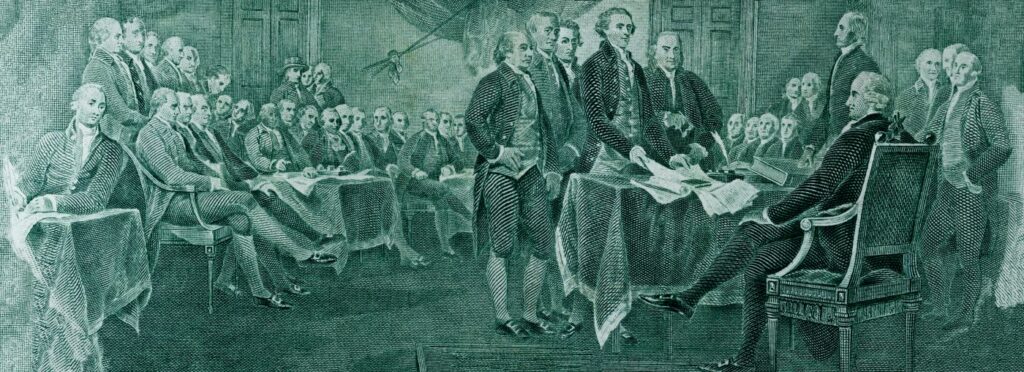
From the time of the American Revolution, France has been one of America’s closest allies. Decades later, Alexis de Tocqueville, a Frenchman, would write Democracy in America, which remains for many the best analysis of America’s culture and institutions. In the spirit of that friendship, Public Discourse asked Rémi Brague, one of France’s most acclaimed philosophers, to offer some reflections on the Declaration of Independence and the meaning of the United States’ 250th birthday.
Nathaniel Peters: This July marks the 250th anniversary of the Declaration of Independence and the birth of the United States of America. The Declaration states its famous principles of human equality and freedom as self-evident truths. Is that the case, or are they products of the Anglo-American tradition and the Enlightenment?
Rémi Brague: Declaring these principles as if they were self-evident truths required some nerve. They were not so for the ancient world; on the contrary. As for human equality, for instance, we read In Homer’s Odyssey that when a man is enslaved, he loses the half part of his wits. The Founding Fathers, who were steeped in the classics, knew that full well. Consequently, they had to ground the principles on an idea they borrowed from the Bible: the will of a benevolent Creator God.
We don’t have to choose between an alleged self-evidence, eternal in nature, and alleged discoveries of the eighteenth century and its so-called Enlightenment. There is a third element, or rather a whole batch of elements, stretching over two millennia: Roman legal reasonings; the prophets of the Hebrew Bible and their commandments; the teachings of Jesus enlarging the notion of a “neighbor” beyond the fellow members of the tribe (Luke 10, 29-37); Paul’s bridging the gaps between Jew and Pagan (“Greek”), free man and slave, male and female, thereby implicitly and methodically deconstructing the Jewish morning prayer (Galatians 3, 28); and the scholastics, especially the Spanish thinkers of the Renaissance who stood for the rights of Amerindians to freedom and property. All this slowly crystallized into the highly counterintuitive idea of human equality and gave it what Karl Marx called “the force of a popular prejudice.” Now, whereas Marx purposefully avoided mentioning the Christian origin of this idea, some other people were more straightforward, like Martin Luther King, Jr., who explicitly referred to Thomas Aquinas’s theory on “eternal law and natural law” in his 1963 Letter from Birmingham Jail.
The reference to “the Laws of Nature and of Nature’s God” can be read in a Christian key, too. Speaking of “the Laws of Nature,” tout court, would sound typically “enlightened.” Many authors who upheld radical “enlightened” views would consciously conflate the proper use of the word “law” viz. its juridical and political meaning, with its use as a metaphor for us to describe the regular behavior of physical phenomena such as it can be expressed in rigorous mathematical language. This move enabled the most radical advocates of Enlightenment to do away with the idea of a divine being and to replace it with “Nature.” On the other hand, and this is often overlooked, speaking of the “Laws of God,” full stop, hardly tallies with a Christian view of reality. As a matter of fact, this would fit an Islamic view far better. According to Christianity, God does not create bundles of properties which stick together by his will only, but things he endows with a stable nature.
Start your day with Public Discourse
Sign up and get our daily essays sent straight to your inbox.NP: And a follow-up: If the Declaration’s principles are not self-evident and are products of the Enlightenment, what happens to them when more and more people question the ideals of the Enlightenment? If America is more of an idea or an experiment than a nation with a longer history and stronger ties of blood, are there ideas necessary to bind it together?
RB: I have just been contending that all the ingredients that came into the intellectual melting-pot that undergirds the Declaration don’t hail from the Enlightenment. Yet some undoubtedly do. There is an element that comes straight from the Enlightenment and lacks any underpinning in the classical and Biblical traditions: the alleged “pursuit of happiness.” To some extent, the French revolutionist Saint-Just was right when he famously said, in a 1794 speech—ironically in the very peak of revolutionary terror—that “happiness is a new idea in Europe.” In ancient and Christian thought, happiness was never an end in itself; it was a side issue. To be sure, people knew what happiness is all about. But what they sought was the good, and for us human beings, the good we are striving for is our flourishing, the fulfilment of our nature, what the Greeks called aretē: a word we clumsily translate to “virtue.” Virtue is not enough for us to be happy. To enjoy happiness, we need what Aristotle called khorēgia, a set of external circumstances like peace, health, and wealth.
Now, I very much doubt that the pursuit of happiness is that natural. For us, and more if we accept the modern view of man, what we want is often the so-called “autonomy”—a misnomer for “independence.” Being happy depends on external factors. There are things that make us happy when we rejoice in them. The experience of happiness is an experience of decentration: we no longer circle around ourselves but bask in the light of the good. We sometimes prefer being wretched, provided we remain interesting in our own eyes. Christians interpret this because of the fallen nature of human beings. Perhaps we must learn how to desire our own good.
Typically, “enlightened” is the quasi-identity between “happiness” and “security,” very much in keeping with the emphasis put on utility by English utilitarians. Nothing to object to, if utility (Cicero’s utile) doesn’t run counter to the good (his honestum).
You asked what happens when enough people, especially among the leading elite, get rid of those principles, be they rooted in the Enlightenment or, as I believe, in more ancient thoughts. I’m afraid we can experience those consequences in the present time, or we will in a near future. In your question, you put your finger on a very important point: America as an experiment. For a long time, Americans thought of themselves as endowed with a mission God has entrusted them and that they should live up to. This enabled them to legitimate dubious enterprises like subduing the Indians. I would rather call this a task than a mission.
NP: What do you see as the most important differences between the French Declaration of the Rights of Man and the American Declaration of Independence? How did each come from and then shape the nation that produced it?
RB: A comparison between those two fundamental texts is a matter of some delicacy because they were not simultaneous; the French Declaration was penned thirteen years after the American one. By this token, the French authors could take advantage of the former text. Jefferson contributed his mite to the preliminary discussions over the French Declaration and even wrote a first draft of it.
The main difference is obvious: the American Declaration deals with the situation of a definite group of people at a definite point of time, namely, the citizens of the colonies in late eighteenth-century New England, whereas the French Declaration claimed to hold good for each and every human being, regardless his or her race, age, nation, etc. A rather cheeky attempt, which naively forgets that weighing anchor from one’s rootedness in a place, time, language, and habits is simply impossible. The nineteenth-century French historian Hippolyte Taine clearly saw the origin of this dream in classical education laying stress on abstract ideas and looking down on concrete experience.
Whenever people pretended to launch into this kind of enterprise and start from scratch, the dream turned to a nightmare, for they would in fact bring back to life and virulence passions and representations of the most archaic kind. The French Revolution, as a comedy, saw people changing Christian first names and taking Roman names of the republican period: Brutus, Cincinnatus, and names of that ilk; as a tragedy, it let loose the most brutish instincts and ended in bloodshed.
NP: The most famous analyst of the American spirit is Alexis de Tocqueville. What do you think of the fact that Tocqueville does not discuss the Declaration in Democracy in America? What should he have said then? Are there ways his analysis of America should be updated?
RB: Tocqueville’s intention was not to shed light on the principles of American democracy, but to perform an empirical study of its concrete functioning, of the mindset that made it possible in the first place, and of the consequences it produced in the long run.
What he could have said about the Declaration of Independence is anybody’s guess. What I feel in my bones is that he would have preferred it to the French Declaration of the Human Rights, precisely because it is rooted in history. Tocqueville accepted the democratic regime, in which he saw the hand of providence, unlike people like the Anglo-Irish Edmund Burke, whom he criticizes in his book on the ancient regime and revolution, or his fellow countryman Joseph de Maistre. He had no illusion about the shortcomings of democracy, however. A sentence in the second part of his Democracy in America exposes clearly a drawback of democratic societies: “Democracy not only makes every man forget his ancestors, but conceals from him his offspring and cuts him off from his contemporaries.” This can be understood as the flip side of Burke’s famous line: “People will not look forward to posterity, who never look backward to their ancestors.”
NP: What significance does America have for Europe today, not in terms of diplomacy or political clout, but as an idea?
RB: It is difficult to distinguish this possible significance from what you are telling me to avoid, i.e., diplomacy and politics. This is a permanent problem, and it will remain still trickier if the dust raised by Mr. Trump is not settled. Beyond the present predicament, we meet a general difficulty. The country changes so quickly. “Today” is what philosophers call a shifter, and a quick one, into the bargain. The French poet and diplomat Paul Claudel had a wonderful image: “Writing on America is like photographing a child: in a nick of time, the time of the click, the child changed and America is no longer the same.” This may be true of the U.S. political and social reality, even of ideas, although they are longer-lived. But dreams last and recur almost forever.
Perhaps something in the American tradition could help us Europeans out of the lurch: the ability to change, to realize what had been wrongly done and understand that they urgently have to undo it. They sort of repent to start again, not from a clean slate, which is not feasible, since the past can’t be wiped out, but at least from a clean conscience. Europeans are more prone to chew on their past and to let it poison them.
This American tendency is biblical in origin; its roots are to be found in the Jewish tešūva and the Christian metanoia, and it came to a head in the Puritan mind. This behavior—acknowledging one’s sins, exposing them, regretting them, begging pardon, trying to improve—all this was perfectly sane and even helpful. Most unfortunately, it is about to lose its moorings and run amok. The woke movement wants us to confess our sins, or rather, what is easier, the sins of our forebears, but it doesn’t allow us to hope for any forgiveness.