“The Declaration of Independence itself,” note Catholic legal scholars Michael Scaperlanda and Teresa Collett,
reflects several assumptions about the nature of the human person. Broadly speaking, it assumes that (a) the human race did not bring itself into existence but was created by some transcendent Being, variously referred to as “Nature’s God,” “Creator,” and “Supreme Judge”; (b) the human person has an unalienable and equal right to be free; (c) freedom is exercised in community; (d) freedom must be ordered by government and law; and (e) these truths are self-evident.
Put simply, the underlying impulse of the Declaration is the conviction that the human person is prior to government. Government is both necessary and good, but it can only order and safeguard what is already there, namely, the community of persons created by God. As the Declaration asserts, government derives its “just powers from the consent of the governed.” The priority of the human person is taken, moreover, as a self-evident truth.
Such reasoning provided a firm justification for declaring independence from Britain. The Founders could step onto the world stage confident that their decision was not motivated by arbitrary voluntarism or the haughty arrogance of power. Theirs was a principled Declaration, founded on the unshakable truth that the human person is created free, not by government, but by God. As Scaperlanda and Collett note, “states are bound by a higher authority to respect these unalienable rights, and when a state exercises its power in contravention of these rights, it can be judged by an objective standard and held accountable for its abusive actions.”
All of this is held very much in doubt by modern America. Increasingly, our modern world recognizes only power, and denies that there could be any higher or objective standard by which to determine moral action. Human dignity has become a pleasant fiction in our society.
Start your day with Public Discourse
Sign up and get our daily essays sent straight to your inbox.Immigration and Human Dignity
This comes to a head in the current debates about our country’s immigration policy. In a wonderful essay on immigration law, Michael Scaperlanda surveys various modern political theorists such as Richard Rorty, Bruce Ackerman, and Michael Walzer, among others. He notes that these thinkers are consistent in their rejection of any notion of a Creator, and yet attempt to retain the idea of human dignity:
What they desire is to keep the idea of human dignity but cast aside its foundation in a Creator. In their view, we should all agree to be nice to each other and treat each other as equal moral agents, but this is merely a matter of preference and agreement because nothing external to our contingent humanity obligates us to order justice in this fashion.
We can be nice to one another so long as it is convenient. But the moment another’s existence becomes burdensome to me in some way, or asks me to adjust my life and priorities, I can at any time cast such a person aside. This is the “throwaway culture” spoken of by Pope Francis.
To put the question directly about the current immigration policy of the United States: is a policy moral and just that results in mass deportations of so-called illegals, the forcible separation (or fear of separation) endured by many families, and individuals, including many elderly as well women and children, being held in indefinite detention?
According to the logic of arbitrary and volitional power, the answer is yes. “Illegals” are lawbreakers, and our law, which is our own invention, is supreme. Furthermore, what kind of country—what kind of government—would allow everybody in? Are we not a nation of laws, and do we not decide what bonds—such as nationality, language, culture, even religion—will tie us together? If those lawbreakers now suffer the consequences of their actions, such as the separation of a mother from her child, or the deportation of a father to a country to which he has no real tie, that is perhaps regrettable but entirely justifiable, since such actions safeguard our interests and protect our way of life.
Such a response is common today. But such a response reveals a betrayal of the foundational principles of this country, the principles articulated by the Declaration. God is no longer believed to be the source of our inmost rights and dignity, nor is he held to be the author of those bonds by which we are most closely and intimately tied to one another, such as the bonds of family. All ties that could possibly bind us together are now thought to come from the government, that is, they are ties that we ourselves establish. Or perhaps we believe in God, but we no longer fear him. God becomes merely another enlistment to prop up our pleasant fiction. His justice has been supplanted; it is now wielded by government, an instrument of our own devising.
In the Land of Promise, Castle Garden
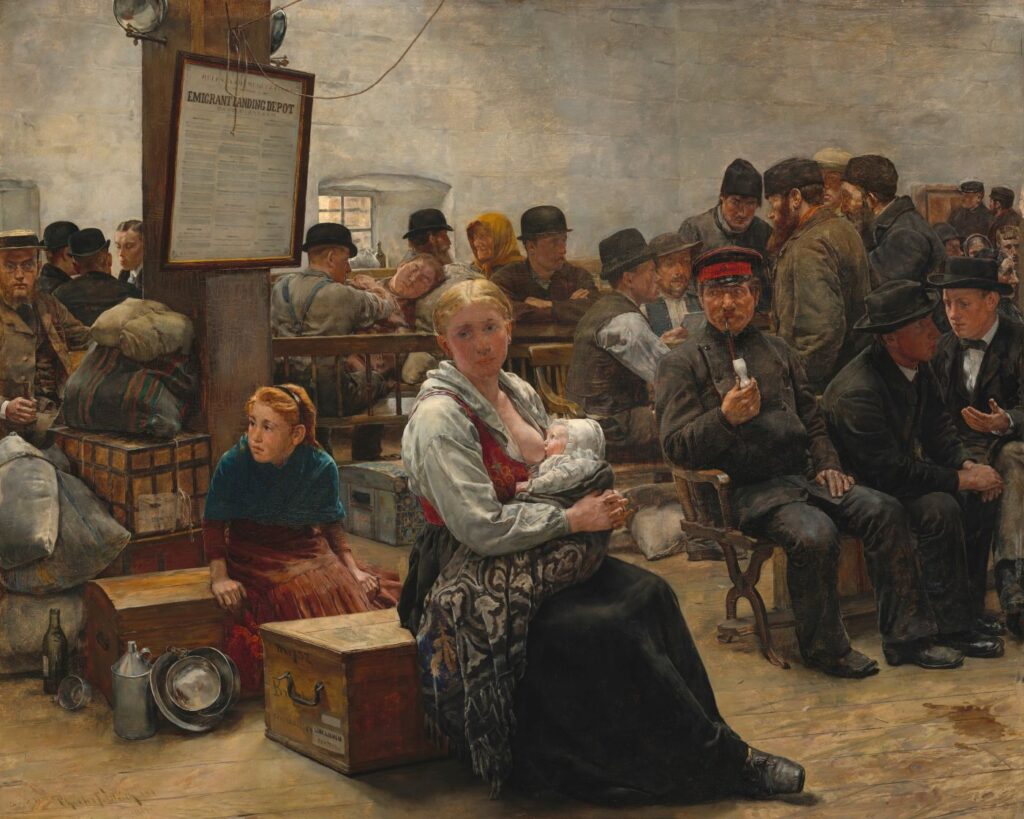
In the face of cruel rhetoric and emergent restrictive immigration policies in the United States, the American Realist painter Charles Frederic Ulrich painted In the Land of Promise, Castle Garden in 1884. The work shows us the nation’s first immigration station, predating even the famed Ellis Island. In the composition, we see a tired and huddled mass of newly arrived immigrants at the depot station. The wooden floor is stained and littered with their luggage and debris, and the varied clothing and uniforms indicate their various languages and nationalities. The immigrants are waiting to be processed, and there is a sign hanging from a wooden pillar in the room with “Rules and Regulations” printed at the top, under which is “Emigrant Landing Depot: Castle Garden” followed by a long list of indistinct rules.
But it is the seated woman nursing her child in the center of the painting that captures our attention. The woman is seated on a trunk that says “Stockholm.” Presumably she is Swedish. A young girl sits behind her staring vacantly into the distance—perhaps her daughter? The woman herself stares just past the viewer, her eyes tired and sad as she nurses her infant. She is alone; perhaps her husband awaits her somewhere in America? Perhaps he has died? We do not know. She sits with her feet crossed before her, her breast uncovered as she tenderly yet wearily nurses her child, bourgeois discretion a luxury unavailable to the poor and destitute.
The painting is significant for its historical context. Two years before Ulrich painted this piece, the federal government passed the first law in the nation’s history restricting both the number and the nationality of immigrants. The 1882 Chinese Exclusion Act suspended Chinese immigration for ten years. Although Chinese immigrants had been actively recruited by western railroad companies to construct untold miles of tracks that enabled the conquest of the land, and although Chinese immigrants composed a mere fraction of California’s population, they came to be seen as a threat that must be expelled. Prior to the act’s passage in Congress, the California legislature produced a report that outlined the many evils that the Chinese presence supposedly brought to America. According to the report, Chinese immigrants threatened the American way of life in every way imaginable, and so they must be expelled. The history of racism against the Chinese in California at this time is one of the dark chapters of our nation’s history.
Immigration Today
And yet, 128 years later, in 2006, a speech was given on the floor of the House of Representatives by a California congressman that echoed the hysteria of the earlier report—this time, however, directed at Hispanic immigrants. Immigration must be restricted, argued the congressman. He went on to explain:
A good example, I remember seeing dry-wallers being laid off and an illegal being hired. It is not that illegals are bad people. By and large, they are really good people. They are just trying to come here to better their lives. So it is not a matter of race or discrimination. It is just the fact that can the United States accept all the poor that this world wants to send here? … Why not accept them from anyplace in the world and double, triple, quadruple our population if we are just going to be benevolent and accept people who are poor and want to better their lives?
But the problem you have, and this is back to the dry-waller, then you see an illegal hanging dry wall and his wife and kids are going behind him nailing the dry wall off to get the job done quicker so the husband could produce more at a much lesser rate than the American citizen was paid before.
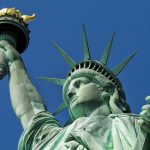
The logic is purely utilitarian; the calculation purely economic. The congressman insists his remarks are not motivated by race or discrimination. It is simply that the promise inscribed on the Statue of Liberty would cost too much. The great symbol of America is, in this reading, a façade, since when we get down to brass tacks the poor are too great an inconvenience and a threat to our personal interests.
2006 appears as an idyllic time in comparison with the current state of affairs surrounding immigration enforcement. On one hand, open borders and unchecked immigration—as was effectively in place under the previous administration—are an act of great injustice, both to the host nation and to the immigrants themselves. It is to the detriment of the United States that a blind eye has been turned for so long toward illegal immigration, so that a shadow multitude now dwell among us who can be, and are, economically and politically exploited. The individual is but a means, with no inherent tie or dignity to respect.
On the other hand, the draconian policies of mass deportation, the cruel and dehumanizing rhetoric now directed at immigrants, the cavalier separation of families and their prolonged detention: all of this also fails to see any higher bond or human dignity in migrants. Having effectively lured immigrants to this nation, it is shameful that we would now seek their mass deportation, break apart their families, and detain them indefinitely in subhuman conditions.
All of this brings us back to the seated immigrant woman breastfeeding her infant in Ulrich’s painting. Her weary eyes stare out and remind us that there is indeed a bond more real, more enduring, and more sacred than any we might artificially create by momentary consensus. She reminds us that the ties of family, especially of that between mother and child, are not bonds that we invent but that we receive from the hand of a just God. Any law that would transgress rather than protect such a bond is to be most forcefully repented of and repudiated.
Ulrich’s painting is an instantiation of the verses by Emma Lazarus that would be inscribed a few years later on the Statue of Liberty:
Give me your tired, your poor,
Your huddled masses yearning to breathe free,
The wretched refuse of your teeming shore.
It is in accepting the poor and the wretched refuse that the greatness and promise of America are to be found. The congressman from California had asked if we must accept the poor that the world wants to send to us. The answer is yes. We must. No doubt we must do so in a lawful and orderly way. But to fail to do so is to renounce the promise of America and to reject the very foundation of our nation’s independence, which asserts that human rights and dignity come from our Creator and are not the products of our volitional and aimless construction.