A Note from the Editors: We will be taking a brief publication break in observance of Independence Day and the semiquincentennial. We will resume our normal publication schedule with new, original essays on July 12th. In the meantime, please enjoy a few of our favorites from the archives here, here, and here.
Happy Independence Day from all of us at PD, and thanks for reading!
Start your day with Public Discourse
Sign up and get our daily essays sent straight to your inbox.In this historic year of the semiquincentennial of the United States, it is worth reflecting on the nature of the American experiment in ordered liberty. It is also worth examining the perennial question of the relationship between law and culture, especially as these topics have been increasingly tested in recent years by the rise of populism, postliberalism, and a general sense of malaise and dissatisfaction with America at this historic milestone.
America, I propose, has two constitutions, both of which are foundational, but whose relationship requires attention and consideration. A proper understanding of the dynamic between law and culture, which are ways of referring to these two respective constitutions, is necessary for rightly ordering our attempts to restore and reform our nation.
Our Two Constitutions
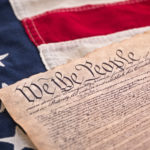
What are these “two constitutions”? The distinction is simple enough, although in that simple binary there is enough dynamism to power a republic for two and a half centuries and more. By America’s two constitutions I mean merely to point out the difference between the written, public law of the land on one hand, and the unwritten, interior law of the individual conscience on the other. Simple enough. One of America’s constitutions is what we first and normally think of when we hear that word: the document promulgated and ratified by thirteen former colonies in 1789, modified by a Bill of Rights and seventeen subsequent amendments. This written constitution serves as the basic and supreme law of the land, commanding respect and loyalty from federal office bearers, military service members, and citizens alike.
And while I do mean to include the document known as the U.S. Constitution in my reference to America’s constitution in the first sense, I also mean to include all the public laws on the books in America, whether at the federal, state, or local level. Thus, the legal constitution of America broadly understood includes all positive law: the Constitution itself, but also statutes, codes, regulations, policies, and judgments at all levels. The “constitution” in this first sense, then, refers basically to what we think of when we refer to “the law of the land,” with all of the variety, hierarchy, and complexity therein, including, notably, fifty different state constitutions.
What, then, of America’s constitution in its second sense? America’s other constitution, put simply, is the moral character of its people. It consists of the habits, mores, cultural norms, judgments, desires, and activities of the citizenry. America’s constitution in this sense has to do with the virtue (and vices) of the people, what we are capable of, both positively and negatively. This understanding of constitution is in some ways more basic than the first meaning. In his first published dictionary in 1828, Noah Webster included six distinct meanings for the term, including defining it as “the state of being; that form of being or peculiar structure and connection of parts which makes or characterizes a system or body.” The latter three definitions refer to what we have called the law, or the constitution in its first sense. And Webster’s earlier definition invokes constitution in a prior but more physical sense: “Hence the particular frame or temperament of the human body is called its constitution. We speak of a robust or feeble constitution; a cold, phlegmatic, sanguine or irritable constitution.”
Thus, we can think of a person’s constitution on an individual, and even a physical, level. This is how we can think of the constitution of the American people in the secondary sense. We might think of the physical health of the American people, and it would be worthwhile to do so. As the ancient adage goes, what we seek is a “sound mind in a sound body” (mens sana in corpore sano). But in a democratic republic it is vital to consider the moral and spiritual characteristics of the people. Indeed, the moral constitution of America is what animates the people to action or inaction, to enterprise or to complacency, to “do justice, love mercy, and walk humbly” (Micah 6:8) with God or to “trample on the heads of the poor as on the dust of the ground and deny justice to the oppressed” (Amos 2:7). Webster concludes the entry on the word constitution with the arresting proposition (drawn from the work of social reformer Thomas Smith Grimké): “The New Testament is the moral constitution of modern society.”
This distinction between America’s two constitutions in some sense echoes what the political philosopher and historian Russell Kirk describes in his magisterial work, The Roots of American Order. In that study Kirk writes of “two sorts of roots, intertwined: the roots of the moral order, of order in the soul; and the roots of the civil social order, of order in the republic.” It is the relationship between these two sets of roots that Kirk traces out under the rubric of “liberty and order,” and their synthesis that he finds in that evocative phrase, “ordered liberty.” Rightly understanding the nature of the relationship between these two orders, between America’s two constitutions, is crucial to understanding the American founding itself and its vision of republican government, as well as for renewing American society today.
That distinction between the promulgated Constitution of the nation and the moral constitution of the people seems straightforward enough. We can think of it in Kirkian terms as a distinction between the outer order of society and the inner order of the soul. We might be tempted to think of this in terms of the difference between written and unwritten law, since the outer order of society is governed by positive law (which must be promulgated) and the inner order of the soul is the realm of conscience and the natural law. If natural law in that sense is written, it is written on the heart and not on tablets of stone.
And we can think of America’s two constitutions as roughly corresponding in some way to the distinction between written law and unwritten norms, or between what Friedrich Hayek calls legislation and law. Law is the broader term here, inclusive of promulgated, legislated laws but not limited to these. The common law and cultural norms are in mediating positions here, standing between the written, promulgated law of the land (such as the Constitution) and the inner order of the personal soul.
Virtue, Morality, and the Two Orders
Having set up in broad strokes the framework of a distinction between America’s two constitutions, it is still necessary to describe the relationship between these two orders. There is, we might say, a necessary connection between order in the soul and order in society, and this is especially true in a constitutional republic. It is for this reason that the Founding Fathers, when articulating the importance of civic virtue, consistently asserted the significance of religion and morals for the maintenance of the social order.
We might illustrate this with a few well-known but nevertheless apt quotations. In his 1796 Farewell Address, George Washington wrote:
Of all the dispositions and habits which lead to political prosperity, religion and morality are indispensable supports. In vain would that man claim the tribute of patriotism who should labor to subvert these great pillars of human happiness, these firmest props of the duties of men and citizens. The mere politician, equally with the pious man, ought to respect and to cherish them. A volume could not trace all their connections with private and public felicity. Let it simply be asked where is the security for property, for reputation, for life, if the sense of religious obligation desert the oaths, which are the instruments of investigation in courts of justice? And let us with caution indulge the supposition that morality can be maintained without religion. Whatever may be conceded to the influence of refined education on minds of peculiar structure, reason and experience both forbid us to expect that national morality can prevail in exclusion of religious principle.
The fact that America was, as Lincoln would later put it, “a new nation, conceived in Liberty,” meant that popular virtue was a prerequisite for the kind of self-government the Constitution was instituted to make possible. Thus, continues Washington, “It is substantially true that virtue or morality is a necessary spring of popular government. The rule indeed extends with more or less force to every species of free government.”
Later, John Adams would famously describe the nature of the American Constitution this way:
[W]e have no government armed with power capable of contending with human passions unbridled by morality and religion. Avarice, ambition, revenge, or gallantry, would break the strongest cords of our Constitution as a whale goes through a net. Our Constitution was made only for a moral and religious people. It is wholly inadequate to the government of any other.
Like Washington, Adams would immediately refer to oath-taking and oath-keeping as examples of the “sacred obligations” which make a constitutional republic possible.
This relationship between religion and morality on one hand and law and social order on the other was nearly universally understood by the founding generation to be essential to the formation and maintenance of what Washington called “free government.” As the historian Mark David Hall has argued persuasively, “America’s founders believed that republican government requires a moral citizenry and that religion is necessary for morality.” Hall refers to James Hutson of the Library of Congress, who “suggests that this argument was so widespread that it should be called the ‘founding generation’s syllogism.’”
The syllogism goes something like this: a free government must leave much space for liberty, for the individual enterprise and activity of its citizenry. A free government is founded to serve as a protector and an arbiter of public justice, but otherwise is tasked with guarding the boundaries of the nation and maintaining liberty within its jurisdiction. A free government therefore requires a virtuous citizenry, one that does not require a great mass of promulgated laws and regulations to punish wrongdoing and to disincentivize malicious behavior.
Laws are salutary and unavoidable, of course. As Madison put it famously in Federalist 51: “If men were angels, no government would be necessary.” Men are most certainly not angels, as we all know from experience and as we are taught from both history and sacred scripture. Perfect virtue is not possible for fallen humanity. As Madison also wrote in Federalist No. 10: “The latent causes of faction are sown in the nature of man.” This dynamic between the social nature of the human being in its primal, created form and the sinful, fractious reality of fallen humanity recalls St. Augustine’s observation that “there is nothing so social by nature, so unsocial by its corruption, as this race.”
Men are not angels; government is necessary. But men must not be devils so that a free government can be possible. And since civic virtue is required for the maintenance of republican government, the Founders were also nearly unanimous in their view that sincere religion—and especially, although not exclusively, Christianity—must be present in society. This is one of the main reasons that the Founders also prized religious liberty. There is an inherent relationship between the republican government of a free people and the manifestation of civic virtue and exercise of religious piety in culture. The religious cult informs the civic culture which, in turn, makes possible free government. This is the Founders’ syllogism and this is precisely why Benjamin Franklin, when asked about the outcome of the Constitutional Convention, is said to have replied, “A republic, if you can keep it.”
A republic requires a virtuous citizenry, which, in turn, demands religious commitment. We might think of exceptions to this formula, both from the founding generation perhaps as well as in individual cases. But as Abigail Adams put it in a letter to Mercy Otis Warren, “A patriot without religion in my estimation is as great a paradox, as an honest Man without the fear of God.” Given the reality of natural law and the moral order, a virtuous atheist, at least in a civic sense, might be possible. But this logical possibility is a thin reed on which to build a national government. And just as hard cases make bad law, the exceptional possibility of non-religious civic virtue is no sure foundation for a free government—at least according to the Founding generation. And I would assert that there is little evidence from the intervening 250 years to contradict them.
To put it in the language of the two constitutions: the U.S. Constitution presupposes and requires a particular moral constitution of the people. And with this formulation we seem to have arrived at an answer regarding the relationship between law and morality. After all, if the Constitution was “made for a moral and religious people,” as John Adams put it, then religion and morality are preconditions for the law, even in its most basic and fundamental form. In that sense it becomes clear that law is downstream of culture. This is something that we hear often in discourse concerning political engagement and religious activism. And the claim that law is downstream of culture is indeed true.
There is a danger, however, if we simply keep that proposition as a fundamental axiom and work out all our social engagement on the basis of that singular truth. The danger is that we discount the formative role of the law itself, both in its pedagogical and in its restraining purposes. Because, after all, it is the case that the law also exercises influence on culture, and so we can also rightly proclaim the proposition that culture is downstream of law.
The law is a teacher, not only of what is merely legal but also, more broadly, a teacher of what it means to live in society: what is required, what is permissible, and what is prohibited. As the legal philosopher Robert P. George writes, “it is an evident fact that laws regularly, and often profoundly, affect notions abroad in society about what is morally acceptable, forbidden, and required. People shape their own lives (and often treat others differently) in light of these notions.” We need only reflect on the history of the legal treatment of things like alcohol and Prohibition, and more recently, drugs and gambling, to see the truth in George’s observation.
A Path Forward
Where do we begin, then, if we are seeking to restore our society to a healthier state? We might all agree that things are not the way they ought to be. We should seek to reform and improve things. But where to start? With political activism or personal formation? Or is that a false choice?
In fact, we need both. There are important things we can accomplish through political means, but there are limits to what the law can (and ought to) do. Similarly, there are significant things we can do in terms of cultural renewal and moral reform, but there are limits to what individuals can accomplish. If we only focus on the order of society, we run the risk of hypocrisy, legalism, and corruption. But if we only focus on the order of the soul, we run the risk of social anarchy, apathy, and ongoing structural injustice.
We must therefore be cognizant of the necessary relationship between America’s two constitutions and have a holistic view of American society and necessary civic reform. Our collective efforts must operate in both constitutional arenas.
As Martin Luther King, Jr., eloquently observed, there are limits to what the law can do; but that is no reason to abandon legal reform and political action. Speaking particularly about the problem of segregation, King contended:
It may be true that you can’t legislate integration, but you can legislate desegregation. It may be true that morality cannot be legislated, but behavior can be regulated. It may be true that the law cannot change the heart, but it can restrain the heartless. It may be true that the law can’t make a man love me, but it can restrain him from lynching me, and I think that’s pretty important also. So while the law may not change the hearts of men, it does change the habits of men. And when you change the habits of men, pretty soon the attitudes and the hearts will be changed. And so there is a need for strong legislation constantly to grapple with the problems that we face.
There must thus be a legislative, juridical, political dimension to our social engagement. But we should not deceive ourselves about the difficulties and limitations inherent to such political advocacy.
The late nineteenth- and early twentieth-century Dutch theologian and politician Herman Bavinck had this to say about efforts to renew culture and political activism in his own times, focused especially on the institution of marriage:
All good, enduring reformation begins with ourselves and takes its starting point in one’s own heart and life. If family life is indeed being threatened from all sides today, then there is nothing better for each person to be doing than immediately to begin reforming within one’s own circle and begin to rebuff with the facts themselves the sharp criticisms that are being registered nowadays against marriage and family. Such a reformation immediately has this in its favor, that it would lose no time and would not need to wait for anything. Anyone seeking deliverance from the state must travel the lengthy route of forming a political party, having meetings, referendums, parliamentary debates, and civil legislation, and it is still unknown whether with all that activity he will achieve any success. But reforming from within can be undertaken by each person at every moment, and be advanced without impediment.
So law is downstream of culture, but culture is also shaped by the law. In this way it makes sense to speak of a dialectic of law and culture, an ongoing dynamic relationship between the two that is mutually formative. And in this same way America’s two constitutions are mutually reinforcing or mutually repelling, at one time bringing society together and reinforcing social bonds and at other times setting us against one another and fraying our social fabric.
Let me conclude with an image that I think helps capture the relationship between law and culture, America’s two constitutions, drawn from Scripture. It’s the well-known story of David and Goliath from 1 Samuel 17. The Philistine giant is mocking God’s people, and a shepherd boy hears it and cannot abide the disrespect that is being heaped on his God. We know the result: David confronts Goliath and defeats him. But I want to draw attention to an aspect of the story that doesn’t often get much attention, and that’s an episode in the story that happens before David goes to fight Goliath.
When King Saul hears that there is someone with enough courage to challenge Goliath, he calls David to his court. Saul takes some convincing that David stands a chance, but after Saul questions David and he sees the young man’s conviction, what does Saul do? As we read in the text: “Then Saul dressed David in his own tunic. He put a coat of armor on him and a bronze helmet on his head. David fastened on his sword over the tunic and tried walking around, because he was not used to them.” Saul is going to send David out to fight Goliath with Saul’s own equipment, something that makes some sense because David will be representing the king and all of Israel in this confrontation.
The interaction between David and Saul illustrates something important about the nature of the relationship between America’s two constitutions.
But what happens when David tries to wear Saul’s armor and use his weapons? “I cannot go in these,” David says to Saul, “because I am not used to them.” So David takes them off. Then he takes his staff in his hand, chooses five smooth stones from the stream, puts them in the pouch of his shepherd’s bag and, with his sling in his hand, approaches the Philistine.
As we know, David is victorious over Goliath. The interaction between David and Saul illustrates something important about the nature of the relationship between America’s two constitutions. We can think of the legal system, inclusive of all the positive law, as something like the armor that Saul wanted David to wear. But because of David’s own virtue, his own physical constitution, this equipment would not work for him. Just as Saul’s armor was not fitted to David physically, we are in an analogous situation when the law of the land is not fitted to the moral character of the people. In such cases the armor (or the law) needs to be modified and perhaps even cast off.
This is precisely what happened in the American Declaration of Independence. A free and virtuous people cannot and will not bear being shackled by onerous and tyrannous laws. They must be free to live and to fight as they are able. In the words of the Declaration,
Prudence, indeed, will dictate that governments long established should not be changed for light and transient causes; and accordingly all experience hath shewn, that mankind are more disposed to suffer, while evils are sufferable, than to right themselves by abolishing the forms to which they are accustomed. But when a long train of abuses and usurpations, pursuing invariably the same Object evinces a design to reduce them under absolute Despotism, it is their right, it is their duty, to throw off such Government, and to provide new Guards for their future security.
Something like this happens when faithful people today run afoul of the law, when they lose their jobs because of their religious convictions or face some other kind of consequence because of their belief. It takes courage to stand up to corporations and governments and administrators, perhaps not as much courage as David facing Goliath, but real courage and conviction nonetheless. And because we have people with the moral fortitude and virtue to stand up for what they believe in, the law can be changed or annulled, whether by statute or by court decisions.
“From their beginnings,” notes Russell Kirk, “all human institutions have in them the seeds of corruption.” But, in God’s providence, there are also the resources for reform and revival in the midst of decline and decadence. As Pope Leo XIII wrote in 1891, “When a society is perishing, the wholesome advice to give to those who would restore it is to call it to the principles from which it sprang.” This is good advice for us today as we reflect on America’s 250th anniversary and work toward renewal of our law and culture.