Pillar

Politics & Law

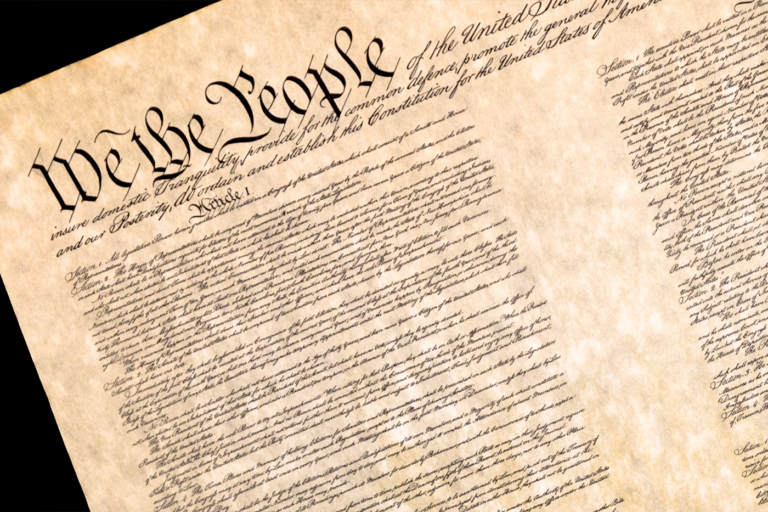
The third pillar of a decent society is a just system of politics and law. Such a government does not bind all persons, families, institutions of civil society, and actors in the marketplace to itself as subservient features of an all-pervading authority. Instead, it honors and protects the inherent equal dignity of all persons, safeguards the family as the primary school of virtue, and seeks justice through the rule of law.

Learn more about Politics & Law: get your free eBook today!

There are moral standards applicable to all forms of human behavior, including speech, but neither the existence of such standards nor even our acknowledgement of them entails that government should enforce them. Whether the government should enforce a given standard depends on the likely effects of such enforcement, and the sad history of censorship shows that empowering the government to suppress “immoral” or “offensive” speech is highly susceptible of abuse and results in serious violations of the rights we all have to engage in good speech and hear the good speech of others. Giving this power to government is wrong for the same reason that giving alcohol and automobiles to teenage boys is wrong.
Robert Miller’s defense of free speech risks removing the moral ground that could explain the rightness or goodness of the freedom we seek to preserve. In place of a moral defense in principle, we would simply have a set of utilitarian guesses: that if we pretend we have no standards of judgment, things will work out better for us in the long run.
Although they often have the flavor of thought experiments, the arguments of integralists are nonetheless worth taking very seriously. Their reflections include spot-on diagnoses of many pathologies affecting our political community.
If you really must attack other conservatives, take the time to figure out what they actually said and why, and interpret them charitably, the way you would wish to be interpreted. You owe this even to your enemies, but other conservatives are not your enemies but your friends. After that, have some definite arguments.
“Virtue politics” is modeled on the phrase “virtue ethics,” an approach to moral philosophy inspired by Aristotle and elaborated by the British philosopher Elizabeth Anscombe. “Virtue politics” describes the central concerns of Renaissance political philosophy. Like the ancient Greeks, the Renaissance humanists had a richer understanding of what the state has to do in order to encourage virtue.
Every time we fail to muster the courage to do what’s right, what God is calling us to do, there is behind that failure a still deeper failure: a failure of love.
Faith and family: for many of us, these are not only the most important parts of the Christmas season. They’re also the things that make life most worth living.
The team at Public Discourse doesn’t pretend to have all the answers, but we do think we’re asking the right questions, and getting the right thinkers to propose some of the answers. That’s one thing that we hope will always be our hallmark: thoughtful, reasoned discourse, which is rigorous yet still accessible to the educated layman.
Though Christmas is a religious holiday, secularists should appreciate its great contribution to Western Civilization: the lesson that all men are equal in their fundamental human dignity.
Christmas isn’t tasteful, isn’t simple, isn’t clean, isn’t elegant. Give me the tacky and the exuberant and the wild, to represent the impossibly boisterous fact that God has intruded in this world.
Once we recognize the insufficiency of liberal political theory, we should turn back to classical political philosophy, which offers us a deeper understanding of the American tradition and invaluable guidance in reforming our contemporary politics.
Conservative critics of “liberalism” are right to identify major flaws in liberal theory. But a deeper appreciation of those flaws should prevent us from blaming the American political tradition for them. Liberal theory is so erroneous that neither the Founders nor any other Americans could ever really put it into practice.
The first recommendation of the U.S. Commission on Unalienable Rights should be directed to the same State Department that houses it: Stop using the UN to advance sexual ideologies that have no basis in international human rights law.
Pope Francis’s theology of the people gives us a new ecclesial lens and paradigm through which to understand earthly politics. And the clerical abuse scandal, like the Church’s loss of temporal power, may well do Catholics a service in the long run, freeing us up to a better, more “ground-up” conception of how societies and their economies work.
Without a proper understanding of human beings that is grounded in natural law, human rights will always fall short of the lofty goals set by the Universal Declaration of Human Rights. If the U.S. Commission on Unalienable Rights is to help the U.S. protect human rights, it needs first to try to understand their nature.
Were the criminal sentencing reforms that began in the 1970s too harsh? Rachel Barkow’s new book says they were. But most Americans would likely call these changes progress: our worst offenders now get something closer to what they should get than in the days when the experts were more in charge of punishment. Perhaps the real question is whether we should ground our criminal law more on justice as retribution.
The Church must exercise its authority over temporal matters in a way consistent with its spiritual mission, of which the exercise of temporal jurisdiction is a betrayal. The human person is drawn by nature to seek out and hold the truth whose fullness is revealed in God’s revelation in Christ, but this vision of human fulfillment implies a human subjectivity whose freedom must be respected as it seeks out the truth which fulfills it.
Patient freedom would not survive a single-payer federally controlled health care system. The right to life would not survive a single-payer health care system. The right of religious freedom and faithfully Catholic health care would not survive such a federally controlled single-payer system.
Debates over judicial review and constitutional interpretation only stand to benefit from deeper reflection on the type of political community the Constitution established. The Political Constitution invites us to take the word republic, and its vision of self-government, seriously.
War has the complexity of most of the human condition—so complex, indeed, that it often behaves like a force of nature, but with a human face. And that renders the question of determining the justice of a war a little like determining the justice of a tornado.
Through his life and writings, Czech dissident Václav Benda showed that political activity, in the highest sense, requires one to adhere steadfastly to moral principles and to take care that one’s efforts be effective. Above all one must act with and for one’s community: humbly seeking mutual understanding among community members and, as far as possible, fighting for the common good together.
Senator Warren, please don’t compromise what you know to be true for the sake of political expediency. Don’t hurt American families by pushing them farther and farther into the two-income trap. Most of all, please don’t create a system that penalizes moms who choose to stay home with their children.
How should we understand the common good of a political community? Is membership in a political community purely instrumental, like membership in a business venture? Or is it intrinsically good, worth pursuing in itself? The answer to this philosophical question has far-reaching political implications.
We need good measures of economic activity, but we must not presume that these measurements are impervious to political pressures, as though they were no more than the product of certain methods.

Get your free eBook for The Human Person

"*" indicates required fields

Get your free eBook for Sexuality & Family

Get your free eBook for Politics & Law

Get your free eBook for Education & Culture

Get your free eBook for Business & Economics