Pillar

Politics & Law

The third pillar of a decent society is a just system of politics and law. Such a government does not bind all persons, families, institutions of civil society, and actors in the marketplace to itself as subservient features of an all-pervading authority. Instead, it honors and protects the inherent equal dignity of all persons, safeguards the family as the primary school of virtue, and seeks justice through the rule of law.


Learn more about Politics & Law: get your free eBook today!

What often intrigues my Chinese colleagues and students is that we do not need to accept the Christian faith that Thomas Aquinas embraced to see that, on his principles, there is no need to choose between viewing creation as the constant exercise of divine omnipotence and acknowledging the causes that the natural sciences disclose.
The Catholic Church should not abandon Just War doctrine in favor of Just Peace theory. The social and political realities of our time, as in all times, require that we have a theologically grounded moral framework for both judging particular acts of war and then working to limit war on the basis of those judgments.
Americans are in the midst of an important debate about the virtues and dangers of nationalism. Unfortunately, interlocutors are not always clear about what they are arguing for or against when they use the term. Some key distinctions from the work of Jacques Maritain can help clarify matters.
For centuries, judges, lawyers, and legislators agreed that the object, end or purpose of the law—more precisely, the “mischief” that it was enacted to overcome—is crucial for determining its meaning. Any uncertainties in the meaning of the terms employed by the lawgiver must be resolved in accord with general custom and common usage at the time the law was enacted. Bostock is the most recent example of the Supreme Court violating this foundational principle of the rule of law.

A great war was fought. Slavery was abolished. Still, on this fourth and fifth of July, 168 years after Frederick Douglass gave voice to feelings of alienation from white American pride and patriotism, recent events compel us to recognize that such feelings persist.
Pro-lifers have waited nearly a half century for the Court to repudiate its entire ill-founded abortion jurisprudence. The state’s interest is not in protecting some esoteric “potentiality of human life,” but in protecting the lives of actual vulnerable, unique, and utterly dependent human children. More still, women’s liberty is not best described by Casey’s paean to nihilism; rather, properly understood, women’s liberty is not in conflict with their unborn children at all.
A new book systematically defends the American Founding against those who believe it was destined to end in nihilism.
For Abraham Lincoln, the victory at Gettysburg appeared almost as a ratification of the Declaration of Independence and its principles.
Many on both the left and the right tend to speak of systemic racism simply as a 0/1 state: either the system is fundamentally and inextricably racist or it is not racist at all. But recognizing distinct mechanisms at play in a racialized system should help us see systemic racial bias as a matter of degrees—as something that can improve or worsen over time. Indeed, research suggests that racial disparities have been declining over time, though there is no guarantee of inevitable progress, and our present situation makes it clear that we still have a long way to go.
Sin corrupts every institution and every system because, one way or another, sinful human beings are involved. This means that laws, policies, habits, and customs are also corrupted by sin. We are called to do everything within our power to expunge sin from the structures of our society. Christians know that the justice of God demands that we do so. At the same time, we cannot accept that the structural manifestations of sin are the heart of the problem. No, the heart of the problem is found in the sinfulness of the individual human heart.
Christians are called not only to pray but also to act for justice, because faith without works is dead. Today, we are called to give new birth to the civil rights movement, to finally fulfill the promise of the American civil rights project for which so many fought and died.
Police killing is not the work of vigilant warriors defending society at great personal cost, and sometimes going too far. It is the day-in, day-out petty tyranny of a taxpayer-funded bureaucratic lobby group. The difference is that, unlike other public sector unions, police unions have military-grade equipment they can use to violently crush protests against their abuses, and they are legally immune from most consequences. They’re teachers’ unions, but with tanks and endless get-out-of-jail-free cards.
Neither the intent nor the letter of the Civil Rights Act, nor the Court’s own jurisprudence, compels sex blindness. The judges who have failed to see this truth are not “woke.” They’re asleep on the job.
In some respects, Alasdair MacIntyre offers strong arguments in favor of political liberalism. At the same time, he offers critiques for both liberalism’s proponents and opponents.
“Black lives matter,” taken as a sentence, is profoundly true. God made every human being in his image, which means every life on the planet, at every stage, matters. Yet that sentence is understood, nearly universally, as expressing approval of a movement rooted in critical race theory, which is grounded in destructive Marxist ideology.
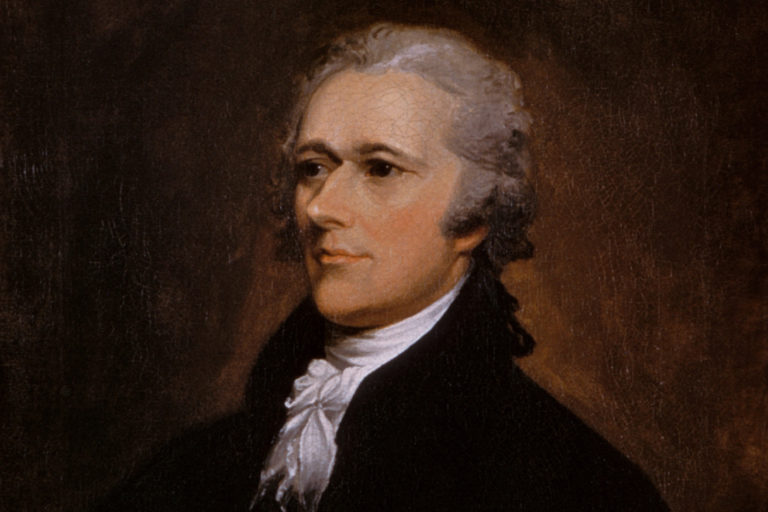
Although Alexander Hamilton is regularly invoked by contemporary American nationalists to lend legitimacy to their positions, his nationalism differs significantly from theirs.
Justice Gorsuch’s position would either require the elimination of all sex-specific programs and facilities or allow access based on an individual’s subjective identity rather than his or her objective biology. When Gorsuch claims that “transgender status [is] inextricably bound up with sex” because “transgender status” is defined precisely in opposition to sex, he presumes the very sex binary his opinion will help to further erode.
The bargain has never been explicitly articulated, but religious conservatives know what it is. The bargain is that you go along with the party establishment, you support their policies and priorities—or at least keep your mouth shut about it—and, in return, the establishment will put some judges on the bench who supposedly will protect your constitutional rights to freedom of worship, to freedom of exercise. How has that worked out for us?
The common good is the flourishing of a community qua community. Every community is built around a common end, which is simply that it excel, in justice, as whatever kind of emergently real community it is. The common good is primarily a practical idea, but if our starting point is too practical we are apt to miss the challenge that the common good poses to the modern political imaginary. On the other hand, a starting point that is too metaphysical will fail to engage the real questions of common life.
Liberal justifications of liberal education are no longer effective. Teachers of humanities need a different way of defending the value of what we do and love. The Renaissance can teach us how to make a case for the study of old books that is compatible with the values of a pluralist society.
Fifty years from now, no one will care about May’s job numbers or the rocket launch. But they will remember whether—in the face of 400 years of pain and oppression—the president of the United States took decisive and bold action to heal this nation of its racist past and present through a particular and sustained national effort.
The fact is, many in positions of power and influence are oblivious or unaware of the unique challenges disproportionately facing African American communities across this country. We must now acknowledge these challenges and address these disparities that they create. The only way forward is to treat each other with the empathy and respect required of a people who have decided to share a nation—and a future.
For the considerable body of people in the western world who still believe in self-government, and in the preservation of their nations’ traditional moral identities, the overreaching of the contemporary human rights project will perhaps lead them to reconsider natural law, presented in a prudently modest formulation. This is a crucial undertaking to which Pierre Manent’s new book is a worthy contribution.
The term “social justice” is typically associated with an aggressively progressive political agenda led by a muscular Uncle Sam. But there is an alternative understanding of social justice—one that is especially well-suited to helping the nation address many of today’s most troubling challenges. It’s time for conservatives to explain this approach and articulate an agenda for the future based on it.

Get your free eBook for The Human Person

"*" indicates required fields

Get your free eBook for Sexuality & Family

Get your free eBook for Politics & Law

Get your free eBook for Education & Culture

Get your free eBook for Business & Economics