Pillar

Education & Culture

The fourth pillar, education and culture, is built upon the recognition of two essential realities. First, the Western intellectual tradition requires a dedication to and desire for truth. Second, education takes place not only within colleges and universities but within our broader culture, whose institutions and practices form us as whole persons.

Learn more about Education & Culture: get your free eBook today!

Lent is not merely an occasion to give up chocolate or beer, do a few good deeds, and give a bit more to charity, although those are all acceptable ways to do penance. Lent is more: an intransigent insistence that humans are free and possess, in whatever condition they happen to find themselves, the dignity of responsibility.
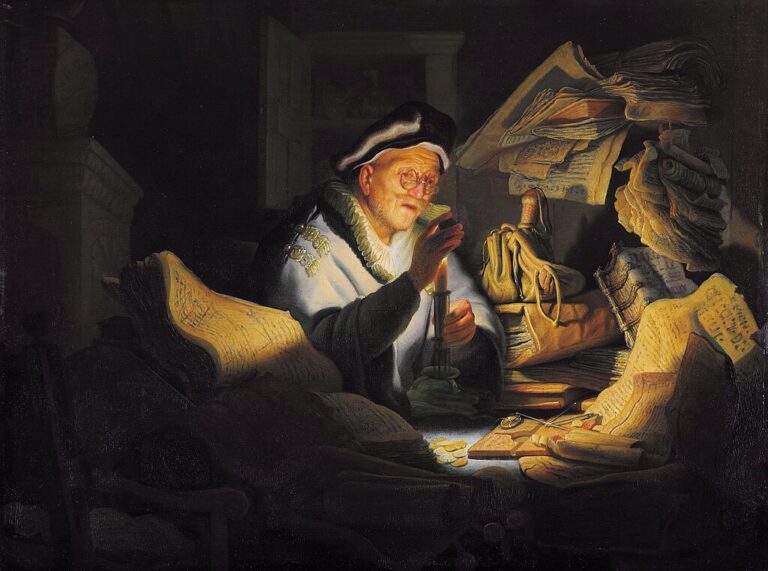
If wealth is as deceitful as Christ teaches in this parable of the sower, and we are the wealthiest society that has ever existed, then the occasion for temptation and deception is greater as well. And so we must cultivate habits of gratitude for what God has provided to us and practices of giving for what God wills.
Called to Liberty may prove useful for those outside the Church who seek a broad introduction to the paradoxes of freedom. Still, more is needed to recover freedom from its current drubbing by both radicals on the Left and reactionaries on the Right—a drubbing that increasingly rejects measure, moderation, and maturity. 
The new antagonism toward wine and other forms of alcohol seems similarly de-personal to me. It neglects the way that wine, at its best, functions in relationships: at a family meal, a wedding, a couple celebrating their anniversary, and the Eucharistic feast. And it treats what should be an individual decision—to drink or not—entirely in terms of a statistical approach to alcohol’s health risks.
Scruton was acutely aware that, in a society that has largely lost its religion, art can give people a sense of the timeless and transcendental. That is why he spent his life defending genuine art from those who would “do dirt on life.” However, it is also true that art can never provide the redemption that is promised by religion. The reason for this is that while art may offer us “intimations” of the sacred, only religion can reconcile us to it. 
It’s unclear so far what, if any, decisive or long-term impact Ozempic might have on American health. But the contours of the debate are revealing.
If you want a guide for revitalizing Western academia and culture, read Joseph Stuart’s masterly introduction to the thought of Christopher Dawson.
In announcing Christianity’s incompatibility with civilization, Kingsnorth implicitly claims to have noticed a vital truth of the faith that was somehow overlooked by most of the great teachers of Christianity for most of Christian history. This is a rather dubious proposition.
The answer to the fear of Babylon, then—Kingsnorth’s “civilizational Christianity”—is not to relinquish the fields where civilization is made in order to pursue a purer form of Christian service. The answer is rather to seek the Kingdom first with such clarity of intention that every domain of human making can assume its rightful share in Christ’s offering of himself and all created things to his Father.
Once you concede that the universe might be a bit more than just a collision of atoms doing meaningless expansions and contractions, you are not standing alone next to an enigmatic aurochs, staring with bafflement into its inhuman eyes. No, you are standing in the same place that generations of human beings have found themselves before: at the beginning of a journey, a quest, a pilgrim’s progress, that you have good reason to believe is going somewhere quite important, somewhere of ultimate significance.
Peterson is not looking to illuminate the pages of the Bible per se. He seems interested in the Bible only insofar as the stories it contains connect with other mythical or symbolic stories throughout human history, and support his main thesis: that each individual should aim at that which is highest and organize life (and by extension, society) accordingly.
A lot of people will no doubt want to know about the political direction of the new civics centers, and there is no hiding that they are inspired by conservative intellectual sensibilities. But to think that there is any sort of partisan agenda set from above misses the point of these schools entirely.
What makes the popularity of a work of art wax and wane is one of the most intriguing questions in the history of aesthetic preferences.
How can the academy recover its vocation, its true identity as a center of humane inquiry?
While Orthodoxy’s “multipolar” context arguably can foster temporary frictions, across centuries it has also lent itself to an oddly flexible resilience, not always easily legible to Western perspectives.
As lawmakers across the country increase their scrutiny of emerging technologies, tech-savvy religious organizations will have to navigate an increasingly contested boundary line between the requirements of law and the demands of faith.
McDermott’s central claim is surely right. In everything and in every place, God is providentially at work to effect redemption. If engaging with his work can foster this awareness in us as readers, then that is precisely a “dimensional difference” that will be all to the good, raising to greater consciousness the wonder and beauty of God’s work.
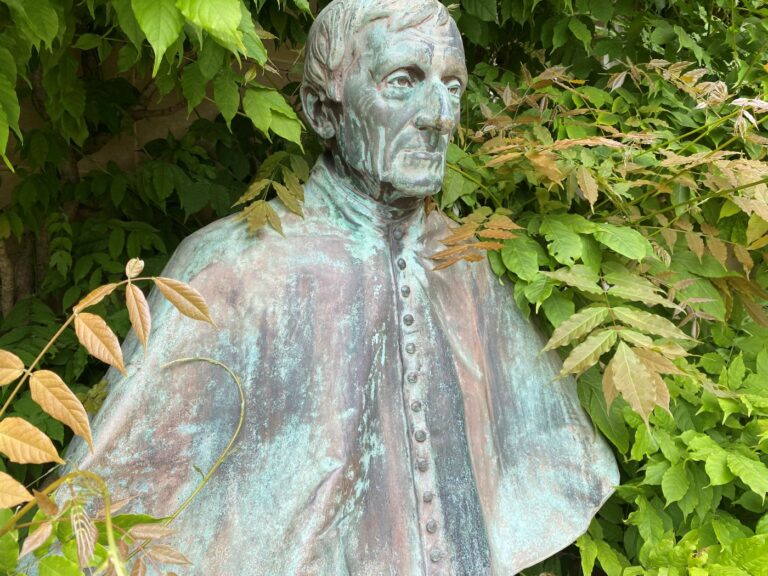
The book’s importance goes beyond the perennial value of Newman; Görres penetrates deeply into the heart of Newman’s character and life. In doing so, she reveals what made him holy, and holiness is of perennial value.
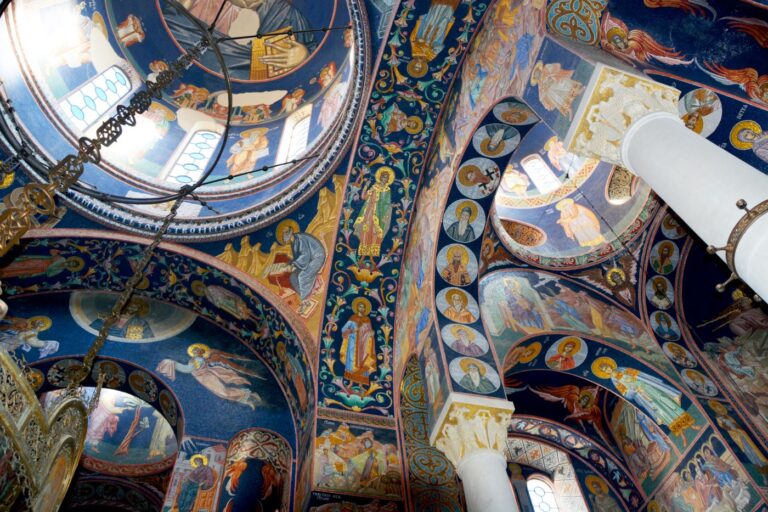
It is once again time to build in stone, to raise walls high, to vault our ceilings in limestone, to buttress the walls, to construct heavy timber and lead towers to the heavens, and to revive the art of murals, statues, and stained glass.
The fundamentally Marxist philosophy of Alasdair MacIntyre has less to teach conservatives than some have claimed.
From a scholarly perspective, the Bud Light boycott represents one of the first battles in the adaptation of political conservatives to their continued cultural disadvantage. Conservatives still operate at a disadvantage in academia and entertainment, but they have created an alternative media system that allows them to have a place at the table and an impact on our culture.
Peterson leads us to the door of the Church, but we must take the step our guide is unwilling to take and enter inside. We pray for Peterson to join us, not because we need an ally—the Truth will fend for itself—but because we hope he can embrace the “ridiculously good” gift of grace, cross the border, and become a brother united in Christ.
Residential undergraduate matriculation may not be worth what is being charged for it now, but if it continues to atrophy and lose its comparative advantages, it may become worth nothing at all.

Get your free eBook for The Human Person

"*" indicates required fields

Get your free eBook for Sexuality & Family

Get your free eBook for Politics & Law

Get your free eBook for Education & Culture

Get your free eBook for Business & Economics