Pillar

Politics & Law

The third pillar of a decent society is a just system of politics and law. Such a government does not bind all persons, families, institutions of civil society, and actors in the marketplace to itself as subservient features of an all-pervading authority. Instead, it honors and protects the inherent equal dignity of all persons, safeguards the family as the primary school of virtue, and seeks justice through the rule of law.


Learn more about Politics & Law: get your free eBook today!

Many people do care—and care a lot—what the editors of First Things think about Christian-Jewish relations, and this time the galloping statism of First Things is doing great damage in the real world. Robert T. Miller calls on R.R. Reno to disavow the position Romanus Cessario takes on the Mortara case and to reaffirm the journal’s historical commitment to the freedom of religion as understood in liberal states.
In a paradoxical new book, Columbia University professor Mark Lilla correctly identifies the defects in contemporary liberalism and identity politics but cannot free himself from them.
The letter below was written by a bipartisan group of past Chairs together with the current Chair of the United States Commission on International Religious Freedom (USCIRF). They praise the people of Iran for their courage and expressing solidarity with them. In addition, they call on the US government to support the protestors in Iran and to send a clear signal that human rights and the Iranian government’s treatment of dissidents will be at the top of the agenda in any future dealings between the US and Iran. This letter is a response to nearly a week of demonstrations across Iran. What began as a protest against high food prices and rampant unemployment has broadened into a political movement demanding leadership changes and greater freedom and human rights. The government has responded with violence: more than twenty protestors have been killed, and hundreds have been arrested.
While the American regime is often criticized as Hobbesian, the letters of Thomas Jefferson provide evidence that it may be more accurately described as Epicurean.
By making our common humanity irrelevant to the question of identity, Richard Spencer sets himself in diametric opposition to the intellectual roots of the “Western” civilization to which he would lay claim.
Because he accepts a Straussian framework that sees modernity rather than Christianity as the major turning point of Western history, Rod Dreher underestimates the influence of Christian and classical thought on the American founding.
Young people today, especially the ones who are serious about religion and look to the editors of First Things for guidance, must resist the allure of an intellectual Fortress of Solitude where they can sit and feel superior to everyone. Griping about the state of society is a waste of time. Part two of two.
Leo Strauss’s statements on philosophy do not deny that knowledge is possible. Rather, they emphasize that philosophy—while motivated by awareness of one’s own ignorance—is a way of life teleologically ordered toward knowledge.
The government cannot impose creedal and exclusionary limits on occupational freedom by compelling particular citizens to provide goods and services contrary to their beliefs, unless those citizens have such a monopoly market power as to exclude other citizens from the market.
New research points to “internalized homophobia” as the problem, not external discrimination.
Why are Christian bakers and florists less worthy of accommodation than groups who would engage in nearly identical behavior for equally expressive, but not necessarily religious, purposes?
Just as governors, abortionists, and sexual-identity activists enjoy legal protection for their property rights, so do religious business owners.
The Supreme Court is about to decide whether a baker has a First Amendment right not to be compelled to design and create cakes celebrating same-sex weddings. The baker’s best legal argument is simple, and it survives the best objections filed by the ACLU and Progressive scholars.
Two Yale law professors say religious liberty should not be accommodated in “complicity” cases such as Masterpiece Cakeshop and Arlene’s Flowers. Their argument fails to recognize that such accommodations are a traditional and necessary part of the American legal framework.
Several progressive Muslim organizations have signed an amicus brief supporting the same-sex couple in the Masterpiece Cakeshop case. This not only distorts Islamic teaching and anthropology, it also fuels the increasingly powerful movement of militant irreligious orthodoxy.
If E. Christian Brugger is right, then the Church has been teaching grave moral error and badly misunderstanding scripture for two millennia. Nothing less than her very credibility is at stake.
E. Christian Brugger is wrong: neither scripture nor tradition could justify a reversal of the Church’s millennia-old teaching on capital punishment
Candida Moss and Joel Baden sound an alarm about the Green family, owners of Hobby Lobby and founders of the Museum of the Bible. The real target here, though, is not so much the Greens as the evangelical Protestant view of the Bible that they embrace.
Christian witness must go deeper than simply asserting our right to our “sincerely held beliefs.” Igniting the religious question is the best way to restore reason to a public square.
In their new book, Ryan T. Anderson and Sherif Girgis make a strong case for pluralism and ordered liberty, while John Corvino drafts a blueprint for a comprehensive despotism that would consume the preconditions and legal safeguards for ordered liberty. Part two of a two-part review essay.
The implications of John Corvino, Ryan T. Anderson, Sherif Girgis’s well-argued debate reach far beyond the latest round in the culture wars. They go to the foundations of the American experiment in ordered liberty. Part one of a two-part review essay.
Love of country and love of the Constitution—a simple and pure patriotism matched with a sophisticated historical sensibility—run through a new collection of Justice Antonin Scalia’s speeches.
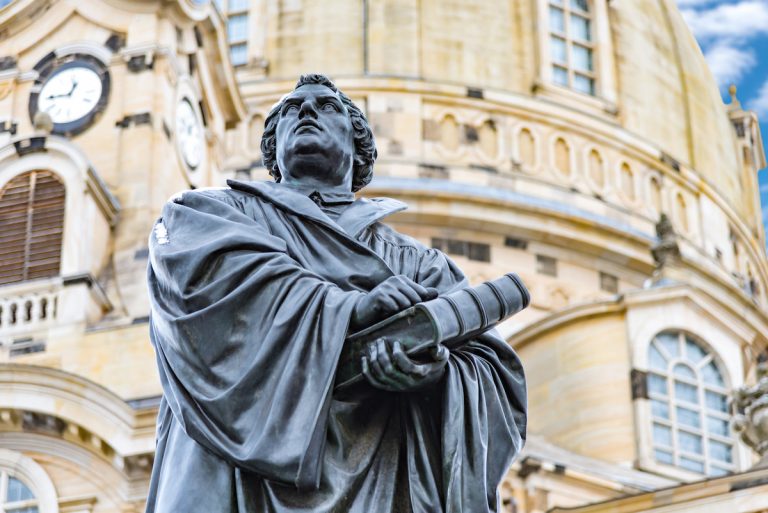
On the 500th anniversary of the Protestant Reformation, it is worth returning to the thought of Martin Luther, particularly his understanding of vocation.
Antidiscrimination laws are fully within the government’s authority—but only when the government is not using such laws as part of a campaign to compel people to express “by word or act” their support for a government-prescribed orthodoxy. The second in a two-part series.

Get your free eBook for The Human Person

"*" indicates required fields

Get your free eBook for Sexuality & Family

Get your free eBook for Politics & Law

Get your free eBook for Education & Culture

Get your free eBook for Business & Economics