Pillar

Education & Culture

The fourth pillar, education and culture, is built upon the recognition of two essential realities. First, the Western intellectual tradition requires a dedication to and desire for truth. Second, education takes place not only within colleges and universities but within our broader culture, whose institutions and practices form us as whole persons.


Learn more about Education & Culture: get your free eBook today!

Political theory typically attributes political action to one of two main motivations: idealism or self-interest. But incompetence plays a much larger role than many assume.
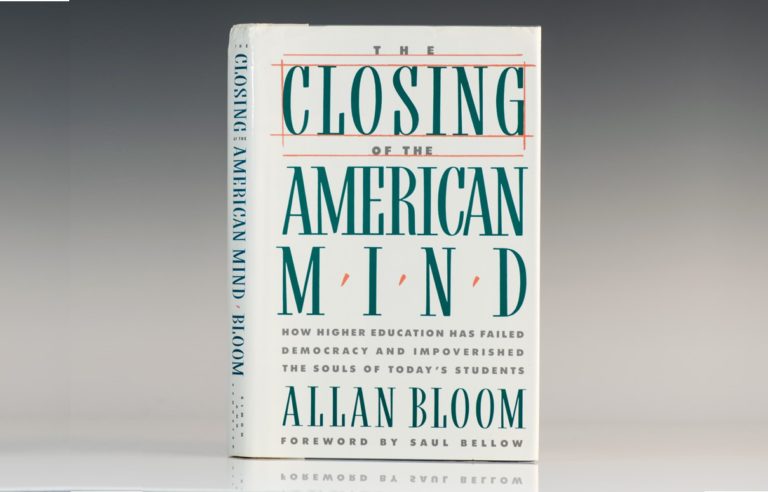
The authors in this symposium have offered insightful analyses of Bloom’s book and the contemporary university it describes. Can what has been lost be recovered? If so, this will come through restoration of the imagination.
Allan Bloom would not have been surprised by recent developments in American higher education, from trigger warnings and safe spaces to micro-aggressions and physical violence.
What would have happened if literature professors had continued to love literature, admire Shakespeare, and teach others to do the same? Perhaps if they had emulated Allan Bloom’s attention to words—if they’d taught writing and written well themselves—our colleges would not now be so enraged.
Souls without longing are the price to be paid for a free, comfortable, and secure life. Yet the unnatural state of radical isolation and apathetic “niceness” can only last so long.
All is not well in America—or in the University. Allan Bloom’s The Closing of the American Mind offers a profound and compelling diagnosis of the common illness infecting them both and of the intimate connection between liberal education and liberty.
Fake history has established the foundation for fake news.
As long as complicit bystanders refrain from voicing dissent, embryo destruction will continue to masquerade as a practical, commonplace business, rather than the social cancer it truly is.
Significant advances in evolutionary biology and the neurosciences have led many who are already committed to a materialist philosophy to offer sweeping accounts of the origin and development of life, from bacteria to the human mind and consciousness.
To detach religious liberty from truth is to decapitate it.
Is “pro-life IVF” necessarily an oxymoron?
The traditional philosophical and theological concept of the soul allows us to integrate what the empirical sciences reveal with what we know about ourselves as rational and moral beings.
Let’s set aside partisanship and unite to provide disadvantaged children with the educational opportunities they deserve. Rather than deny low-income families the same educational choice that wealthier families enjoy, we should seek other ways to improve the quality and efficiency of public schools.
A newly published translation of “the Italian Russell Kirk” offers important insights into the philosophical roots of our culture’s nihilistic impulses—and how we might fix them.
Abraham Flexner, founder of the Institute for Advanced Study, has much to teach modern researchers—not only about seeking knowledge for its own sake, but also about effective fundraising and private philanthropy.
The more you minimize the value of humanity itself, the less you will be capable of understanding our fundamental rights, the meaning of our bodies, and the gift of sexuality.
Kevin Vallier’s recent book is a rich and rewarding attempt to reconcile people of faith with public reason liberalism.
All children are equally valuable. Their bodies are equally deserving of protection, regardless of their religious status.
The easiest test of a work’s true power is to ask whether or not it pulls us into the wardrobe and propels us out of the cave. If an author has inspired us to vacuum the carpets, wash the windows, or buy the groceries with brighter smiles on our faces, then he has done something truly wonderful.
Libertarians may miss certain cultural nuances that traditionalists are able to see, but the reverse is also true. In this moment of political transition, we should be grateful for minds that turn endlessly on the government-skeptical spit.
Contemporary legalism downplays, ignores, and occasionally denigrates the “rules” of morality in favor of mercy, accompaniment, and integration, because it fails to see that there is an essential and constitutive relationship between morality and human flourishing.
Both principle and prudence are necessary if “the very mercy of the law” is to be achieved.
This world does not need men to selfishly take whatever we want, especially if the price is the welfare of our children. Our children don’t need superheroes—just quiet, unsung, ordinary, everyday heroes who answer to the name “Daddy.”
Global governance projects don’t just foster unaccountable bureaucracies and rule by experts. They are increasingly corrupting the idea of human rights.

Get your free eBook for The Human Person

"*" indicates required fields

Get your free eBook for Sexuality & Family

Get your free eBook for Politics & Law

Get your free eBook for Education & Culture

Get your free eBook for Business & Economics