











Search Results For:

Search Results for: patriot

The things we’re willing to die for are tied to what we hold as sacred. In fact, the willingness to die for something also consecrates it as sacred. We need to entertain the possibility that love for our country might lead us to sacrifice greatly, even radically, in order to preserve the best that remains in it.
A timely book on the thought of Harry Jaffa and Walter Berns reminds us that patriotism needs to be about ideas and principles, but it cannot only be about ideas and principles. To win—and deserve to win—elections, conservatism must also inspire love of country and serve the immediate interests of the ordinary man.
As the American story enters its fifth century, the list of those who have earned the right to be called fathers and mothers of our country grows ever longer. As we retell our national story to each generation, we will of course continue to argue about whether some of the characters were really heroes or villains—a debate that is part of every nation’s storytelling. But unless we can recover a certain generosity towards those who came before us, we will find ourselves with nothing to pass on to those who come after.
We’re not born being patriots. It’s not something that’s inscribed in our moral DNA; rather, it’s something that has to be cultivated. It is love of country. But as Edmund Burke famously wrote, “To make us love our country, our country ought to be lovely.” What does it mean to have a lovable country, and what should the honest patriot do or think?
The things we’re willing to die for are tied to what we hold as sacred. In fact, the willingness to die for something also consecrates it as sacred. We need to entertain the possibility that love for our country might lead us to sacrifice greatly, even radically, in order to preserve the best that remains in it.
September 11 should serve as a day of remembrance, but also as a day of reflection. We should reflect on the day, what it means to be an American, and how we can take up President Reagan’s charge to develop an “informed patriotism.”
While the economic arguments for free trade remain compelling, the political rationale requires a long-overdue overhaul.
A timely book on the thought of Harry Jaffa and Walter Berns reminds us that patriotism needs to be about ideas and principles, but it cannot only be about ideas and principles. To win—and deserve to win—elections, conservatism must also inspire love of country and serve the immediate interests of the ordinary man.
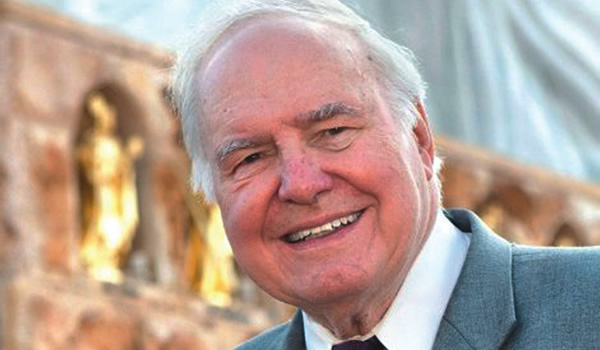
The life and work of Michael Novak was a witness to Christian faith and the promise of America.
Patriotism isn’t merely something you show in a parade; it means having to deal with people with whom you disagree, but whose lives are bound to yours as yours is to theirs, in a long, difficult, patient, and sometimes painful search for the common good.
Rather than reject liberalism for its excesses, we should take up the more modest task of recovering the principles of liberalism once embraced by our founding fathers and Abraham Lincoln.
Though America’s ideals were riddled with ironies and inconsistencies, the nation still emerged as a global beacon of ordered liberty and republican democracy. No one better explained the history and significance of that American nation than Gordon Wood. 
Reflections on the nature of the American experiment in ordered liberty 
Two hundred and fifty years since our nation’s founding, the public conscience has begun to replace its fidelity to inalienable rights and religious freedom with a state-enforced commitment to radical human autonomy.
What unions need is more internal flexibility. Workers need a way to voice their displeasure with union politics. And if voice isn’t enough, they need a realistic way out.
Taken as a whole, Rosen’s book offers a learned and sober account of the relevance of Hamilton’s and Jefferson’s principles to America’s past, present, and possible future. 
The broad acceptance by self-described conservatives of casual war, initiated without the approval of the clear constitutional authority of Congress, is in sharp contrast to the caution and prudence at the heart of the conservative disposition.
From the Gospel, to Acts, to the Church Fathers, to the doctrine of the two swords and the freedom of the Church, to the recognition in modern times of the freedom of conscience as an unalienable right at the foundation of a free society: the very ideas of human equality, freedom, and limited government would never have borne the fruit we see in American society without the Christian—and Catholic—intellectual tradition supplying the argument.
The church’s task is neither to baptize the sword nor to pretend the sword has no place in a fallen world. It is to stand beneath the cross, telling the truth. 
In recent decades, many have committed themselves to the recovery and practice of classical education. It has until recently been a close-knit affair, but in the last half decade the growth and success of the movement has prompted those outside to ask those inside what, precisely, the thing is.
Field’s account is eye-opening. At the same time, as a professed “liberal,” she exhibits elements of excessive partisanship that weaken her argument. 
We need philosophical arguments to counter the empty voluntarism of our time, and this is a challenge the Church should meet head-on.
Few Christians in the eighteenth century wore as many vocational hats, and accomplished as much in so many different fields, as John Witherspoon. The question is whether all these hats held together. I think they did, perhaps just barely, but they did. And I think they tell us something important about the founding of this country and the spirit of 1776.