Pillar

The Human Person

The first pillar of a decent society is respect for the human person, which recognizes that all individual human beings have dignity simply because of the kind of being they are: animals whose rational faculties allow them to know, love, reason, and communicate. It also recognizes that human beings are persons, members of the human family who flourish in a community that respects their fundamental rights and who long to discover transcendent truths about the nature of reality.


Learn more about the Human Person: get your free eBook today!

In some states, it’s almost impossible for pro-life governors to appoint originalist judges. That’s why we must pursue state-level judicial reforms before Dobbs is decided. To make the most of this opportunity, most of us need to turn our attention away from DC and toward our state capitols.
We are witnessing a kind of last battle, a feminist Armageddon that will determine whether feminism, as a movement centered upon the wellbeing of women and girls, will endure into the future or self-immolate. Only a return to realism can provide a stable definition of woman, the requisite ground for effective feminism.
In her new book, Erika Bachiochi presents a compelling vision of female equality and happiness that embraces a woman’s capacity for childbearing and encourages sexual virtue and strong marriages as an antidote to difficulties that abortion can never hope to solve.
The resolution on abortion that was passed at the annual meeting of the Southern Baptist Convention in Nashville was well-intended but woefully flawed. It offers no exception for the life of the mother, and it opposes incrementalism. Those two items are serious shortcomings that would lead to the loss of more innocent lives, not fewer.
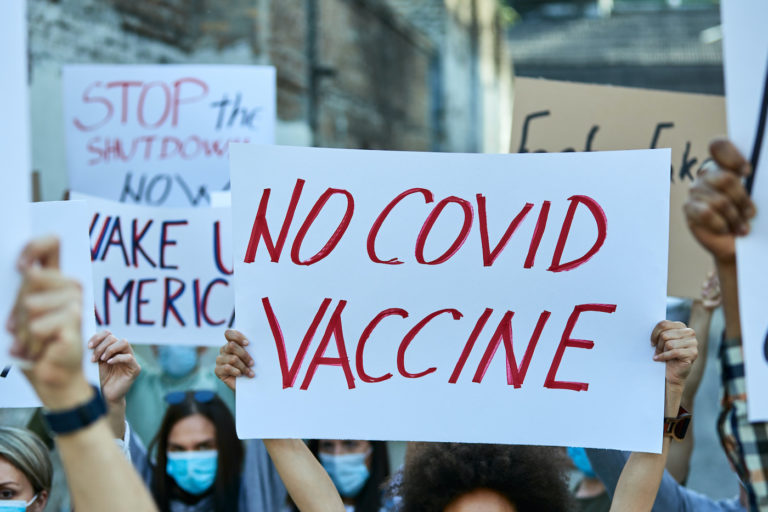
Even if abortion had nothing whatsoever to do with the development of COVID-19 vaccines, many pro-lifers would be just as vaccine-hesitant. Often, convincing our neighbor to take a vaccine requires rebutting objections that have nothing to do with abortion.
It is wrong to force religious individuals who are highly skilled medical and mental health professionals to violate their core religious convictions by compelling them to support and participate in terminating life, or in elective therapies that seek fundamentally to alter the human person, whether to achieve transgender ends or transhumanist ones.
“Medicine is a humanistic discipline that uses science to accomplish what all human beings would like to see for themselves, in their capacity to sustain themselves. Ultimately it is to aim for a person who could be what God intended him to be.”
If we have a calling in life, it is because someone has called us. God calls each of us by name to a specific path of holiness and service to others. Important as professional success may be, the only success of ultimate importance is holiness. The only real tragedy in life is not to have been a saint.
If stopping gestation no longer inevitably entails the death of a fetus, then the entire landscape of abortion rights and jurisprudence has fundamentally changed.
The greatest enemy of our freedom, which we all must confront, whether we live under a totalitarian regime or in a free society, is our deep-seated tendency to create and cling to a simplistic, false notion of our identity.
Neither Michael Pakaluk’s criticisms of a statement by pro-life scholars on COVID-19 vaccines nor his positive arguments against those vaccines hit their mark. The purchase and use of HEK293 and similar cell-lines are not intrinsically impermissible. Well-formed people of good faith may be moved by the very strong reasons that exist to take the vaccine to do so.
Scholars who advocate receiving the vaccinations for COVID-19 should not minimize or brush aside concerns that those vaccines were produced with the help of abortion. Facing the problem more fully should not rule out vaccination, but it will help us better understand the depths of our entanglement in this late-modern culture of death.
No magic pill or incantation solves the mystery of death, but a new handbook shows mortals how to use medical resources and cultural practices to die better. It emphasizes our interdependence, cautioning readers to avoid therapeutic obstinacy, to recognize the moral dimensions of dying, to grieve, and—in so doing—to grow.
Easter reflections are supposed to be lighthearted and joyful. But I’m gravely concerned by the unkindness in the name of kindness so evident in our cultural moment. Our society appears determined to return to the mastery and enslavement of Egypt. We have become forgetful of human limits, do not stand in awe of God’s acts, and so we have become cruel. Jewish and Christian holy days remind us of the need for mercy if society is to overcome its hatreds.
Christianity and Judaism have survived, and now thrive, not by erasing the problematic aspects of their past, but by openly acknowledging them—by building them into their rituals and incorporating them into the very fabric of their faith.
The following began as an email exchange, initiated by Richard Stith’s message to the authors of recent Public Discourse articles—particularly this statement by Catholic scholars—arguing for the moral permissibility of receiving the COVID vaccines. Melissa Moschella responded to the message, and an insightful dialogue ensued, which we believe would be of interest to many readers. Here is a revised version of the exchange.
To live a good life, our intellect, will, and passions must be aligned with one another and with the nature of God. We must know what good we pursue, how we pursue that good, and what—or Whom—we love.
The Equality Act goes far beyond the noble desire to protect vulnerable people. It burdens consciences, severely curtails the rights of people to practice their faith, smuggles in an abortion mandate, and explicitly exempts itself from respecting religious freedom.
The Ethics and Public Policy Center has organized the following statement from leading pro-life Catholic scholars, including EPPC President Ryan T. Anderson, EPPC board member and Princeton professor Robert P. George, and EPPC Fellow and Notre Dame professor O. Carter Snead, along with two professors at pontifical universities in Rome and other U.S.-based scholars, to explain why it is morally acceptable for pro-life citizens to receive any of the COVID-19 vaccines currently available.
Natural and legal rights are not like individuals of the same species, but analogous ways of identifying what justice demands. Natural rights provide a standard by which legal rights are to be understood and corrected; but legal rights are the means by which natural rights are to be secured and realized in a polity.
Wokeness meets a religious need by mimicking a Protestantism that our society has largely left behind. Although it highlights important truths, Wokeness needs to retrieve the orthodox teaching on the universality of original sin, the Christian understanding of salvation through the divine Scapegoat, and the centrality of the Church in its social imagination.
A new book by Christopher Kaczor is an accessible resource for those who want to understand current debates in the field of medical ethics.
The lastingness of each person’s reality as male or female is so integral to the faith’s architecture, that to deny it—even to equivocate about it—is to undermine Catholic faith itself. No Catholic institution should risk that effect.
Practical reasons are where the action is if one is to engage agents, the culture at large, and even popes, in moral discussion, debate, and deliberation. There is really no alternative in an ethics of virtue, acquired or infused.

Get your free eBook for The Human Person

"*" indicates required fields

Get your free eBook for Sexuality & Family

Get your free eBook for Politics & Law

Get your free eBook for Education & Culture

Get your free eBook for Business & Economics