Witherspoon Institute
2026 Summer Seminars
Held in Princeton, NJ
For rising high school juniors and seniors, undergraduates, and graduate students.
Keep up with the conversation! Subscribe to Public Discourse today.
Book Reviews
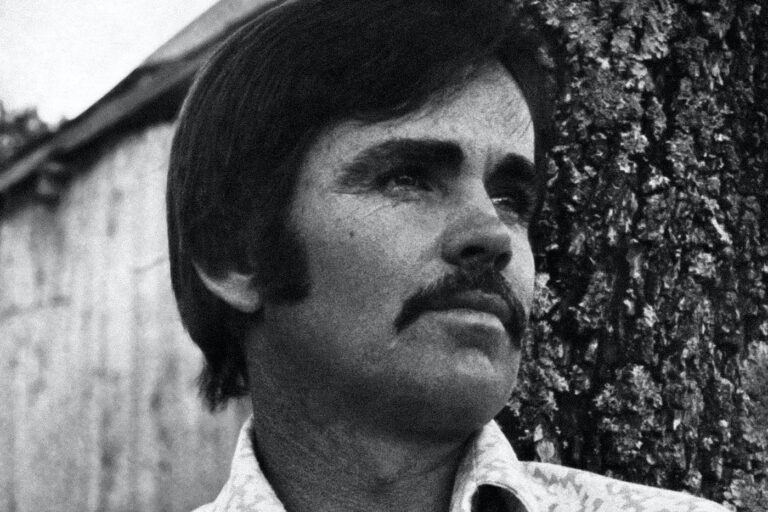
Cormac McCarthy, who passed away today, gives readers reason to suspect that he did not shut the door on God before his life ended. His last two novels, The Passenger and Stella Maris, offer more than just an artistic representation of reality’s inescapable brutality. They forcefully struggle with the greatest questions of human existence. Like any good work of art, these books don’t allow any reader—religious, atheist, materialist, Christian—to walk away feeling perfectly comfortable in their understanding of the world.
The Soviet regime is formally gone, but the legacy of its formidable security apparatus lives on. There was never a “decommunization” process in the wake of the USSR’s collapse. The vast majority of those who had participated in its structures and atrocities escaped punishment, and many of them created political careers in the post-communist era. People like Vladimir Putin were deeply marked by their socialization within that apparatus.
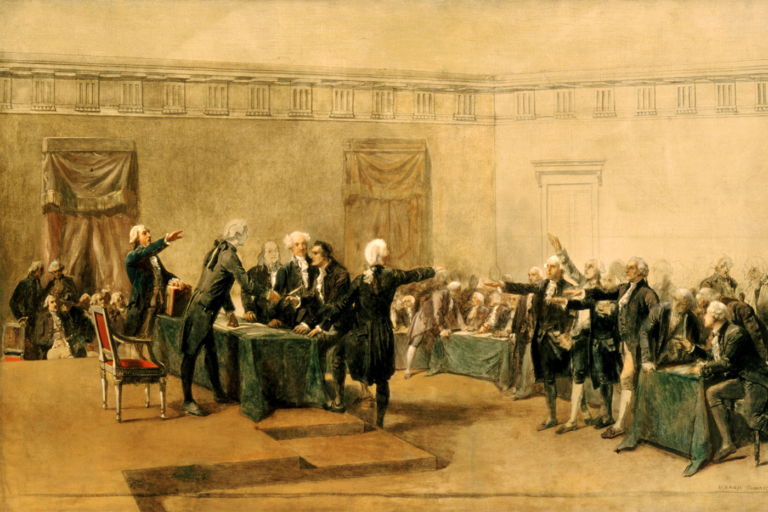
In The Classical and Christian Origins of American Politics, Kody Cooper and Justin Dyer successfully refute the still (somehow) influential interpretation of the American Founding as a secular-not-Christian project. However, they do so without successfully establishing their preferred alternative, the Christian-not-secular interpretation. There is a vast middle between these two extremes whose existence slips through the authors’ fingers again and again like a well-greased elephant.
What would happen if we dropped that charged word “liberalism” from the conversation and got down to specifics? I suspect much of Patrick Deneen’s postliberal magic would disappear.
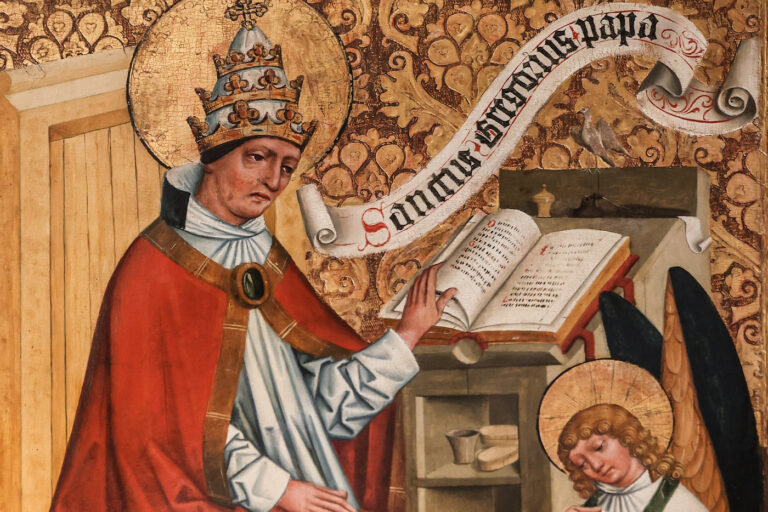
In Sacred Foundations, Anna Grzmała-Busse argues that the secular nation-state derives much of its structure from the Catholic papacy when it was at its peak in the Middle Ages.
By Andrew Busch
In The Myth of Left and Right, Hyrum and Verlan Lewis certainly succeed in proving to the reader that the pieces within each ideological bundle have shifted over time and do not inevitably go together, but they go well beyond that in concluding that each coalition’s bundle is fundamentally random. Though labels and coalitions may be quite movable, at any given time (including now) ideological identifications can tell us something intelligible about our politics.
Lincoln saw the fundamental problem in democracy as one single, monstrous question: “Can the principle that liberates all and produces self-government remain disciplined and restrained enough in practice to retain self-government?”
By Samuel Gregg
As a moral framework for assessing regimes in an imperfect world, Nigel Biggar’s Colonialism: A Moral Reckoning has much to recommend it.
By Paul Krause
Fred Kaplan’s new biography of Thomas Jefferson, His Masterly Pen, gives us the Jefferson we deserve: Jefferson the writer, the listener, and the aesthete.
Newsletters
By The Editors
A properly ordered life builds strength of mind, soul, and body. This collection offers reflections on the state of sports in our society.
By The Editors
Can we trust our senses? Are theology and scientific inquiry at odds? How has our world developed into what we experience today? Public Discourse authors thoughtfully consider these questions, among others, about the evolutionary theory of reality.
By The Editors
Scholars Robert George and Jameson Doig posit alternate perspectives on the nature of marriage. Through this exchange, they offer compelling arguments and insights on both sides of the issue and ultimately demonstrate that although they disagree, they are "united in the conviction that it is an issue on which reasonable people of goodwill can and do reach divergent conclusions."
By The Editors
Why do settled principles such as prior restraint or ex post facto laws exist in our jurisprudence? Hadley Arke's Constitutional Illusions and Anchoring Truths: The Touchstone of the Natural Law examines landmark cases in law in order to sketch both the mystery and natural law based necessity of key facets of American Constitutionalism. With Arkes' book as the impetus, Arkes and O'Brien further deliberate about the nature of natural law.