We concluded Part I with a discussion of strategic bombings, but the obliteration bombings of German and Japanese cities are among the most controversial aspects of World War II, and Moral Combat devotes large sections to them. Burleigh makes clear that the decisions to launch the bombs were not made flippantly or overnight. German and Japanese conduct became so unbearable that it convinced the Allies that they needed to “fight fire with fire”—literally. When Churchill and his airmen launched their attacks on German cities, they did not, like the apostles of the Third Reich, have visions of racial and political domination in their heads; instead, they were thinking “about the forty-four thousand British lives lost in the Blitz and the threat to their families and the freedom of their country. They knew about police states and concentration camps and did not want them in Britain.” In the Pacific theatre, the saturation bombings of Japan were pitiless, but were preceded and exceeded by the atrocities of Emperor Hirohito’s forces, which rivaled those of the Third Reich.
The men who led the Allied bombings—Arthur Harris, of the Royal Air Force, and his American counterpart, General Curtis LeMay—argued vigorously for them, even when they clashed with their countries’ values. Against the Christian principle that the end never justifies the means (Romans 3:8), both maintained that, in this case, it did, because the end was to preserve Christian civilization and restore peace. Neither man was given to further introspection. “Harris made no pretense that his purpose was anything other than the destruction of Germany’s cities,” comments Burleigh. “They had no value in his eyes…. [H]e said that that none of them was worth ‘the bones of a British Grenadier.’” LeMay was even more frank in his memoirs, dismissing the moral qualms of “aged beatniks, savants and clergymen.” There was only one thing on the minds of LeMay’s airmen—defeating the enemy as rapidly as possible—and so, he wrote, “we just weren’t bothered about the morality of the question.”
It would be unfair to accuse Truman’s White House of being quite so cavalier. Moral considerations did play a part in their strategic decisions; the question is whether they made the right ones. In his narrative leading up to the attacks on Hiroshima and Nagasaki, Burleigh explains the dilemma Truman faced, and rightly asks those opposed to the bombings if they would have risked the alternative—a continued, open-ended “conventional” war (which may have exacted an even greater toll on human life), or a naval blockade that would have starved Japan into submission. The idea that the country was “about to surrender,” and would have, even if Truman had not used nuclear weapons, comes in for considerable doubt: even after the incineration of Nagasaki, powerful segments within Japan’s empire still wanted to fight on.
For all his sympathy for Truman, however, Burleigh is not uncritical. The author has no patience with obfuscation. He writes to inform, not to protect. Truman did what he thought necessary, but he also “swallowed the fiction that the bombs were being used against vital industrial and military objectives rather than women and children.” People who defend the bombings should at least be honest about them: they were large-scale massacres, done in the sincere belief that they would prevent even more death, but massacres nonetheless.
Because they “worked,” or are widely believed to have worked, in the sense of successfully ending the War, the debates over the bombings have been confined largely to academics and theologians—of the sort General LeMay so disdained. The philosopher Elizabeth Anscombe famously protested Truman’s honorary degree from Oxford, citing the nuclear attacks: “For men to choose to kill the innocent as a means to their ends is always murder, and murder is one of the worst of human actions.” But most Americans supported the President’s decision; the War finally won. For many, Truman was and remains a hero.
Start your day with Public Discourse
Sign up and get our daily essays sent straight to your inbox.The voice of Professor Anscombe, however, deserves remembrance: it is a caution against allowing politics or nationalism to override moral concerns. That World War II was a necessary and unavoidable war is hardly in question, but that does not mean that we need to defend the Allies’ every act. We can admire generals and statesmen for many things, but targeting innocent and defenseless civilians, even for a “good end,” should not be one of them—even if that means risking a longer conflict. We need to have some faith that we can fight defensive wars vigorously and ethically without dooming ourselves to defeat or to the “boot stamping on a human face – forever,” to quote Orwell.
Those who celebrate Truman as the quintessential “common man,” the prototypical American, might reflect that Americanism has a downside, too, especially if it is left unchecked by self-criticism and moral discipline. John J. McCloy, who served under Truman, touched upon this briefly in his diary, when he described the President as “a simple man, prone to make up his mind quickly and decisively, perhaps too quickly—a thorough American.”
Harry Truman, Arthur Harris, and Curtis LeMay were not, by nature, bad men. In many respects—as Burleigh shows—they were admirable, courageous, and principled. But the lesson of war, as Moral Combat so convincingly shows, is that even good men tend to redefine and reshape their ethics in the heat of the moment, rationalizing their decisions along the way.
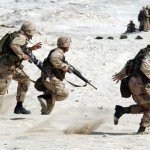
If war alters the moral compasses of statesmen and generals, it has even more dramatic effects on ordinary soldiers. In a bracing section titled “We Were Savages,” Burleigh recounts the fear, violence, and intensity that every soldier faced. In order to cope with their situation, soldiers often had to put themselves in altered states of consciousness, lest they dwell too much on what they were actually doing. Depersonalizing and dehumanizing the enemy became key to overcoming the inhibition to kill. On the whole, the Allied troops—with the notable exception of the Soviets—acted far more decently than those of the Axis; the ordinary privates from Omaha or Liverpool never came anywhere close to the radical evil—torture, rape, medical experimentation, summary executions—practiced by their enemies. But even some of our best men lost their moral bearings at times. “US Marines on Iwo Jima went into combat with ‘Rodent Exterminator’ stenciled on their foreheads,” notes Burleigh. Even some civilians were corrupted by the nihilism that the War unleashed. After news of the Bataan Death March and Japan’s kamikaze pilots came out, “polls of American attitudes to the Japanese revealed that 13 percent of the sample wanted the Japanese exterminated entirely, with another 33 percent wanting Japan extinguished as a functioning state.” True, they were only a minority, but the figures remain chilling.
Given the bloodshed and immorality that wars provoke, it is easy to become cynical and fall into despair. After years of covering such combat, correspondent Chris Hedges wrote of his disillusionment in War is a Force that Gives Us Meaning, concluding that wars are mass deceptions, which nonetheless have a narcotic appeal: “The rush of battle is a potent and often lethal addiction, for war is a drug.” But this is a lament, not a solution to the problem of human conflict. More importantly, it is not universally true. If Moral Combat proves anything, it is that the voice of conscience did survive the Second World War, in spite of all its outrages and ethical compromises. There were civilians and resistance fighters and clergymen and politicians, and yes, even military men, who did, in fact, uphold the moral law, and protested to their leaders when they violated it, even at the risk of being called traitors or worse. They were not seduced by the “lust for war,” and they didn’t countenance its abuses. Whether conscious of it or not, they were following the noble precepts of the Just War tradition, which went into abeyance for a time but, thankfully, have been revived.
Moral Combat is a work of history, not a treatise on Just War criteria, but the ethics of that tradition resonate throughout its pages, as it examines legitimacy, ends and means, and “the need to exercise humanity, discrimination and proportionality.” It also points to that tradition’s inspiration. That there are no atheists in foxholes is more than a religious bromide. “Most soldiers sought supernatural protection,” writes Burleigh, revealingly. “The Red Army was officially atheist, but a large number of men wore metal crosses, and crossed themselves before going into battle.” Sir Alan Brooke, a senior commander in the British Army and one of the most insightful of men during those days, recorded in his diary:
I am… convinced there is a God all powerful looking after the destiny of this world. I had little doubt about this before the war started, but this war has convinced me more than ever of this truth. Again and again during the last 6 years I have seen His guiding hand controlling and guiding the destiny of this world toward that final and definitive destiny which He has ordained. The suffering and agony of war in my mind must exist to gradually educate us to the fundamental law of “loving our neighbor as ourselves.”
Humanity was still young and in need of moral enlightenment, General Brooke concluded, but he knew just where to look to find it.