Pillar

Politics & Law

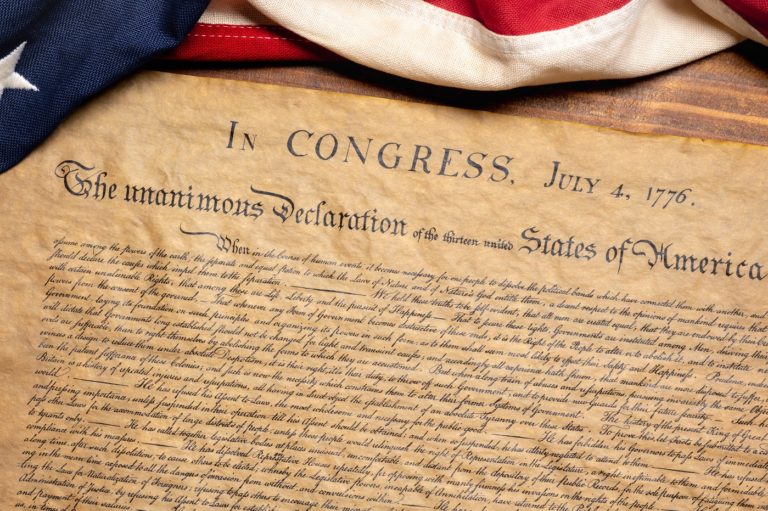
The third pillar of a decent society is a just system of politics and law. Such a government does not bind all persons, families, institutions of civil society, and actors in the marketplace to itself as subservient features of an all-pervading authority. Instead, it honors and protects the inherent equal dignity of all persons, safeguards the family as the primary school of virtue, and seeks justice through the rule of law.

Learn more about Politics & Law: get your free eBook today!

Without a revelation from God to confirm that man’s end transcends this world, politics will dominate our life and make hell on earth. But in its proper place, politics can do great good. As Fr. James Schall reminds us, the “abiding problem” of the “political enterprise” is to grasp this “limit of politics.”
Many conservative elites know that cultural resentment has the potential to take the Republican Party in an ugly direction. That’s why so many of them cling to the alternative explanation: “It wasn’t racism or misogyny that was motivating Trump voters! It was righteous anger that their government hasn’t done more to protect them from the ravages of globalization!” In reality, to the extent that the Trump coalition was unified and energized by anything, survey data suggest that it was cultural issues, not economic ones.
Where there is a mutual commitment to truth and truth-seeking, relationships can be built between religious believers and secularists, and they can indeed reason together. The minimum condition is this: interlocutors, however wide and deep their substantive philosophical or other differences, need to share the conviction that business between them is to be conducted in the proper currency of intellectual discourse—namely, reasons, evidence, and arguments.
It may seem strange to pair Lawrence Ferlinghetti with Ryan Anderson, who argues against virtually everything for which Ferlinghetti stood. What they have in common is the courage of their convictions, a willingness to challenge the conventional pieties of their respective ages, and to do so in ways that conformist critics are quick to label offensive, obscene, unsafe, or misframed.
The Equality Act goes far beyond the noble desire to protect vulnerable people. It burdens consciences, severely curtails the rights of people to practice their faith, smuggles in an abortion mandate, and explicitly exempts itself from respecting religious freedom.
The passage of the Equality Act would mean the death of religious liberty. It would force all religious institutions and citizens to prove to the government’s satisfaction that their convictions merit constitutional protection.
Charles Kesler’s new book, Crisis of the Two Constitutions, offers a straightforward approach to the Constitution, a pointed (though always measured) characterization of progressivism, and an honest assessment of American conservatism.
The question was never whether or not conservatives should engage the multilateral system. It was always what kind of multilateralism conservatives want: one that is accountable to self-governing sovereign states and advances U.S. interests, or one that is wholly untethered from political oversight and unaccountable to the American people.
Natural and legal rights are not like individuals of the same species, but analogous ways of identifying what justice demands. Natural rights provide a standard by which legal rights are to be understood and corrected; but legal rights are the means by which natural rights are to be secured and realized in a polity.
Wokeness meets a religious need by mimicking a Protestantism that our society has largely left behind. Although it highlights important truths, Wokeness needs to retrieve the orthodox teaching on the universality of original sin, the Christian understanding of salvation through the divine Scapegoat, and the centrality of the Church in its social imagination.
The things we’re willing to die for are tied to what we hold as sacred. In fact, the willingness to die for something also consecrates it as sacred. We need to entertain the possibility that love for our country might lead us to sacrifice greatly, even radically, in order to preserve the best that remains in it.
Pulitzer Prize–winning author Thomas Ricks has produced a thoroughly researched and engaging book on the intellectual world of the American founders. We who live in a highly partisan age can hope, as Ricks does with mild optimism, that we can return to virtue to cope with the problems of modern-day factionalism.
Catholic citizens can hope for a society where the faith is more broadly shared, but we cannot escape the responsibility of political deliberation about our society as it is—riddled with its pluralism and confusion—not as we would have it be. A healthily secular society can acknowledge the freedom of the Church and a positive role for the Church in society, understanding that the state is rightly focused on natural norms and goods, not supernatural ones.
Why must a “serious Catholic politics” tolerate a regime that worships the profit motive and carnal pleasure but recoil from one that worships the Blessed Trinity? Why is it sophisticated to ask the state to recognize truth of supply and demand but simplistic to ask that the state recognize the truth of the sacraments?
In their new book, Scott Hahn and Brandon McGinley provide a rousing exhortation for Catholics to unapologetically live out their faith. Unfortunately, the book contains too many generalizations, overstatements, and imprecisions to be a thoughtful guide to Catholic politics. Any serious Catholic politics must recognize that the problem of pluralism cannot be solved by dominating non-Catholics and imposing our view of the good on them.
After decades of struggle, the conservative judicial project has finally produced a possible working majority of five originalists on the Supreme Court. There are plenty of reasons to wonder how consistently they will coalesce in practice and how willing they will be to revisit wrong precedent. But trashing Antonin Scalia’s originalism and replacing it with Josh Hammer’s idiosyncratic, results-oriented version isn’t likely to help matters.
One feature of Mitt Romney’s Child Allowance proposal has been critically under-billed: the extremely high likelihood that it would reduce the abortion rate. Conservatives arguing that a rise in single parenthood is an unacceptable cost of a child allowance are necessarily arguing, as a corollary, that some of those children instead being aborted is an acceptable cost of the current policy regime. But if abortion is murder, then keeping single parenthood down by murdering the infants is surely not an optimal anti-poverty policy.
Conservatives are generally good at conserving, and we are particularly aware of the continuities across the human condition. But given today’s conditions, when so much has changed so recently and so many social problems bedevil us, we need to get great at creating new institutions.
Common good originalism is the best constitutional complement to a politics of a conservative restoration. It is ordered toward a profoundly and distinctly conservative politics that elevates the concerns of nation, community, and family over the one-way push toward ever-greater economic, sexual, and cultural liberationism.
Many have argued that without God there can be no fixed moral principles. George Orwell’s 1984 goes further, raising the possibility that without God there cannot even be “facts” in any meaningful, reliable sense.
Justice John Marshall Harlan the First courageously stood against his learned opponents on the Supreme Court. By his example, we too might muster the courage to be “Great Dissenters” against the intellectual and cultural classes that progressives have come to dominate.
Eric Voegelin’s warnings about the dangers of gnostic politics apply to the right as well as the left. Christians must make a clear and unequivocal distinction between the historic Christian faith and the misleading political religion that is more pervasive on the right than anyone seemed to realize.
As a post-Trump conservative coalition struggles to define itself, social and religious conservatives should seize the opportunity to step up and play a leading role, making support for families a central tenet of the American right.
The editors of Public Discourse invite conservatives of various schools to participate in the debates that will best advance our common cause. We believe that disagreement is not something to avoid. In fact, a real and productive disagreement is an accomplishment. Civilization, in the end, is formed by men and women “locked together in argument.”

Get your free eBook for The Human Person

"*" indicates required fields

Get your free eBook for Sexuality & Family

Get your free eBook for Politics & Law

Get your free eBook for Education & Culture

Get your free eBook for Business & Economics