














Search Results For:

Search Results for: founders – Page 9

Brown University researcher Lisa Littman has been attacked for publishing results that call into question the politically correct narrative about transgender youth.
Virtue ethics can help originalism maintain its integrity.
Intellectual diversity, academic freedom, and freedom of speech are means to an end, the end of truth-seeking. If a university does not retain its traditional mission of seeking the truth through reasoned discourse, it will not remain committed to freedom of inquiry or freedom of speech.
Leslie Rubin’s portrait of Aristotelian America and American Aristotelianism is an invaluable contribution to our understanding of our situation.
As the late Justice Scalia was fond of pointing out, the views of individual lawmakers in the midst of debate are not themselves the law we must interpret. Neither are the votes taken in a deliberative body rightly viewed as votes on anyone’s interpretation of the text under discussion. The text that they passed, not what they said about what they passed, is the law.
By calling our attention to the Founders’ political theory of the family, Thomas West’s new book leads us to ask whether a secular theory of natural rights and natural law can sustain the moral ecology necessary for self-government. If a secular natural-rights republic cannot sustain the family, it would seem to be neither a good nor attractive political theory.
Please use your influence as a major donor to persuade the Southern Policy Law Center to amend its embittering and unproductive campaigns to label any political or social issue opponent as a hate group. Although controversial, organizations that fight to protect the unborn and strengthen families are not motivated by hate. Vilifying them only worsens our toxic and polarized political climate.
If we want a different politics, ultimately we must offer a different moral imagination for ourselves, our children, and theirs.
Patrick Deneen’s Why Liberalism Failed is a provocative attempt to explain what’s wrong with our culture, how this came to be, and what might be done about it. Although his historical account of liberalism is unpersuasive, he offers a prescient analysis of the current moment and insightful prescriptions for constructive action.
It was Christianity, not modernity, that separated church and state. It was modernity, not Christianity, that sought to bind them back together. And, at day’s end, the American order has more in keeping with the Christian apostasy than with either antiquity’s sacral political orders or modernity’s rejection of the claim that there exists any domain outside the jurisdiction of the modern state.
A recent conference on Christianity and liberalism brought together high-profile Catholic scholars who strongly disagree about whether Catholicism is compatible with liberalism in general and the American version of it in particular.
Originalism is the commonsense, traditional American approach to constitutional interpretation, not a contemporary conservative invention.
Religious freedom in America is caught between opponents on the left and the right. The second in a two-part series.
In both the United Kingdom and the United States, the fundamental rights of parents have dangerously eroded, undermining the ability of parents to protect the welfare of their children, instill moral values, and pass on religious beliefs and practices.
A new book illustrates how Alexander Hamilton used British legal traditions and the American judiciary to give a distinctive constitutional form to a new republic.
Dr. Paul McHugh is optimistic that the ascendency of transgender ideology is a passing fad. Yet the damage that transgender ideology can wreak in even just ten or fifteen years—the hormones, the surgery, the irreversible decisions, the mutilated bodies—is considerable.
In a paradoxical new book, Columbia University professor Mark Lilla correctly identifies the defects in contemporary liberalism and identity politics but cannot free himself from them.
While the American regime is often criticized as Hobbesian, the letters of Thomas Jefferson provide evidence that it may be more accurately described as Epicurean.
Because he accepts a Straussian framework that sees modernity rather than Christianity as the major turning point of Western history, Rod Dreher underestimates the influence of Christian and classical thought on the American founding.
We must act now to prevent assisted suicide from gaining a stronger foothold in the United States.
The government cannot impose creedal and exclusionary limits on occupational freedom by compelling particular citizens to provide goods and services contrary to their beliefs, unless those citizens have such a monopoly market power as to exclude other citizens from the market.
Candida Moss and Joel Baden sound an alarm about the Green family, owners of Hobby Lobby and founders of the Museum of the Bible. The real target here, though, is not so much the Greens as the evangelical Protestant view of the Bible that they embrace.
There is a genuine tension, not just in Aquinas but in Church teaching more generally, between claims about the intrinsic goodness, sanctity, and inviolability of human life, and claims about political authority to kill. The second in a two-part series.
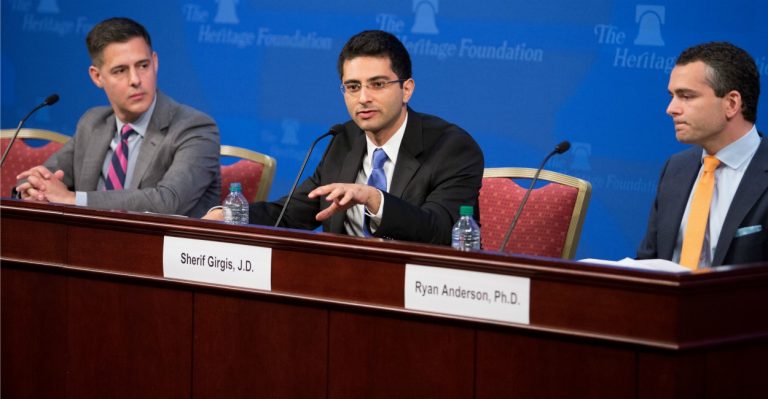
The implications of John Corvino, Ryan T. Anderson, Sherif Girgis’s well-argued debate reach far beyond the latest round in the culture wars. They go to the foundations of the American experiment in ordered liberty. Part one of a two-part review essay.