Search Results For:

Search Results for: founders – Page 4

Without a leading semiconductor industry of its own, China will not have the military capability to challenge the United States for world military leadership and, for example, be able to “reconquer” Taiwan. Similarly, without the best in-house processors, it is difficult to exploit all the advantages promised by artificial intelligence, including its military applications such as programming advanced drones.
The 1950s have two main nostalgic pulls on conservatives: aesthetic and technocratic. Both rely on a constructed past that has little to do with the realities of American history—and therefore neither type of ’50s nostalgia offers serious solutions to the country’s problems. In fact, early conservatives like William F. Buckley, Robert Nisbet, and Russell Kirk saw the postwar liberal settlement of the ’50s as a betrayal, not an embodiment, of the best of the American political tradition.
By deviating from the American political tradition, national conservatives double down on rather than challenge many of our political ills.
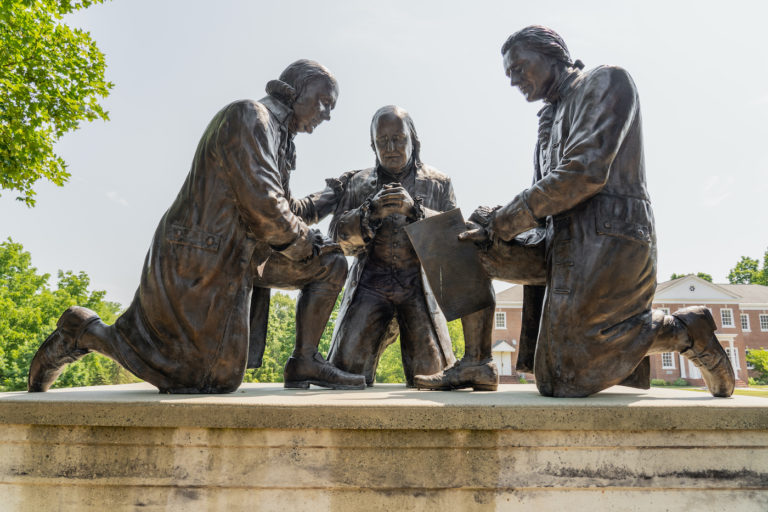
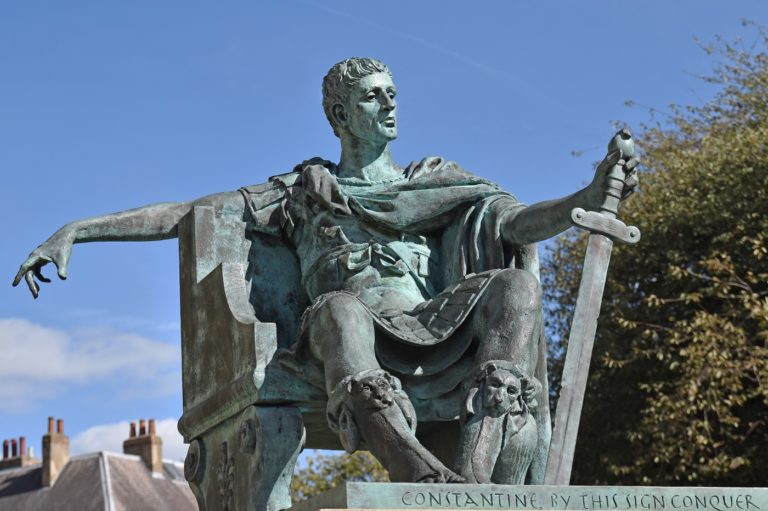
Aside from a certain gruff nobility, the statue of John Witherspoon in Princeton is not overly stylized; he’s human, which is to say, flawed. A hero in bronze he may be, but with feet of clay, Witherspoon is worth remembering as he is portrayed there.
“What I see in modern America is something maybe a little bit different than what other folks see. I think the nation vis-à-vis its laws is far more just than it has been at virtually any point in its previous history. Racial discrimination is outlawed de jure. You have an extension of the First Amendment to all American communities. You have greater religious freedoms in a concrete way than we’ve ever enjoyed in the history of the United States. We have a lot of problems, but we’re better than we’ve been.”
The long debate over who should be speaker was a healthy expression of Madisonian transactional politics, and it had helped illuminate the path toward restoring the People’s House as the seat of American self-governance.
We must resist the sense that gratitude has no place in this era of frequently justified outrage. In fact, gratitude may be exactly what can help us distinguish justified from unjustified outrage. And, in any case, gratitude is the proper disposition toward all the good we have been given that we have done so little to earn.
We should celebrate Dobbs—but cautiously, for it is only the beginning of the project of constitutional restoration that needs to be done. If Dobbs is to stand, American society must move away from the stifling, tyrannical concentration of national power that we are experiencing now and begin a return to the balanced government of the Founders’ Constitution.
As the American story enters its fifth century, the list of those who have earned the right to be called fathers and mothers of our country grows ever longer. As we retell our national story to each generation, we will of course continue to argue about whether some of the characters were really heroes or villains—a debate that is part of every nation’s storytelling. But unless we can recover a certain generosity towards those who came before us, we will find ourselves with nothing to pass on to those who come after.
Philip Muñoz’s new book helps illuminate the “social contract–natural rights” style of reasoning that was undoubtedly influential at the Founding. But I find it hard to follow—or, for that matter, to fathom—when this sort of reasoning from fictions is deployed normatively to justify contemporary prescriptions that would otherwise seem unjust or undesirable.
According to Steven Smith, it’s meaningless to speak of our inherent natural rights. He dismisses the Founders without properly understanding them. A return to the Founders’ natural rights constitutionalism may not offer the best alternative to protect religious liberty today. But we cannot even entertain the possibility that it might if we do not understand the principles of justice or the practical meaning of the philosophy that originally animated the Constitution.
In Religious Liberty and the American Founding, Phillip Muñoz believes that there is a kind of natural rights logic that leads to his minimalist version of religious freedom. His central premise is that the Constitution should be interpreted according to the “natural rights” logic that was prevalent in the Founding period; and he tries to follow this logic to its conclusions, come hell or high water.
Although social contract theory is a prominent feature of the American founding, it is both unsound and harmful to a proper understanding of politics. This fact presents a challenge to any form of conservatism that is based on protecting and promoting the principles of the American founding.
National Review midwifed and nurtured the modern conservative movement into being. Conservatism today is in a very different situation from the one that Bill Buckley confronted in 1955. There is this vast conservative enterprise now; it’s kind of hydra-headed. But the basic need is, first, to think about the circumstances in which we find ourselves and how to apply conservative principles to them—or a conservative disposition, if one prefers—and second, how to build a coalition that is large enough to take these ideas off of the shelf.
Lord Shaftesbury’s success in transforming education for the poor provides a variety of lessons for us today. His “ragged schools” suggest that by increasing local control of schools, expanding vocational training, and introducing curricula that recognize the integrated nature of human beings, our society might become more enriched—both materially and spiritually.
John Witte, Jr.’s The Blessings of Liberty offers a wonderful overview of the development of human rights in the West. He contends that natural rights are found in the Bible, were developed by Christian thinkers, and played an important role in the West long before Enlightenment thinkers wrote about them. Witte also focuses on religious freedom more narrowly as the preeminent right.
Francis Fukuyama offers a useful account of the pathologies of liberalism and argues that it still has the internal resources necessary to resist its critics. But his defense of liberalism seems designed only to appeal to likeminded centrists. Liberalism today should not be about splitting differences and seeking moderation, but staking out its ground and affirming its beliefs.
Readers of Thomas Kidd’s book, Thomas Jefferson: A Biography of Spirit and Flesh, are left with a portrait of a brilliant, morally flawed, and often contradictory, overindulgent, and undisciplined man—a combination not uncommon in great men. The biography is careful and balanced in its presentation of the evidence, revealing a man of monumental achievements and profound failings.
For the rationalist or fundamentalist character, hope cannot but seem inadequate, even corny. Such a character has a rage for order and cannot but suffer an anxious repulsion for disorder. Hope, on the other hand, is not blind, or merely optimistic, nor is hope something we churn up in ourselves as a kind of subjective attitude. Hope, rather, is a virtue. It is a state that perfects us, makes us well, capable of thinking, living, and acting in the freedom of excellence.
Yoram Hazony’s Conservatism: A Rediscovery offers a valuable new take on non-Lockean political theory, grounded in the Biblical tradition and relevant to our current affairs. Part one of a two-part review.
Built Better Than They Knew Studies endeavors to show that our practice of self-government rises above simplistic ideological reductions and achieves political equilibrium. From its beginnings, our country has been a blend of ideas, practices, and understandings of what it means to be a free and flourishing human person within community, local and national. That means that our theory must be sufficiently aware of a political practice that involves contrasting accounts of how Americans choose to be constitutional.
Peter Augustine Lawler was a rich, dialectical, and irenic thinker who strove to prevent fruitful tensions from transforming into dangerously implacable oppositions. His wisdom was attuned to the needs of the late modern age. It has been nearly five years since his unexpected death at the age of sixty-five, and his wisdom remains just as needed now as it’s ever been.
Genuine postmodernism—a real reflection on the failure of the modern project—would be a recovery of the idea that the lives of free and rational beings are really directed by purposes given us by nature and God.
Adrian Vermeule’s new book, an attempt to rescue American constitutional law by recurring to the “classical legal tradition,” is undone by the author’s unreasonable attack on originalism and his inattention to the Constitution and its history.