













This background should prepare us for a more positive account of sexual morality that not only supports the right conclusions, but does so in a way that allows us to affirm the intrinsic goodness of sexual desire and sexual pleasure while connecting them to the great goods of marital friendship and procreation.
As parents, may we each choose what is real, no matter the cost, that we may come to know real love and pour it out for our children.
Interpreting the times requires a genuine historical sense as opposed to an unnatural amalgamation of philosophy and history exhibited in the modernist and traditionalist genealogies. This requires us to rediscover the Age of Enlightenment on its own terms. 
Culture, enriched by religion, is the genesis of historical epochs that would not exist without cultured societies. To that end, we can only hope that culture can continue to steer societies away from the desacralized “way of death” toward the sacralized “way of life.”   
The most important benefits the Christian religion can give to democracy is the awakening of conscience, the substance of ethics, and the rehumanization of society. It gives human freedom guidance, and the human spirit of toleration and forbearance. And it is the Christian religion that teaches a true equality—that of human dignity, on which an imperfect yet a more just society can be built.
In a traditional society people are bound, as if by a chain, but democracy breaks the chain, delinking all from all. The tight bonds in traditional societies attach and oblige men to a variety of people and institutions outside of themselves, turning them outward toward others and toward the society around them.
Christians need to realize that there is no scapegoat on this earth that can be sacrificed to bring us a peaceful end to the evils we encounter.
Teachers are doing the best that they can. At the same time, I want to be clear that the conflict thesis is about as out of step with our current historical knowledge as scientific creationism is with contemporary biology. Continuing to teach its myths as fact is educational malpractice.
Some today think religion and politics should be more intertwined. Alexis de Tocqueville would have thought just the opposite. 
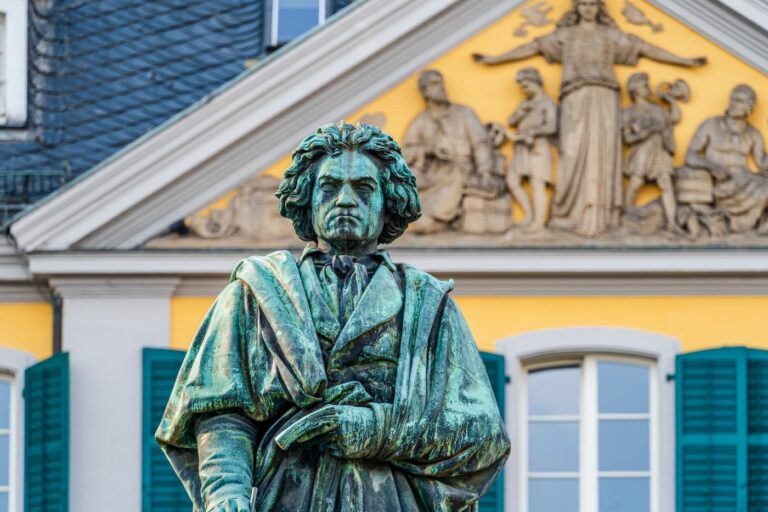
Whether Beethoven ought to be understood as a Catholic composer is no longer the difficult question, but how and when he is Catholic in his music will, I suspect, frame many discussions to come.
McConnell will be the deciding vote for fifteen more months. That’s the countdown for a retirement-eligible judge who wants to be replaced by a conservative. 
Whether state and federal governments will support school choice remains to be seen; there seems to be considerable political pressure in both directions. But on the social level, while we may continue to criticize each other’s school choices, increasing numbers of families seem unwilling to bypass choice.
President Trump plays extreme hardball by American standards, some of it blatantly authoritarian. Conservatives lose credibility when they deny this. But Trump’s election and reelection were, in part, a reaction to decades of undemocratic progressive change in the courts, bureaucracy, and public education—itself a kind of hardball. Liberals who deny or downplay these phenomena only feed populist anger.
Social conservatives have long recognized the civilizational value of the quotidian work of parenthood. In an analogous way, we ought to recognize that it is in the small acts of local participation that societies thrive or languish.
Every age has its distractions, and its temptations for a shortcut. But if we are to understand ourselves and our predicament, we have the same resources our predecessors had. We have books to read. We will grow or shrink as human beings according to our willingness to read them. 
While Trump’s ham-fisted assault on higher ed was justified, that doesn’t mean his tactics are—or that this will end well. 
America has long led the world in economic success, entrepreneurship, technology, and innovation. We can and we should lead in human flourishing. To do so, we must invest in the fundamental ingredients of flourishing: marriage and children.
Yes, patriotism can be as simple as flying the flag or even reciting the Declaration of Independence on Fourth of July. But perhaps the greatest act of patriotism is something we can do every day: start to initiate or rekindle friendships with people with whom we disagree.
We are very different people from those who came before us, because of our deficits in social learning. 
If my younger self had understood even this much—that discernment begins with recognizing one’s gifts and offering them, detached from any personal agenda, for God’s purposes—I might have spent a little less time anxiously waiting for the clouds to part. I might have spent more time offering the little I had, trusting that God could use it for his purposes.
Welcoming children surely is a great responsibility; no one can know ahead of time the challenges and joys that are waiting for them. But perhaps the greatest surprise is that every decision and every parenting strategy will find its true home in realities that, blessedly, far exceed them. 
Individuals who want to marry must choose from options that lack the spontaneity and spark many hope for: singles groups, dating apps, speed dating. One is left wondering whether a bad script is preferable to no script at all. And well-intentioned people—mostly married—offer all kinds of conflicting advice about how to date to find a spouse. I aim to tackle these seeming contradictions in order to show how each can be true and helpful for the Tough Mudder that is twenty-first-century dating.
We make friends with particular people in particular circumstances, and for this reason we should not allow ourselves to be distracted by what is remote and abstract. We should delight in and give thanks for those we can know, love, and enjoy in reality. 
Our duties of care to others place limitations and constraints on our choice of career. But these constraints are, in fact, the path to real freedom.