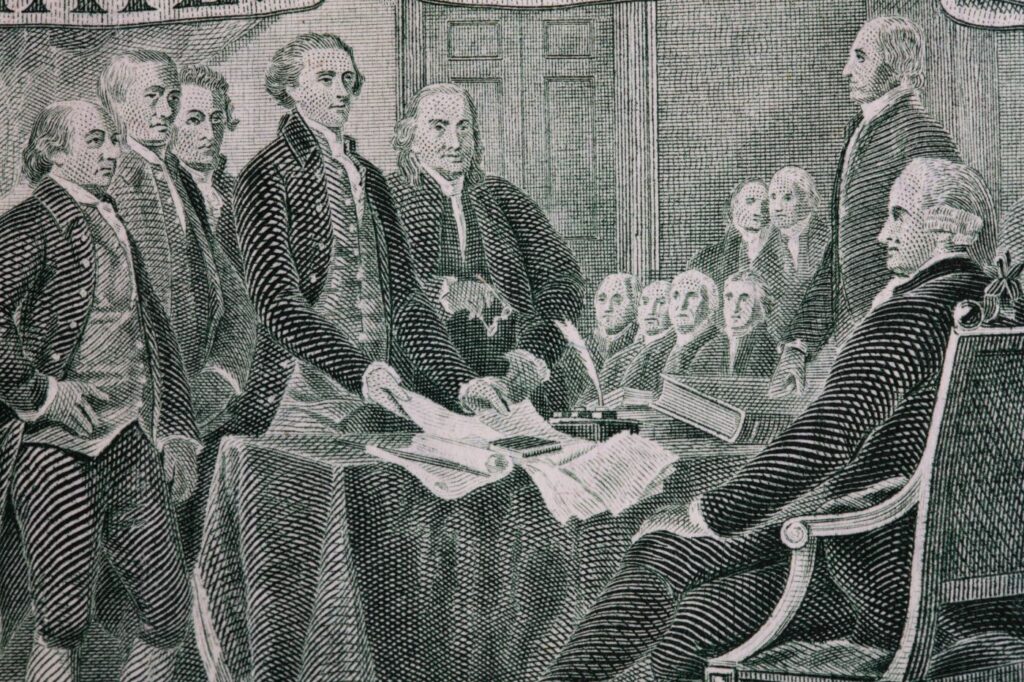
We learn the Declaration of Independence as children; we hear it recited every Independence Day. “We hold these truths to be self-evident.” What truths? That “all men are created equal”; that “they are endowed by their Creator with certain unalienable rights”; that “governments are instituted among Men, deriving their just powers from the consent of the governed.”
My main academic focus has been natural law theory, especially how it relates to politics. I have been working on a book manuscript about this for five years now. Interestingly, it was because of my study of contemporary natural law theory that, for a short time, I abandoned the idea that the legitimate powers of government derived from the “consent of the governed.” Some of my favorite natural lawyers had also rejected it. But after studying closely the consent theory of Spanish scholastics like Vitoria and Suarez, and then the Anglican Thomist Richard Hooker, I came to re-embrace it.
But I am not the only one who has seen the light. Paul DeHart, Robert R. Reilly, and Alexander S. Rosenthal, for instance, have similarly come to appreciate in recent years what can be called scholastic consent theory (or scholastic social contract theory). I would argue moreover that this theory is no different than the commonsense consent theory of American independence, and much more easily defended than the rationalist versions that philosophers are more familiar with.
The basic idea of consent theory, as it was defended by these scholastics, is that people come together—by a sort of natural inclination, and because of the inadequacies of alternatives—to form political communities; for the sake of the common good, they embrace leadership in the governance of such communities. In the older language, the political community was often called a body politic, with a sovereign authority at its head. Today, it is more accurate to distinguish between the body politic or political community and that part of it called the “state.” More recent Thomists, like Jacques Maritain, embraced this same distinction.
Within those political communities, which Suarez says formed a kind of “moral union,” there was a natural authority of self-governance that was then delegated (in some versions or cases transmitted) to a certain member or members of the community who could govern for the sake of the common good of that community. Without that communal consent (in all but exceptional cases), no person or persons had by themselves any natural authority to govern the community; thus, the community’s consent was usually necessary to authorize such governance. This does not mean that the theory required democratic elections (most of these scholastics favored mixed monarchies), but at the very least it requires implicit community consent.
Start your day with Public Discourse
Sign up and get our daily essays sent straight to your inbox.After reading just about everything worth reading about consent theory these last few years, both the theory of the scholastics and the more popular theories that came later, I disagree with just about everyone about what scholastic consent theory is and what it explains. Thus, in the space I have here, I will defend my interpretation of it, not as exegesis of the scholastics, but as a defensible philosophical position in its own right (which I also believe is more or less what the scholastics held). I will argue that communal consent is usually necessary to authorize civil leaders to make governmental decisions for the whole community, and that this is a demand of general justice on the part of the purported authorities themselves.
General Justice: What Is Owed to the Whole Community
Not that it matters that much, but I am of the school of thought that says that the fundamental distinction between kinds of justice is that between particular and general justice. Particular justice concerns what individuals or smaller groups within a larger community owe one another, and general justice concerns what is owed to the community as a whole. Whether one divides things that way or not, one can recognize that we do have duties to the community as a whole, whether that is our local community, our church, our county, our state, our nation, or humanity as a whole. You can say functionally the same thing by saying that general justice concerns our duties in relation to the common goods of those communities.
When it comes to the governance of communities specifically, usurpation is a type of act against general justice. We owe it to the whole community not to steal its self-governance. How then do we, outside extraordinary circumstances, legitimately take on the role of making such decisions and taking such action without committing an injustice to the whole community? That is where consent theory comes in. It is communal consent that authorizes it.
What is communal consent? That is a little harder to pin down. We know it when we see it. It can be implicit, or it can be explicit; it can involve a process that the community comes to embrace implicitly for settling matters (e.g., a vote), or it can emerge the way language and social norms emerge. In either of these cases, when this happens (and we all know it when we see it), the person charged with the communal decision is excused of any usurpation, of putting himself or herself above the other members of the political community. Again, there are extraordinary exceptions (e.g., the victor in a just war might have to establish a government over the defeated aggressor), but communal consent is the ordinary means for legitimating the community’s authorities.
Note what this theory is not claiming. It does not pretend to be a full account of political obligation. Although it has become fashionable among philosophers to treat political authority as that which creates political obligations, this is not the only way of understanding political authority. Political authority, in the sense that communal consent can be said to authorize it, concerns primarily the moral authorization of the political authorities themselves, what makes their governance just and not a case of usurpation.
Admittedly, if there is no independent account of political obligation, then it is also difficult to justify authority. It must be justified in order for the community to delegate it. I take it that the Spanish scholastics saw the community’s need for governance to secure and preserve common goods (e.g., peace, justice, prosperity), that is, to avoid the inconveniences of a state of nature, as sufficient grounds for political obligation. That is because, again, we have duties of general justice to the community, such as to do our part to serve those goods that we share in common with the rest of the community. And as John Finnis, Yves Simon, and others point out, securing and preserving those common goods requires coordination, and thus, coordinators.
In many cases, people even have a moral obligation to obey usurped authority. Activist judges have usurped authority in past cases, and their judgments often still bind the conscience of citizens, who have duties of general justice to go along with it for the sake of the common good. Thus, this scholastic account of consent theory is not at all at odds with the account of political obligation one finds in authors like Simon and Finnis.
If there is no independent account of political obligation, then it is also difficult to justify authority.
Note also that this form of consent theory is not the kind rejected by modern analytic philosophers like Leslie Green, John Simmons, or Michael Huemer. The theories they reject are those that try to explain political obligations on the basis of individual consent.
I will call this thin version of consent theory mere consent theory, as opposed to those that try to explain more than it does, or those that otherwise make claims that are harder to defend. If mere consent theory comes across as obvious, that should make it all the more a candidate to be what Thomas Jefferson meant in the Declaration. He, after all, thought it was self-evident. This, I would argue, is also the same consent theory that floated around the colonies, just as it had floated around Britain before that, through both Calvinist and Catholic sources. As early as 1638, in fact, the Cambridge-taught preacher Rev. Thomas Hooker, whom some call the founding father of Connecticut, said in a sermon: “The foundation of authority is laid firstly in the free consent of the people.” These ideas were common in places like Cambridge, where divinity students were just as likely to read Spanish scholastics as Protestant authors. I write about this history in other places but let that suffice for an example of the early history of these ideas in America.
Once popularized, however, and within a well-read culture, like that of the American colonies of 1776, mere consent theory took on a logic of its own. It is no surprise that it had led to greater emphasis on democratic representation, from the limited suffrage of the founding generation (usually property-owning white males) to the universal suffrage of the twentieth century. That all makes sense as soon as we realize that our government represents us, and our interests, and its officials have no more natural authority than that authority the community receives from the “Laws of Nature and Nature’s God.”
Image licensed via Adobe Stock.