As our political parties grow more polarized and polarizing—each pulling away from the center under pressure from the left and right wings that generate turnout in the primaries—we hear louder cries for substantial changes in the design of our institutions. When Congress, the executive branch, and the judiciary don’t yield the results that the most politically engaged citizens desire, many decide that our institutional arrangements need to be changed to deliver them.
Twice in living memory (in 2000 and 2016) the winner of an electoral college majority was the choice of fewer individual Americans than his defeated rival. “Get rid of the electoral college,” cry the losers, heedless of whether this is a “solution” worse than the problem they see. Year in and year out, legislation fails to pass the Senate because cloture (the supermajority threshold of sixty senators) was not attained to enable a final vote on many bills. “Kill the filibuster!” is heard from the most frustrated partisans. (On this one, I have some sympathy, as I said here years ago—but “kill it” is not what I’d do.)
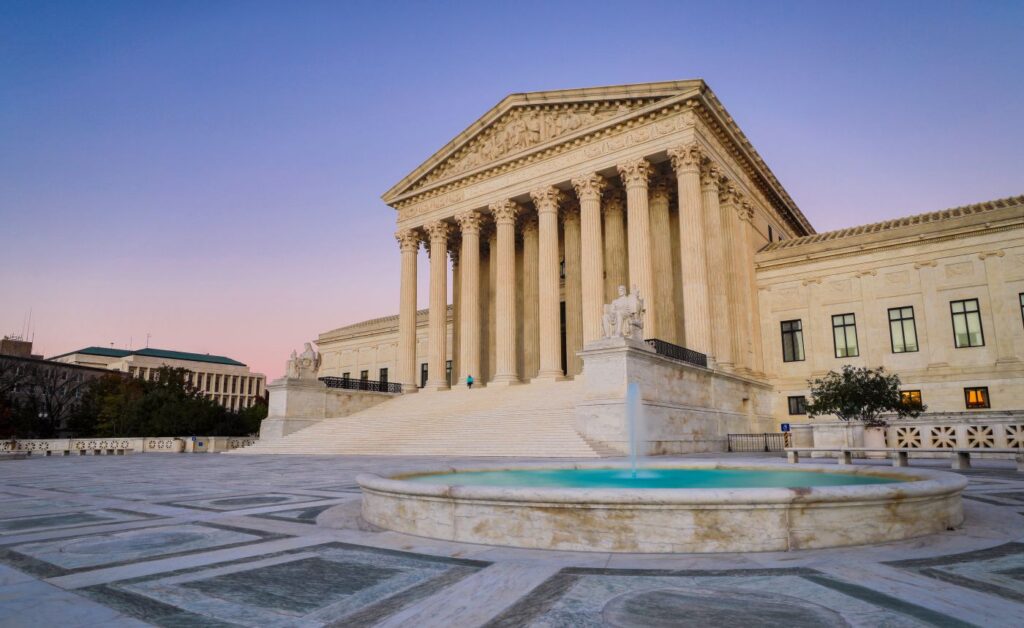
Another perennial in the garden of institutional reform ideas is “packing the Supreme Court.” In the left wing of the Democratic Party, this idea was resurrected during and after Donald Trump’s first administration. For ten months in 2016, the Republican majority leader of the Senate, Mitch McConnell, had forestalled any action on the Supreme Court vacancy created that February by the death of Justice Antonin Scalia. Barack Obama’s nomination of Judge Merrick Garland to Scalia’s seat was simply ignored, and Donald Trump was able to appoint Justice Neil Gorsuch the following year. Trump then appointed Justice Brett Kavanaugh to succeed Anthony Kennedy in 2018. Finally—with the next presidential election scheduled less than seven weeks after Ruth Bader Ginsburg’s death in September 2020—he nominated Justice Amy Coney Barrett, who was swiftly confirmed, and appointed just eight days before President Joe Biden defeated Trump’s bid for reelection.
There was nothing Republicans had done that Democrats would not likewise have done if they had been similarly situated from 2016 to 2020. Nevertheless, Democrats were furious that Republicans had (in their view) “violated norms” to de facto “pack the Court,” and their response was to demand that this be done de jure during the incoming Biden administration: expand the number of seats on the Supreme Court so that its Republican-appointed majority (now 6–3) would become a minority.
President Biden was not enamored of this idea, and he hit upon a smart way of keeping it at arm’s length. Biden appointed a blue-ribbon commission of legal scholars to study a variety of prominent ideas for “Supreme Court reform,” and put the issue in deep freeze while the commission did its work. Appointed in April 2021, the commission—which had genuine viewpoint diversity—submitted its final report that December. Because of the members’ pervasive disagreements, the lengthy report made precisely zero recommendations, but it makes very instructive reading on the pros and cons of every notable suggestion for changing the design of the Supreme Court.
Start your day with Public Discourse
Sign up and get our daily essays sent straight to your inbox.Biden’s “Presidential Commission,” in short, was where he sent the Court-packing idea to die, and he got the result he evidently wanted—until Roe v. Wade was overturned the following year, and Donald Trump was elected a second time in 2024. Now the idea is back, with renewed energy among Democrats who feel frozen out of power in all three branches of the federal government. Win this fall, win in 2028, then pack the Court—that’s the game plan on the left.
This was tried once before, by the most powerful Democratic president of the twentieth century. How did that work out, and what lessons can be learned from Franklin Roosevelt’s failure to expand the Supreme Court in 1937? This is one of the most closely studied episodes of the New Deal, and good treatments have been published recently.
But to understand what moved FDR, a still valuable contemporaneous account is Robert H. Jackson’s The Struggle for Judicial Supremacy (1941), a book I was surprised to learn is very hard to find today, though many university libraries have it. (Here’s a signed copy, if you can afford it.) Jackson had come to Washington as a lawyer at the Bureau of Internal Revenue in 1934, moved to the Justice Department two years later, and ascended the ladder quickly: assistant attorney general, solicitor general, and finally attorney general, the position he held when he published this book. Six months later, he took a seat on the Supreme Court, where he served until his death in 1954.
Jackson subtitled his book A Study of a Crisis in American Power Politics, and there are several features of interest in it. The first is his lucid, thorough account, from a staunch New Dealer’s perspective, of the “crisis” brought on by the conservative majority on the Supreme Court of the early 1930s, as it “nullified” the New Deal in a dozen important cases in FDR’s first term. The second is his equally detailed narrative of the rapid collapse of conservative constitutional doctrines early in Roosevelt’s second term—in Jackson’s view, because of the threat of Court-packing—and the consolidation of a more deferential judicial approach to active interventions in the economy by states and the federal government. But the third noteworthy feature, sandwiched between and far less detailed, is his brief account of the president’s Court-packing plan and its failure in Congress. Jackson himself, as an assistant AG, had vigorously defended the plan on Capitol Hill. But here, after the dust had settled, his summary judgment was this: “The Court’s abuse of its powers had called forth the Court plan; an awakened sense of judicial self-restraint and self-discipline removed its urgent need. And the Court fight became a shadow fight on both sides to save face.”
Is that the takeaway from a political firefight that consumed about half of 1937? It’s certainly one enduring conclusion: that on the Supreme Court there was a “switch in time that saved nine” when Justice Owen Roberts (one of two “swing” votes, with Chief Justice Charles Evans Hughes) apparently changed his mind about longstanding interpretations of the due process and commerce clauses, and that this decisively shifted the ground under FDR’s campaign to expand the Court.
Examining this confrontation between a powerful president and the Supreme Court’s conservative majority, one can see gains and losses on both sides. Michael Nelson, a political scientist at Rhodes College, tells the story mostly as a failure on Roosevelt’s part in Vaulting Ambition: FDR’s Campaign to Pack the Supreme Court (2023), a brisk treatment of about a hundred pages. Nelson structures his analysis around seven decisions FDR made, each of which he considers a misstep to a greater or lesser degree. Among them was that Roosevelt had not campaigned on packing the Supreme Court in 1936, or mentioned the idea in either his pre-inaugural State of the Union address or his inaugural address, but sent a message to Congress with the proposal about two weeks after his second inauguration. What he then proposed was that, for every justice at least seventy years of age who did not retire within six months of the law’s enactment, the president would be authorized to nominate and appoint an additional justice, up to six such justices (for a maximum Court of fifteen). Since there were, in February 1937, exactly six justices already over seventy, Roosevelt would have had—say, by Christmas—exactly six appointments to the Supreme Court (filling either vacated or new seats, or some of each). For months the political conversation in the country had included lots of reform ideas, including expansion of the Court, but, Nelson argues, the president’s decision to keep the plan under wraps and then spring it on Congress as a full-blown legislative proposal was deeply imprudent.
Undeniably a misstep was FDR’s disingenuous initial case for his proposal: that the aging justices needed a complement of younger colleagues to handle their workload. This was demonstrably false, and a powerful rebuttal came in a letter from the chief justice himself, presented by a friendly senator to the Senate Judiciary Committee in late March. By then, though, Roosevelt had already changed his tune, arguing on two occasions in early March that the real problem to be solved by his plan was the misguided jurisprudence of the Supreme Court’s old guard.
Now the issue was joined straightforwardly. Who was right about the interpretation of the Constitution, the Court’s conservative majority—or the justices in the minority, and the president who wanted more like them? But perhaps more importantly, even if the president was right, was this the right way to bring about a change in the Court’s decision-making? Some of the leading figures representing a more liberal jurisprudence—such as Justice Louis Brandeis, and Harvard law professor Felix Frankfurter, who would be appointed a justice by FDR in 1939—thought the president’s course of action was a mistake. Others, such as Princeton’s Professor Edward Corwin, backed FDR’s play all the way.
The 1936 reelection landslide had given Roosevelt’s Democrats more than 75 percent of the seats in each house of Congress. But would the members do their party chief’s bidding? Not enough of them, especially if their constituents saw the president’s effort as an attack on judicial independence and integrity. As legal historian Laura Kalman shows in FDR’s Gambit: The Court Packing Fight and the Rise of Legal Liberalism (2022), a strong counter-campaign to defeat Roosevelt’s proposal was organized by leading figures in American journalism, and the American Bar Association (then still a very conservative organization) came out against it. But it would take every ounce of the opposition’s strength to beat this president.
Kalman’s book should now be regarded as the authoritative treatment of this pivotal moment in political and legal history. She is much more sympathetic to Roosevelt than Nelson is, and she convincingly shows, with day-to-day detail, how close-run a thing it was. For all the missteps that Nelson rightly identifies, Kalman demonstrates that FDR nearly pulled it off. Even after a negative report from the Senate Judiciary Committee, the president schmoozed and cajoled members of Congress who offered substitutes and compromises. The plan was not doomed, Kalman argues: a “state of uncertainty lasted until July,” when Senate majority leader Joseph Robinson, the president’s key supporter (to whom a Supreme Court seat had been promised) suddenly died. After that, the chances of success dimmed rapidly, and a Senate motion to recommit (i.e., to kill the bill) passed overwhelmingly. No serious action ever took place in the House of Representatives.
Politically, the president paid a steep price. Nelson argues that Roosevelt sacrificed comprehensive executive-branch reorganization—arguably more important—with his single-minded focus on Court-packing. FDR’s revenge campaign in the 1938 primaries against Democrats who’d thwarted him came a cropper, and a “conservative coalition” across party lines developed on the Hill. Major New Deal legislation essentially came to a halt for the remainder of his second term.
Yet as Robert Jackson said in 1941—and as Kalman argues too—Roosevelt did end up reshaping the Supreme Court and changing the trajectory of its jurisprudence. Yes, there was the Roberts “switch”—about which a scholarly debate has raged for decades (see, e.g., William Leuchtenburg and Barry Cushman), one that Kalman treats fairly in a thorough afterword. But thanks to another piece of legislation more quietly passed in early 1937 that FDR had little to do with, an improved pension package was created for Supreme Court justices and other federal judges (including the “senior status” option), and older justices began to find retirement attractive. With two deaths and three retirements from the Court, the president—who had had no vacancies to fill in his first term—filled five before his second term was over, including three seats that had been occupied by reliably conservative justices. Before his long presidency was over, FDR would make nine appointments to the Court (including the elevation of a sitting justice to chief, and the replacement of one of his own early appointees), filling every seat except that of … Owen Roberts.
Don’t tear down a structure whose value is hard to see, and the cost of whose loss is hard to know in advance.
What can be made of all this? I confess a certain sympathy for Roosevelt’s side in this struggle, since I incline more to his view on the jurisprudential questions. And so I’m not sorry that the Court changed direction, whatever the justices’ reasons for doing so. There really was a “constitutional revolution” in 1937, and viewed in tight focus, that was not a bad thing. Nor was it bad that FDR was soon able to appoint successors to the “Four Horsemen” of the old Court who had rankled him so in his first term—though some of the new justices would later be responsible for novel and in some cases far worse species of judicial activism.
But it is also a decidedly not-bad thing that Franklin Roosevelt failed to achieve his object by the means he pursued. The Constitution permits Congress to set the number of Supreme Court justices, and so, compared to other reform ideas (like term limits) that arguably require a constitutional amendment, Court-packing seems an easy fix for frustrated partisans. But of all our major institutions, the Supreme Court is still performing better, more reliably, with more integrity, than the presidency or the Congress. I am often disappointed by its rulings; so is everyone I know, though we may be disappointed by different ones. But it is not pervasively corrupt, incompetent, or tyrannical. Expand it for partisan reasons, and where is the stopping point? Here we should be guided by the adage of Chesterton’s fence. Don’t tear down a structure whose value is hard to see, and the cost of whose loss is hard to know in advance.