November is, for me—perhaps for many people—a month in which, everywhere I look, I see a memento mori. I have written here before, in a November column, that it is a month for looking back in gratitude. I still think that. The month includes Thanksgiving Day, after all, which one of my friends calls the best American holiday because it requires no gift-giving and no ostentation, merely the gathering of family and friends around a table laden with good food.
No doubt Thanksgiving is placed in November because it marks the end of harvest season, like that “first Thanksgiving” of the Plymouth colony. (Farther north, where the harvest ends earlier, the Canadians have their Thanksgiving in October.) But for Catholics, and many other Christians, November is a solemn month of prayer as the liturgical year comes to a close, just before the new year begins with Advent. The month begins with All Saints Day, when we recall the intercessors we often address in our prayers, and the next day is All Souls Day, when we recall all those deceased for whom we ourselves intercede. Then of course comes Veterans Day (originally Armistice Day, marking the cessation of hostilities in the First World War). Coming in this season of falling leaves, it somehow feels more elegiac than Memorial Day, which began as Decoration Day at the end of May, when spring flowers could be placed on the graves of the fallen. There’s a lot going on in this cluster of November dates: death, purgation, supplication, exaltation, sacrifice, remembrance, and grateful prayers.
November is the month when my father died. It is the month when my mother nearly died, in emergency surgery on her birthday (she hung on until December). It is the month when I lost my wife, Gwen. Add all these to the common stock of November commemorations, and you can see why it is my memento mori month, two fortnights of memory, thanks, and prayer.
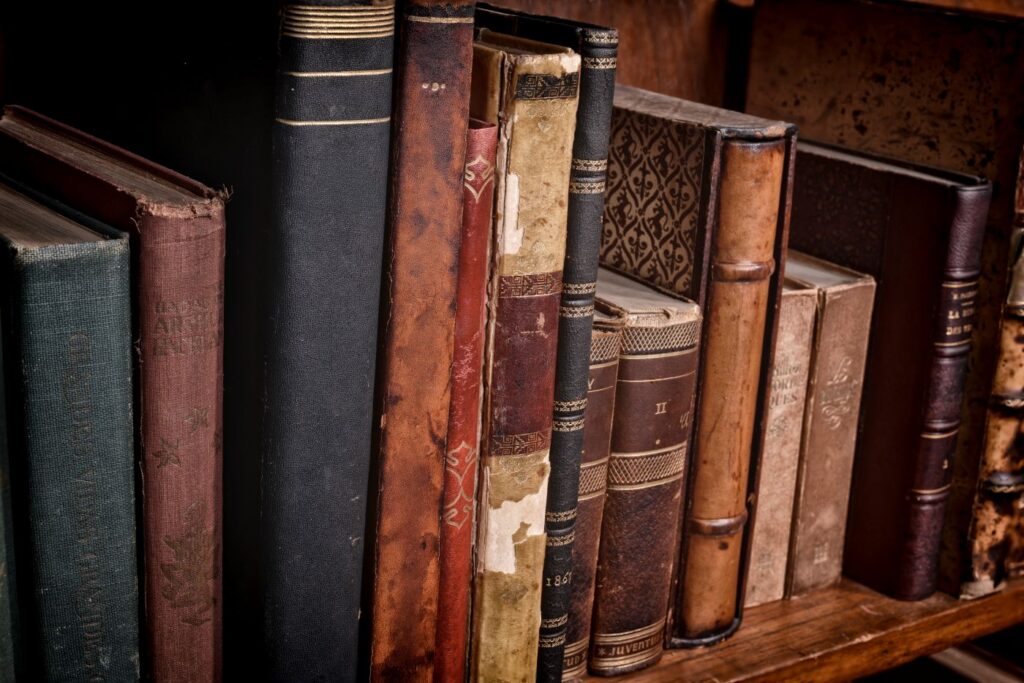
This month I’m also taking delivery of a couple of new (and badly needed) bookcases, which means I need to rearrange my library (again). And as I go through my bookshelves, I find reminders of the departed in the books that were theirs. Here are my mother’s first editions of Muriel Spark and Rumer Godden and Charles Portis. There is my father’s childhood copy of King Arthur and His Knights, read and reread by both of us as boys until the binding cracked and the pages loosened. One old bookcase is entirely filled with multiple copies of the travel books by my grandfather, Harry A. Franck.
In another room are books that mark my wife’s progress from English major to student and teacher of drama to professor of communication. After her passing I sent, to a protegée-turned-colleague of hers, her dogeared copies of Kenneth Burke, about whose importance to her work she spoke many times. (For her, to speak simply of “Burke” meant Kenneth, not Edmund, which took some getting used to for me.) But several shelves remain of books on rhetoric, theories of communication, media criticism, and other subjects that Gwen studied and taught. She and I had overlapping interests—she specialized in political communication, and we wrote together several times—yet like many academic couples, our distinct formations as scholars led us into very different disciplinary literatures. Much of what she knew is opaque to me, as was much of my field to her. What shall I do with all these books? To read them now, without her to discuss them with, seems pointless, and anyway they will tell me nothing I need to know about the woman I lived with for three decades. Away to the public library for its fundraising sales, then. I’ll keep the Northrop Frye and the Neil Postman, but let the rest go. Maybe I’ll check out some of that (Kenneth) Burke after all as well.
Start your day with Public Discourse
Sign up and get our daily essays sent straight to your inbox.I have often sung the praises of used books and bookstores in this space. Have you ever thought about the hands through which your books have passed? I have. Some of my books have been in my family a long time, four generations or more. But here’s what I don’t know: exactly who read this Macaulay, or that Thucydides, and why is the eighth and final volume of Gibbon missing? (I know how it ends: the Roman empire falls.) A set of Disraeli’s novels prompts the question—why? Yet I do not get rid of them. Their age alone seems to command respect.
Then there are my bookstore, auction, and library sale acquisitions. Lately, for a scholarly project, I’ve been examining the various editions of John Marshall’s Life of George Washington. How did my copy of the first edition—published in Philadelphia, 1804–07—make its way to a public library and then a bookshop in Geneva, Illinois? Who owned it first? No markings tell me. One of my copies of the 1832 second edition (printed 1838) has a bold signature on the first volume’s front endpaper, in ink turned brown by age: E. C. Pechin. Google tells me this is probably Edmund Cash Pechin, a Philadelphia lawyer and mining engineer, who retired to a farm in the Roanoke Valley of Virginia, near where the two volumes came into my hands. The pages are all cut (as one had to do in those days when a new book came with pages uncut at the fold of the outer edge), so it seems Mr. Pechin read Marshall’s work. Or at least he cut the pages open!
Every so often one discovers books whose provenance is a delight and yet also sobering. Two books I acquired in the last year or so belonged once to the great historian Daniel J. Boorstin, who capped his career with a dozen years as the Librarian of Congress. Somehow it is rather sad that I should have any of this man’s books—could they not have remained in his family, or adorned a university library? Yet I am proud to own them, and since they are useful to me, perhaps they have found the right home.
The books of the dead are the repositories of past lives—not just of the books’ authors, but of their readers too: of their pleasures in a tale well told, of the things they saw, marked, remembered, knew.
Inevitably, for someone in my line of work, I have a great many books by friends and acquaintances, and I like, when I’m able, to get them to sign their books. Some have been kind enough to inscribe them to me as well. What will the heirs of my books—or those who buy them in years to come from used bookstores—make of these scribbles? Will a scrawled note and signature increase the book’s value for future sales? Maybe in some cases; probably not in most. What, for that matter, will some future reader make of my annotations, sometimes consisting of a random question mark, exclamation point, or “NO” in the margin, other times of a whole penciled paragraph at the foot of a page? If I were famous, the reader’s interest in such minutiae would be very keen. I am not, and it won’t be.
I remember hearing the late Robert Louis Wilken tell, with boyish delight, of his discovery, in the Library of Congress, that late in his life Thomas Jefferson had read Tertullian and seen the affinity between that ancient Christian’s argument for freedom of religion and his own argument, made years earlier, in his Notes on the State of Virginia. The Library holds both Jefferson’s own copy of his Notes, and his copy of Tertullian, and the statesman’s marginalia in both books are evidence of his having made the connection. Wilken relates the discovery in the appendix of his 2019 book Liberty in the Things of God, and his flutter of joy at this little find is infectious.
But this is what the books of the dead can do for us. They are the repositories of past lives—not just of the books’ authors, but of their readers too: of their pleasures in a tale well told, of the pains they took to master a subject, of the arguments they carried on with the authors, of the fascinations they pursued, of the things they saw, marked, remembered, knew. Memento mori, dear reader. Remember you shall die—but your books will not.