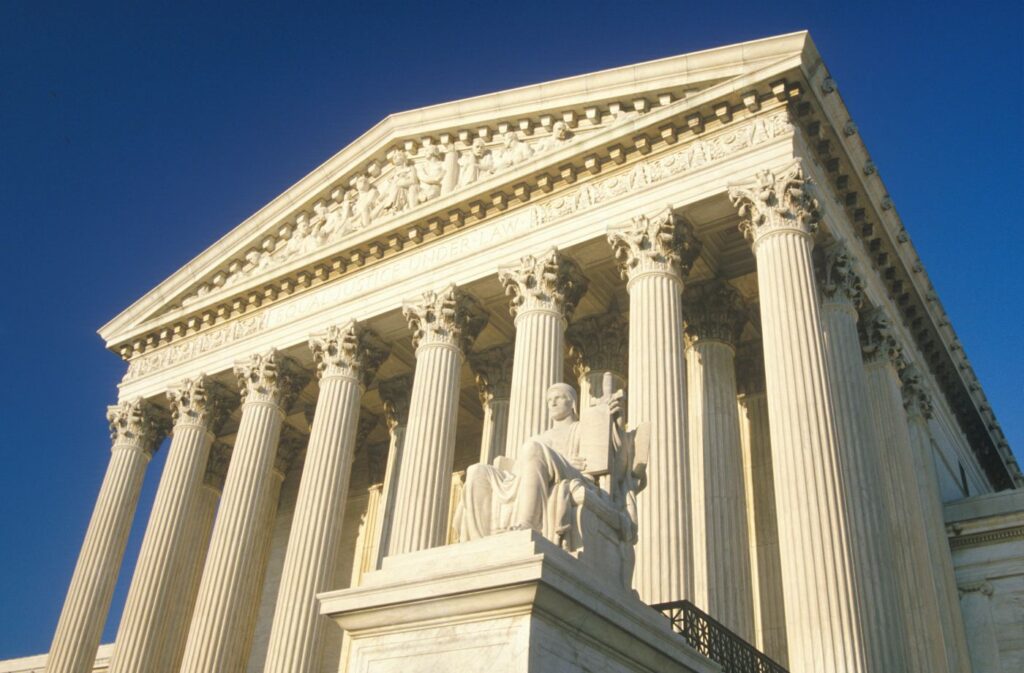
The second Trump administration seems to have spent half its time in court. The president’s shock and awe campaign of executive orders quickly ended up bogged down in interminable litigation, seemingly via an endless string of unreviewable temporary restraining orders (TROs) that have tied down the administration like Gulliver. The administration has fought back, in turn, and maintained a very aggressive campaign of appeals. But because these suits are almost all brought in liberal courts, Trump’s only hope for relief is in the Supreme Court—where he has probably won more than he has lost—but the record is decidedly mixed.
What’s interesting about that record—and this litigation dynamic—is what it says about contemporary constitutional litigation: it’s all death-penalty litigation now. Because of the posture of these cases—stays, TROs, preliminary injunctions—they reach the Court on its emergency docket, where they are not decided on their merits but under judicially invented four-factor tests.
For decades this was the near-exclusive province of death-penalty appeals, but now it seems to apply to every major public-law case—or nearly so. Indeed, the Court’s liberals seem to understand this and are using reasoning redolent of those cases: namely, that the magnitude of the possible harm outweighs all other legal considerations. The Court’s conservatives should step back and recognize this dynamic for what it is, and approach the public-law emergency docket the same way that conservatives approach the death-penalty emergency docket: the rigorous and formalistic application of the law, and not the false attraction of dirty justice in favor of a sympathetic party.
The Emergency Docket
The Supreme Court has two main dockets: the merits docket and the emergency docket. They are, in a sense, what they sound like. The high-profile cases whose arguments are carried on C-SPAN, with scores of briefs filed by every white-shoe law firm, and which are decided at the end of June, are on the merits docket. The emergency docket is for, well, emergencies.
Start your day with Public Discourse
Sign up and get our daily essays sent straight to your inbox.For decades, appellate litigation was rather languid. Cases of law would be tried before a district judge who’d issue a permanent injunction, summary judgment, or a judgment after a bench trial. This would then be appealed, with full briefing and argument, after which the Supreme Court would perhaps grant certiorari.
Recall, for example, the California gay-marriage case, Hollingsworth v. Perry. There, a suit was brought challenging California’s Proposition 8 in May 2009. The district judge denied the plaintiffs’ preliminary injunction motion a month later. That October, he then denied a summary judgment motion filed by the defendants and set a bench trial. The judge didn’t issue his ruling until August 2010. While he had his political reasons for drawing out the spectacle of the case, it’s hard to imagine a trial judge today allowing a hot button, alleged constitutional violation to persist for fifteen months while he deliberated.
Instead, cases involving consequential questions of public law are decided early in the litigation process. The plaintiff will seek a TRO or a preliminary injunction and, if it’s granted, it’ll immediately be appealed to seek a stay at the circuit and perhaps the Supreme Court.
At all levels, the merits of the case are only one factor considered. To get a preliminary injunction requires a combination of the likelihood of success, the potential for irreparable harm, the balance of equities, and the public interest. It’s similar if someone seeks a stay: you need a strong showing that you are likely to succeed on the merits, that you will be irreparably injured absent a stay, that the stay won’t substantially injure the other parties interested in the proceeding, and that it’s in the public interest to grant one.
Different courts of appeals handle these factors differently. Some evaluate them as a “sliding scale,” whereby the four are measured against each other and considered as a whole. Others analyze them sequentially, whereby a claim that’s unlikely to succeed is also unlikely to get a preliminary injunction or a stay.
The Supreme Court has not really clarified the issue—even though, one would assume, that’s why we have a Supreme Court—but it has observed, in Nken v. Holder, that the likelihood of success and the magnitude of the harm are the most important factors in considering a stay.
Death-Penalty Reasoning
Given the reality of contemporary death penalty litigation, prisoners frequently make many appeals over time to federal courts—including the Supreme Court—to stay their executions. Death penalty litigation goes in many phases—the trial, its direct appeal, collateral attacks, habeas corpus, etc.—and it’s all governed by a highly complex statutory and constitutional scheme. But when the hour approaches, it invariably ends up on the Supreme Court’s emergency docket, with the prisoner seeking a stay of execution.
Unsurprisingly, those who advocate for death-row convicts—both at the bar and on the bench—tend to favor a sliding-scale approach. Does it really matter how remote the chance of victory is if the failure to grant a stay will mean death? It’s the most irreparable harm imaginable. The harm, then, swallows up the rest of the test.
Trump’s Cases
This approach—the primacy of harm—is what the Court’s liberals now openly advocate.
We first saw it in Justice Jackson’s dissent in Libby v. Fecteau. There the Supreme Court granted an injunction pending appeal for the member of the Maine House of Representatives who was barred from voting due to the way in which she opposed biological men in girls’ sports. Justice Jackson wasn’t having it, saying that the case was not at all fit for emergency relief. After all, Libby had “not asserted that there are any significant legislative votes scheduled in the upcoming weeks; that there are any upcoming votes in which Libby’s participation would impact the outcome; or that they will otherwise suffer any concrete, imminent, and significant harm while the lower court considers this matter.” In other words, no harm, no foul on the emergency docket.
On the other hand, there is Justice Jackson’s dissent in the CNHV case, Noem v. Doe. There beneficiaries of Joe Biden’s Cuba, Nicaragua, Haiti, Venezuela (CNHV) mass-parole policy sued to stop Kristi Noem for taking away what Alejandro Mayorkas hath given. They succeeded in the District of Massachusetts, and the government did not receive a stay from the First Circuit. The Supreme Court later granted them relief.
Jackson, again, wasn’t having it. She crisply articulated the sliding-scale framework from liberal death-penalty jurisprudence:
The Court has plainly botched this assessment today. It requires next to nothing from the Government with respect to irreparable harm. And it undervalues the devastating consequences of allowing the Government to precipitously upend the lives and livelihoods of nearly half a million noncitizens while their legal claims are pending. Even if the Government is likely to win on the merits, in our legal system, success takes time and the stay standards require more than anticipated victory. I would have denied the Government’s application because its harm-related showing is patently insufficient.
Here we have a policy, CNHV, that was almost certainly unlawful when adopted, and yet, should Trump try to unravel it, he should be stopped because of the harm it would cause to those he’s looking to deport.
The merits of the case are preposterous. The judge below faulted Trump for not partaking of an “individualized” assessment of each parolee as required by law—even though they were granted categorical parole, as the name of the program indicates. The Biden administration’s own justification for ignoring the legal mandate for individualized determinations was that they actually determined whether each individual was from one of the four applicable countries. If that wasn’t class-based parole, then neither is revoking it by checking to see whether those people were part of the CNHV program. In other words, Noem should have the petitioners dead-to-rights on the merits.
But that’s not what mattered to Justice Jackson. She went on to argue, “this Court has long understood that the ‘authority to grant stays’ is only justified by the ‘need to prevent irreparable injury to the parties or to the public pending review.’ Hence, even if an applicant is likely to succeed on the merits of their legal claims, we also ask whether they have demonstrated irreparable harm.” In her view the government has not done so—in being unable to enforce the Immigration and Nationality Act—but “[r]espondents have shown that tangible, imminent, and significant harm is likely to befall them if this Court grants the application and issues a stay.” In other words, it’s harm all the way down.
It's hard to imagine any irreparable harm today worse than the execution of someone who claims innocence with post-conviction evidence, and yet Justice Scalia’s response then should echo today: he’s entitled only to what the law allows.
Unfortunately, it’s hard to see how this approach didn’t infect the Court’s majority decision in the Tren de Aragua case, A.A.R.P. v. Trump. While the relative merits of the Court’s per curiam decision and Justice Alito’s scathing dissent are well trod by now, it’s worth noting how the Court dealt with the question of harm in reaching its conclusion: “Here the District Court’s inaction—not for 42 minutes but for 14 hours and 28 minutes—had the practical effect of refusing an injunction to detainees facing an imminent threat of severe, irreparable harm.”
Perhaps because of the administration’s unwillingness or inability to return the “Maryland man,” Kilmar Abrego Garcia from El Salvador, the “severe, irreparable harm” in A.A.R.P. swallowed up the rest. The case was a thicket of jurisdictional questions, and the remedy fashioned—putative-class preliminary injunctive relief—was so novel that it was justified by a treatise collecting district-court opinions. Indeed, the circuit-court opinion most on point—Kartman v. State Farm—has Judge Sykes of the Seventh Circuit concluding that such relief is only appropriate under the Federal Rules of Civil Procedure if it’s final, thereby implying that—for A.A.R.P. and his putative class to receive an injunction—class-wide habeas relief must be available. The Court clearly didn’t intend to get into all of that, but it did. As with liberals and the death penalty, it was harm all the way down.
What Would Antonin Scalia Do?
The Court—or at least its conservatives—should step back and look at what’s developing. The omnipresence of the emergency docket is clearly not their preferred way of doing business—in particular, as I have explained here, in the view of Justice Barrett—but for better or worse it’s where the litigation currently is. Until that changes, they’ll keep being called upon to apply injunction and stay tests and—especially as the president’s immigration agenda gets going—it will present the question that Doe and A.A.R.P inherited from decades of death-penalty litigation: do you asses the likelihood of success first and go from there? Or do you balance it all off the purported harm?
As is often the case, there’s a good example for them to follow: the late Justice Scalia. While not directly on point to the question of stays, Justice Scalia’s approach to actual-innocence claims in habeas corpus litigation helps present the judicial-conservative position.
In a case called Herrera v. Collins, the Court considered whether a claim of actual innocence by a convicted cop killer entitled him to relief under habeas corpus. Chief Justice Rehnquist concluded for the Court that it didn’t, largely due to the circumstances of Herrera’s case. Justice Scalia—and Thomas—concurred, but noted, “There is no basis in text, tradition, or even in contemporary practice (if that were enough), for finding in the Constitution a right to demand judicial consideration of newly discovered evidence of innocence brought forward after conviction.” To his dissenting colleagues he said, “If the system that has been in place for 200 years (and remains widely approved) ‘shocks’ the dissenters’ consciences, perhaps they should doubt the calibration of their consciences, or, better still, the usefulness of ‘conscience shocking’ as a legal test.”
It’s hard to imagine any irreparable harm today worse than the execution of someone who claims innocence with post-conviction evidence, and yet Justice Scalia’s response then should echo today: he’s entitled only to what the law allows.
The shock of conscience should no more apply as the fourth stay factor under Nken than it should in the issuance of habeas relief. If the Court wants to stand apart from the toxic politics of the moment, it needs to focus on where the law leads, not where the DHS flight is headed.
Image licensed via Adobe Stock.