The Bookshelf: Audiobooks and the Recovery of Leisure Reading

Audiobooks’ greatest potential is to encourage a sense of receptivity and leisure throughout the rest of life, not just one’s reading life. Listening to a novel, accepting its rhythms and flow of detail on the book’s own terms, is a gentle reminder that life’s most glorious things demand quiet, silent admiration, and loving acceptance.
The Psychology of Digital Dehumanization

A Web of Our Own Making overflows with disquieting observations about the ways digital technology is reshaping human nature. Antón Barba-Kay puts into haunting words the anxiety, exhaustion, and emptiness that most of us feel but cannot put into words because we are too busy scrolling and ogling.
If You Like America, Thank Christianity

Mark David Hall’s Proclaim Liberty Throughout All the Land represents a landmark contribution to the debate over the impact of Christian faith on American law and culture. It is high time for Christians to reframe this debate, asking not “How much do we have to apologize for?” but “How much can we take credit for?”
Is Bias Actually Bad?

If we take seriously Thomas Kelly’s ideas about bias blind spots, then we should seek public universities composed of a high degree of biased parts. Such universities would intentionally hire faculty members and administrators who harbor contrary views on divisive cultural issues. This would probably create campuses that can boast of having teaching and scholarship that have much less pejorative bias than their peer institutions.
Barbie’s Quiet Rebuke of Transhumanism

The movie’s most profound insight is its distillation of pop feminism: a praise of women so unceasing that we no longer feel comfortable being normal human beings with blemishes, weakness, and fertility.
The Past As Enemy Country: Why Teachers of Great Books Should Be Teaching History, Too

We need to study history as a subject in its own right, acquiring a deep appreciation for the story of Western civilization, with all its abysses of failure and all its deservedly celebrated achievements. We need to help our students understand old texts at a deeper level, in less anachronistic ways. Above all, we need to arm them against the hostility to their own tradition that has become such a destructive force in our culture.
The Transgender Movement’s House of Cards Is Falling

A growing number of doctors, patients, and whistleblowers are beginning to question the medical establishment’s recommendations for children with gender dysphoria.
There’s No Easy Fix to Our Broken Presidential Nominating System

For the foreseeable future, there will be no institutional barrier to demagoguery, viciousness, or incompetence to be found within the nominating processes. The only barrier will be the voters themselves.
“Housing First” Policy Is Not Helping the Homeless

It takes excruciating self-loathing for a person to defecate on public sidewalks, shoot up with poisonous drugs, engage in rampant criminality. The mental illness and dissipation is sometimes so profound that many of these poor people die on the streets. Providing housing vouchers alone simply doesn’t cut it.
Third Places Aren’t Enough

Activities like gardening—what Josef Pieper has called “active leisure”—offer even more than third places can. They too are a meeting ground for people of any background, but active leisure is more deeply rooted in a true vision of our condition: creatures responsible for stewarding what’s been given to us alongside others.
Graduate Student Unions and Catholic Social Thought

Since the first social encyclical, Rerum novarum (1891), the Church consistently has taught that forming unions is a natural human right, an expression of the right of association and a right that governments may not deny.
“Traditional Values” Are Russia’s Geopolitical Weapons

The militant Russian religious conservatism of the twenty-first century, paradoxically, mirrors the Soviet anti-religious socialism of the twentieth century. Their common feature is a shameless instrumentalization of religion, with the consent of the latter.
The History behind the Formation of Christendom
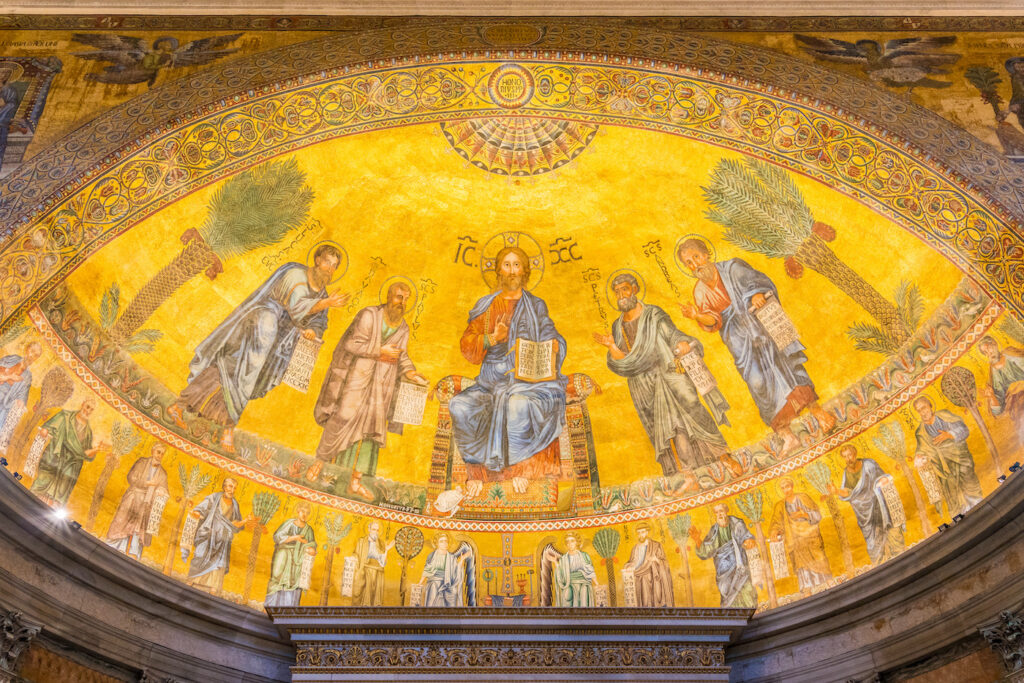
In Christendom: The Triumph of a Religion, Peter Heather wishes to dismantle some of the conventions that have governed how the story of Christian history is told.
The United States Should Give Reparations for Segregation, Not Slavery: A Response to Daniel Philpott

The United States must apologize for treating blacks with contempt and compensate with reparations those American blacks who lived through racial segregation. But reparations for all black Americans will not erase the wealth gap between blacks and whites, nor improve the significant educational achievement gap rampant throughout the black communities in this country.
A Christian Case for Racial Reparations

Slavery, Jim Crow, and distributive discrimination assaulted natural rights and the dignity of persons made in the image of God on which these rights are based. They leave behind wounds, the most central of which is the standing victory of injustice, the moral fact of injustice itself that persists in time unless it is repudiated. While constitutional amendments, legislation, and policies have countered and delegitimated these injustices, the lack of a formal apology and reparations has left them still standing.
Exploring the Evangelical Imagination with Karen Swallow Prior
That’s really what I want out of this whole project: for us to see that it’s all saying something, whether it’s a cheesy T-shirt, or a simple country church building, or a medieval cathedral. I want us to really pay attention and ask, “What is it saying? What is true and good and beautiful in what it’s saying, and what is not?”
The Right Has Become Post-Religious

Trump—and more broadly, the style of politics he represents—did not rise to power on the shoulders of the religious right, but rather the post-religious right. Indeed, his presidency was made possible by the very process of secularization that the religious right has long sought to combat.
Housing Affordability: Putting People First

The deterioration of housing affordability suggests that we must reorient current policies on land use and focus on more fundamental objectives: people’s need for housing
Better Housing Would Make Families Happier

Modern life in the United States is atomizing, lonely, and hard on family bonds. Improving the housing stock would help alleviate these challenges.
Yes in My Backyard—and in My Frontyard

Being pro-family must also mean being pro-housing reform. If we want more neighborhood children playing in our front yards, we should be pushing their elected officials to make it easier for developers to build, baby, build.
The Bookshelf: Editions and Subtractions

A book in its entirety, once given to the world, is a kind of integer, a whole from which nothing should be subtracted if it is to remain what it is.
“You Couldn’t Pay Me to Say That”: 303 Creative and Compelled Commercial Speech

303 Creative prevents a First Amendment violation where it would be most keenly felt—the government commanding an individual to use her creative talent to create and promote a message antithetical to her conscience or beliefs. The relative rarity of prior cases involving attempts to compel creative commercial speech may have reflected a tacit consensus that this was a First Amendment redline, not lightly to be crossed.
Why Religion and the Humanities Are in Decline

What is useful is inherently teleological: calling something “useful” invokes the question “useful for what?” But modernity resists this question by multiplying means without any clear ends. We live an infinite regress of usefulness with little sense of the point of our labors. In a world that only understands useful things, interest in humanities and religious faith (both of which consider human purpose) will inevitably decline.
Scarcity Is about More Than the Market

Before modern economists claimed a monopoly on the topic of scarcity, philosophers, artists, and theologians spent centuries arguing over the nature and limits of our desires.