“Is nothing sacred?”
This is the thought that springs to mind when one hears of the conduct of the Westboro Baptist Church, whose members make public spectacles of their fellow citizens’ funerals—even and especially those of warriors killed in the line of duty—in order to highlight ideas that could otherwise command little attention. Westboro continues to maintain a busy schedule of funeral protests. Earlier this month Westboro leaders tweeted their intention to picket the funeral of Steve Jobs, and just last week they made known their intention to protest at the upcoming memorial of an Army Staff Sergeant killed in Afghanistan.
Although it is a natural response, to wonder whether nothing is sacred is perhaps an overreaction. After all, every society has a small class of zealots who, in their self-righteousness, think they may ignore even the most minimal standards of human decency. The conduct of such people in no way defines the character of the larger society.
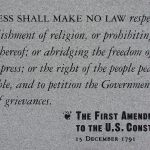
This thought—“Is nothing sacred?”—is, however, a reasonable reaction to the behavior of America’s federal courts, which have given undeserved dignity to Westboro’s conduct by declaring it within the protection of the Constitution. Westboro’s abusive demonstrations, the courts tell us, are sheltered by the First Amendment’s prohibition on laws abridging the freedom of speech. Such judicial pronouncements do reflect on the nation’s character, because they are made under the authority of the United States and in the name of its fundamental law.
Start your day with Public Discourse
Sign up and get our daily essays sent straight to your inbox.This problem first came to light last March, when the Supreme Court announced its decision in Snyder v. Phelps, ruling that the First Amendment barred Snyder—the father of a U.S. Marine killed in Iraq—from suing members of Westboro for the emotional distress caused by their protest at his son’s funeral. Last week, in a different case, the problem resurfaced in the United States Court of Appeals for the Eighth Circuit. The Appeals Court’s ruling is even more troubling than the Supreme Court’s because it threatens more judicially created restrictions on society’s ability to protect decent standards of public expression.
In striking down the suit for emotional distress, the Supreme Court reassured the nation that states still had tools by which they could protect the dignity and privacy of those burying their dead. A number of states, it noted, had passed or were considering laws requiring protesters to keep their distance from funerals. The Eighth Circuit ruling last week, however, cast a serious cloud of judicial doubt over such laws.
To be sure, the Eighth Circuit’s judgment does not definitively settle the constitutional issue here. The Nebraska Funeral Picketing Law prohibits funeral protests within 300 feet of the site and within an hour before and two hours after the funeral. Shirley Phelps-Roper, a Westboro member, challenged this law in United States District Court by seeking an injunction against its enforcement while it was under challenge. The District Court judge denied the injunction, but, on appeal, the Eighth Circuit panel agreed with Phelps-Roper that it should have been granted. Such a procedural ruling does not, again, give a final ruling on these laws’ constitutionality. The panel’s reasoning, however, is ominous for their future. For the three-judge panel granted the injunction on the grounds that Phelps-Roper’s constitutional challenge is “likely to prevail” in the end, a fairly clear signal that she eventually will win relief not only in a temporary injunction but in a judicial decision to strike down the Nebraska law.
Rulings such as these do not arise merely from the preferences of liberal judges inclined to side with offensive malcontents against ordinary citizens. Snyder v. Phelps was decided 8 to 1. Justice Alito alone dissented, while the rest of the Court’s conservatives joined with all of its liberals to forbid the emotional distress suit in the name of the First Amendment. Similarly, the appellate panel’s decision was unanimous. And the Eighth Circuit, well-stocked with Republican nominees, is no haven of liberal judicial activism.
On the other hand, neither do such rulings stem from the real requirements of the Constitution. They are instead the fruit of well-established but still erroneous constitutional “doctrine” created by courts and wrongly acquiesced in by the public. Such doctrine, though decades old and now accepted by both conservative and liberal jurists, must be reconsidered if our governing institutions are to maintain any ability to enforce reasonable standards of public discourse.
The First Amendment, as originally understood, provides no shelter for Westboro’s antics. America’s founding generation—both ordinary citizens and legal elites—drew a distinction between liberty and license. That is, they recognized a difference between, say, the use of freedom of speech, on the one hand, and its abuse, on the other. There can be no genuine doubt that they would have classed Westboro’s outrageously lacerating rhetoric—“Thank God for Dead Soldiers,” “You’re Going to Hell”—in the second category and would have accordingly judged it outside the protection of the First Amendment’s speech clause, which was intended to protect a robust public debate, conducted according to civilized standards of decency.
As recently as a century ago, this Founding understanding was at least tolerably expressed in the Supreme Court’s approach to free-speech cases. This approach was governed by the “Bad Tendency Test,” which applied a standard of reasonableness—or what came to be called “rational basis review”—to laws regulating speech. The courts did not think themselves authorized to strike down speech laws if they suppressed speech that the legislature reasonably could have considered socially harmful, or as having a “bad tendency.” The Bad Tendency Test was guided by the courts’ presumption that duly enacted laws were constitutional and that the burden of proof rested on those who sought to overturn them, a presumption that informed American judicial review from the beginning. Thus citizens who challenged speech laws were obliged to argue their unconstitutionality by showing that they were merely arbitrary or that they lacked any reasonable relation to a legitimate government responsibility.
The Bad Tendency Test, however, has long since been discarded by the Supreme Court and replaced with other standards, which make it almost impossible for the public to enact laws protecting reasonable and decent standards of public speech and conduct. In the early and middle twentieth century, the Court moved to the “Clear and Present Danger Test,” first devised by Oliver Wendell Holmes, Jr. This test held that government could only restrain speech when it was accompanied by a clear and present danger that would lead to other evils—evils that the government has a right to prevent. This test was then superseded by one even more protective of speech, the Imminent Lawless Action Test, which held that speech only could be controlled if it were uttered in a context where it was likely to lead to an unlawful act.
Moreover, the rise of these tests was accompanied by the Court’s rejection of the traditional presumption of constitutionality in a growing number of areas, including that of laws that regulate speech. It embraced the view, first developed by liberal free-speech absolutists such as Hugo Black and William O. Douglas, that speech enjoys a “preferred position” in our system of constitutional values. Accordingly, the Court began to apply various kinds of “heightened scrutiny” to laws impinging on speech, demanding more and more that the government demonstrate their necessity.
This modern approach to freedom of speech makes it almost impossible for our society to maintain a decent standard of public discourse and public conduct. Laws seeking to enforce such a standard must now face the Supreme Court’s rejection of presumed constitutionality. They approach the bar as constitutionally guilty until proven innocent, so to speak. Moreover, the substance of the modern speech tests tends to disfavor the very idea that society has any interest in protecting the moral quality of its public discourse. Civilized societies—even societies that must be regarded as free by any reasonable historical standard—always have recognized that some forms of expression are harmful to individuals and to the common good. Yet the Court’s modern approaches—preoccupied with clear and present dangers, or imminent lawless actions—deny such moral common sense, insisting instead that speech may only be regulated when it threatens some other harm beyond itself.
One is tempted to call Westboro’s conduct barbaric—until, that is, one realizes that this would be unfair to barbarians. For even the most unrefined societies in history would regard it as unacceptably disgraceful to make a political circus of the ceremonies by which a family buries its dead, all the more so when those dead are society’s defenders. It is sadly ironic, then, that the American practice of judicial review, itself a great achievement of civilization, has been turned into a tool for vindicating behaviors that are worse than barbaric—pornography, child pornography, and now Westboro’s profanation of funerals.
Most Americans, I think, sense this irony and wish it were otherwise. Indeed, the enactment and popularity of laws such as the Nebraska Funeral Picketing Law point to a public understanding that some forms of expression do harm and contribute nothing of value to our public discourse. Contemporary constitutional doctrine may impede the public from acting on such an understanding, but such doctrine, in this area at least, deserves none of the deference with which the public usually treats it. For, again, the Founders shared the commonsense view that some expression is an unjustifiable abuse of speech. And there is no reason to think that those who framed and ratified America’s Constitution intended to authorize a judicial review that treats laws protecting decent standards of speech and expression as presumptively unconstitutional.
In order to vindicate the public’s reasonable authority to protect the moral quality of our public discourse, citizens should seek to roll back the modern Court’s speech doctrines; they should elevate jurists who are guided by the Constitution and judicial review, as they were originally understood, rather than by judge-made doctrines whose application is virtually indistinguishable from judicial activism. If we do not do this, then the judgment implied by the question “Is nothing sacred?” will rightly fall not only on outrageous provocateurs and their judicial enablers, but on the country itself.