Witherspoon Institute
2026 Summer Seminars
Held in Princeton, NJ
For rising high school juniors and seniors, undergraduates, and graduate students.
Keep up with the conversation! Subscribe to Public Discourse today.
Book Reviews
John Witte, Jr.’s The Blessings of Liberty offers a wonderful overview of the development of human rights in the West. He contends that natural rights are found in the Bible, were developed by Christian thinkers, and played an important role in the West long before Enlightenment thinkers wrote about them. Witte also focuses on religious freedom more narrowly as the preeminent right.
After reading Terry Eagleton’s new book, Critical Revolutionaries, the message is quite clear for those who love literature: avoid graduate school, find others who share your passion, and recover a proud tradition now lost to ideology and politics.
Francis Fukuyama offers a useful account of the pathologies of liberalism and argues that it still has the internal resources necessary to resist its critics. But his defense of liberalism seems designed only to appeal to likeminded centrists. Liberalism today should not be about splitting differences and seeking moderation, but staking out its ground and affirming its beliefs.
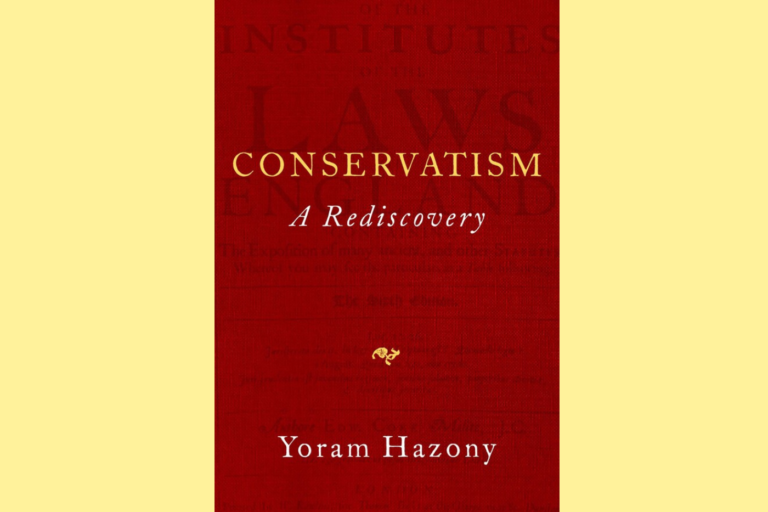
The arguments of Yoram Hazony’s Conservatism: A Rediscovery reveal both the value and the difficulty of applying a Burkean approach to human social life in a modern, non-Burkean society like our own. Part two of a two-part review.
Yoram Hazony’s Conservatism: A Rediscovery offers a valuable new take on non-Lockean political theory, grounded in the Biblical tradition and relevant to our current affairs. Part one of a two-part review.
In her new book, Ilana M. Horwitz shows how public schools are both more formative and more limited than is often assumed. While they serve an important role in the academic and social formation of students, schools stand as just one institution among many in contributing to student outcomes. As we emerge from the significant educational disruptions occasioned by the COVID pandemic, Horwitz’s research suggests that we must work toward rebuilding schools and other institutions alike.
By Flagg Taylor
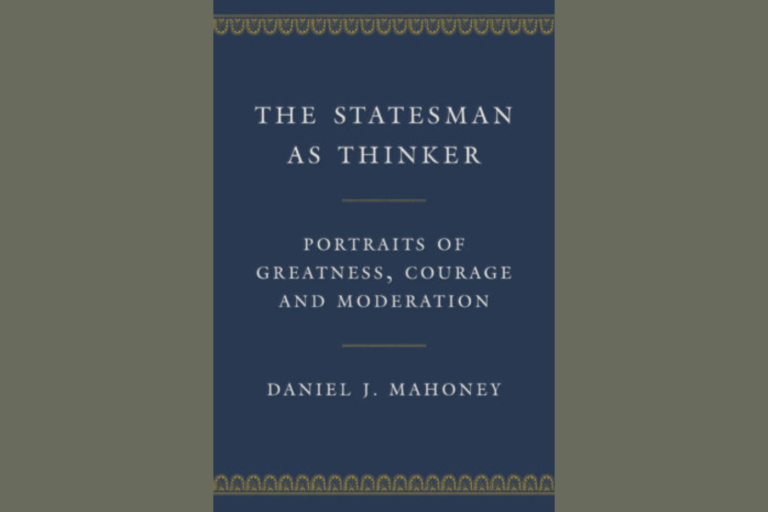
In The Statesman as Thinker, Mahoney seeks to restore principled statesmanship through portraits of six figures who combined political authority with uncommon reflection: Edmund Burke, Alexis de Tocqueville, Abraham Lincoln, Winston Churchill, Charles de Gaulle, and Václav Havel.
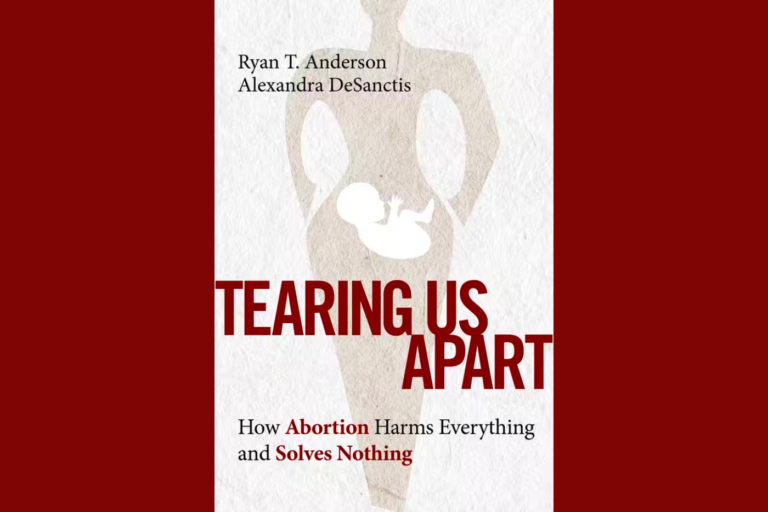
Tearing Us Apart is just the book we need: it understands and works within our current rhetorical and political impulses. Unfortunately, it is silent on specific policies to address how to reduce abortion demand. Nonetheless, with pro-life leaders like Anderson and DeSanctis at the helm, we have every reason to believe that the future of our movement will be guided, not by ideology, but by what will best serve the good of babies, women, and families.
Matthew Continetti’s new book offers an authoritative account of the complex interplay between conservative ideas, politics, and policy over the past century. His telling of conservative history suggests that if we want to know the movement’s future, we should first look to its past.