











Archives - Page 103 of 175 - Public Discourse

Our universities are struggling under competing epistemological trends. Teaching students to master these requires developing their power to listen.
If conservatives want to seriously help address issues related to Islam, the Muslim world, and encounters with the West, they need to escape their narrow information networks.
Political theory typically attributes political action to one of two main motivations: idealism or self-interest. But incompetence plays a much larger role than many assume.
The Christian worldview accepts the validity of people’s testimony that gender dysphoria is a real experience resulting in heartrending distress. The Christian worldview cannot, however, countenance the idea that men can become women or that women can become men.
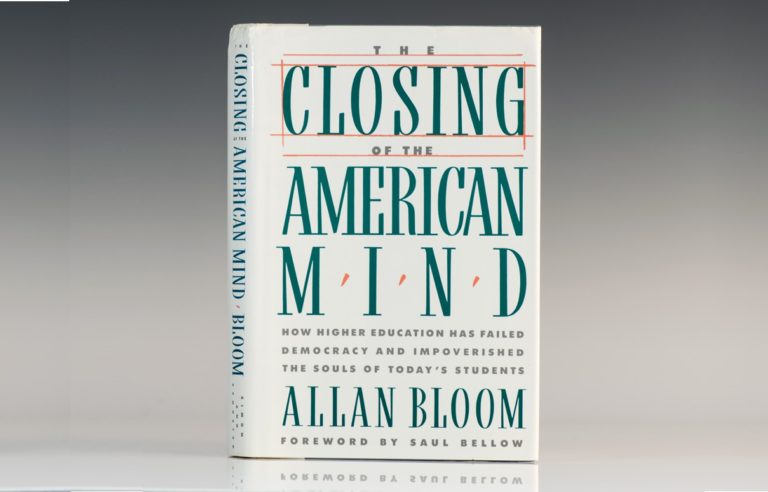
The authors in this symposium have offered insightful analyses of Bloom’s book and the contemporary university it describes. Can what has been lost be recovered? If so, this will come through restoration of the imagination.
Allan Bloom would not have been surprised by recent developments in American higher education, from trigger warnings and safe spaces to micro-aggressions and physical violence.
What would have happened if literature professors had continued to love literature, admire Shakespeare, and teach others to do the same? Perhaps if they had emulated Allan Bloom’s attention to words—if they’d taught writing and written well themselves—our colleges would not now be so enraged.
Souls without longing are the price to be paid for a free, comfortable, and secure life. Yet the unnatural state of radical isolation and apathetic “niceness” can only last so long.
All is not well in America—or in the University. Allan Bloom’s The Closing of the American Mind offers a profound and compelling diagnosis of the common illness infecting them both and of the intimate connection between liberal education and liberty.
With the recent passing of Judge John T. Noonan, Jr., Americans would do well to honor and remember his example of respectful engagement over fundamental moral issues.
Willie Parker’s new memoir displays the characteristic ignorance, arrogance, and violence of the pro-choice worldview.
President Trump has an opportunity to forge a remarkable legacy as a pro-life president. To do that, he must continue to update, reinforce, and apply the principles underlying the Mexico City Policy in a way that is consistent with Ronald Reagan’s original vision.
We have the obligation to propose with the apostle Paul the more excellent way. And this only intensifies as you graduate today and enter a world that is simultaneously hungry for and resistant to your message.
Fake history has established the foundation for fake news.
A new book highlights the shared anthropology and social thought of Abraham Kuyper and Pope Leo XIII without glossing over their differences.
As long as complicit bystanders refrain from voicing dissent, embryo destruction will continue to masquerade as a practical, commonplace business, rather than the social cancer it truly is.
Significant advances in evolutionary biology and the neurosciences have led many who are already committed to a materialist philosophy to offer sweeping accounts of the origin and development of life, from bacteria to the human mind and consciousness.
To detach religious liberty from truth is to decapitate it.
The legalization of physician-assisted suicide sends the message that it is better to be dead than disabled. Do I lack dignity because I lack physical independence?
A culture that substitutes lawn signs and slogans for moral substance can only be renewed by the rigor of Christian thought and the actions that flow from it.
Environmentalism makes us loyal to one another in a fundamental way, points us to values beyond mere utility, and directs us back to the natural order of which we are a part.
Is “pro-life IVF” necessarily an oxymoron?
The traditional philosophical and theological concept of the soul allows us to integrate what the empirical sciences reveal with what we know about ourselves as rational and moral beings.
Let’s set aside partisanship and unite to provide disadvantaged children with the educational opportunities they deserve. Rather than deny low-income families the same educational choice that wealthier families enjoy, we should seek other ways to improve the quality and efficiency of public schools.