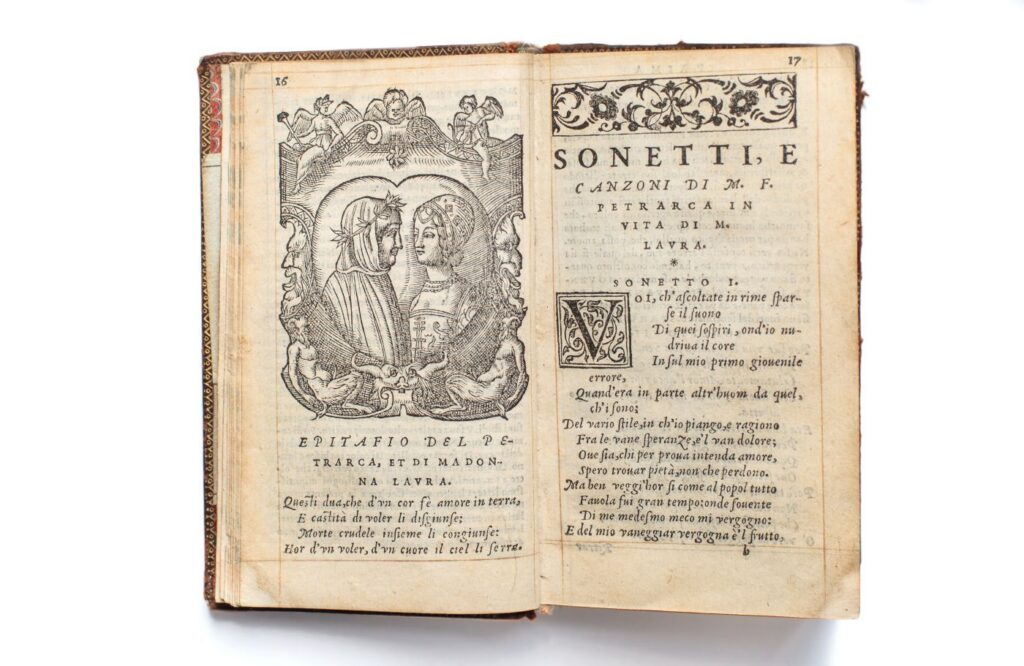
When I was in graduate school, one of my mentors mentioned one day in passing how very sad she found it that people no longer read Petrarch. By “people,” I think she meant “poets and scholars of poetry,” since this was a Master of Fine Arts program, but even in that much smaller category, her complaint rings true: people, meaning poetic people, learned people, don’t read Petrarch all that much. Even people who are fluent in Dante and Shakespeare and Ariosto are less likely to have read the great poeta d’amore. The reason why became clear with her next sentence; when I asked her what translation she recommended, she looked at me with disappointment and said, “Oh no, there is no acceptable translation of Petrarch. You must read him in the Italian.”
This was perhaps ten years ago. In those years, I have not managed to learn to read fluently in Italian, but mercifully, I have at last managed to read Petrarch, thanks solely to the tremendous efforts of the American poet and translator A. M. Juster, whose translation of the complete Canzoniere was published by W. W. Norton earlier this year. I do not know if my mentor has encountered Juster’s translation, or if it has led her to amend her statement, but Juster brings a unique and pleasing spriteliness to the poems, offering an elegant, precise, yet vibrant take on Petrarch’s work. This volume is not merely an excellent translation of an under-read poet; it is a reminder of why Petrarch was so acclaimed in the first place, and an argument that this early Renaissance humanist’s vision of humanity, love, forgiveness, sin, death, and hope can speak directly to our own twenty-first-century hearts.
Petrarch, like my own personal favorite, Rabelais, is one of those strange humanists whose names, in a cruel inversion of the classical model of honor, have outlived any knowledge of their deeds. (Better, many poets might think, to suffer the fate of the author of Beowulf, whose name is lost to time but whose work is still on syllabi the world over.) Though Petrarch was a giant of his day—scholar, diplomat, and inventor of the Petrarchan sonnet form—and of the centuries that followed, the themes and even the forms of his work seem ill-suited to contemporary literary taste. He is best known as a hopeless romantic, besotted with the inaccessible Laura; his other major themes are classical virtue and Christian salvation, neither of which has much purchase today. A few people may recognize his name and have a vague association with some other name—Laura, perhaps, or Plutarch, or Shakespeare, depending on their field of study—but Petrarch’s poems, his actual work, have faded almost completely from public consciousness.
With this in mind, Juster’s choice to translate the entirety of Petrarch’s corpus seems strange. The translation is the fruit of the labor of years; all 366 poems are here, along with some thirty pages of detailed notes. Even more demandingly, Juster has chosen to retain the original form of each of the poems, and wherever possible, he seeks to echo the vowel sounds of the original Italian.
Petrarchan sonnets, which Petrarch perfected in the Canzoniere, are notoriously difficult to write in English because there are so few rhyming words in English as compared to Romance languages. The Petrarchan form follows a rhyme scheme of ABBAABBA CDCDCD (sometimes CDECDE), meaning that at least two of the end-rhyme sounds must be repeated four times. This is a tall order in English, yet Juster rises to the challenge and delivers sonnet after sonnet of limpid, readable verse in which the rhymes arise naturally from the language, as in the heartwarming sextet from poem 114:
Start your day with Public Discourse
Sign up and get our daily essays sent straight to your inbox.
Large crowds and Fortune cause me no concern,
not for myself nor for depravity,
nor do I feel hot passion in or out.
I plead for just two people, and so yearn
her heart be humbled and at peace with me;
I want the other’s foot to heal from gout.
The scale of these labors is Herculean. But on closer inspection, there is an artistic kinship between the two poets that makes it seem inevitable for Juster to undertake this task. Juster is a skilled, highly decorated poet in his own right, a master of a witty formalism that would be very much at home in Petrarch’s Europe, the Europe of troubadours and court poets. He is also, like Petrarch (who studied law and served as a diplomat and statesman) a former lawyer and public servant; Juster served in many positions in the federal government, including as the Commissioner of Social Security, and as an attorney. These biographical parallels contribute, I suspect, to Juster’s fondness for Petrarch, a fondness evident in every line of the book. But the real source of Juster’s fascination with the Canzoniere, I believe, goes beyond these biographical parallels, right to the core of what it means to be a human being passing through time.
The structure of the Canzoniere is worth exploring. In true late-medieval/early-Renaissance fashion, no element of the collection is arbitrary. The total number of poems, 366, alludes to the number of days in a leap year—the maximum amount of time it can take to go around the sun. The story, if you will, of the book is the story of Petrarch the priest and scholar’s love for the beautiful Laura, whom he glimpses for the first time “In thirteen twenty-seven—the precise / first hour of April sixth” (poem 211). Laura goes on to marry another man and dies at a young age, but Petrarch’s love lasts until (at least) the end of his own life decades later. The Canzoniere is also, however, the story of the poet’s struggle against sin, of his conflicting passion for this world and desire for the world to come. Poems honoring Laura’s face, hair, hands, and movements precede poems describing the beauty of the Italian countryside in vivid, sensual language, which give way to hymns to Our Lady. As Laura ages and falls ill, the verse mourns the decay of the human body; as the poet becomes older and more observant, he laments the intrusion of sin into both the body of the Church and the individual soul (“Girls and old goats cavort in every room, / which, for their frolics, Satan has arrayed / with bellows, mirrors, and the flames of doom / [….] May God now smell the stench your life has made!”) Moving from love to loss, youth to age, innocence to recognition of sin, life to the certainty of death, the poems offer ab imaginative vision in which all these things, by God’s grace, are inextricably bound up together and participate in mysterious ways in the salvation of the soul.
In his accessible but scholarly introduction, critic and scholar Andrew Frisardi explains that “the number 6 is to the Canzoniere what the number 3 is to Dante’s Commedia […]. Using standard numerological method, the sum of 3 + 6 + 6 = 15, and 1 and 6 add up to 6 again; Laura’s name in Latin, Laurea, has six letters; and so on.” This example gives us a taste of Petrarch’s skill; not only is he writing beautiful verse, but he is doing it with an eye to the whole. The Canzoniere deserves to be read in its entirety, not merely sampled, so that readers can truly appreciate its arc.
It’s a tall order, of course, to advise a modern reader to pick up 366 fourteenth-century Italian poems and read them in their entirety. But in Juster’s hands, the verse is remarkably fluid and readable, a stream-of-consciousness narrative that is both gripping and gorgeous. As I read, I simultaneously wanted to slow down to savor the verse and to skim through quickly to find out what was going to happen in our hero’s heart and soul next; this tension of the reading experience simulates the tension of life, in which we are so often torn between our desire to stay in the present and our obsession with looking ahead at the future.
Readers unfamiliar with Petrarch (or even many readers quite familiar with Petrarch in other translations) may expect his poetry to be stuffed with archaic language and incomprehensibly flowery flights of fancy. But Juster gives us a Petrarch of lean, direct verse, full of energy and flex, driven by fierce imagery and ringing sounds. Look, for example, at poem 2, in which Petrarch first goes toe-to-toe with Love, the great hunter who will harry him for the rest of the book:
In order to extract revenges with grace
and punish countless crimes in just one day,
Love took his bow out in a furtive way
like an assassin marking time and place….
This stanza, the first of a neatly balanced sonnet, is composed all of straightforward words. The syntax is finely crafted but not overwhelmingly complex; the central image is easy to grasp. And yet, the idea—that Love is an assassin, working within the limitations of temporality and space, that Love is a graceful avenger who comes upon us as punishment for our sins—is startling. The rest of the sonnet is action-packed, describing this first encounter between the poet’s willpower and the attacks of Love. The images extend into the next sonnet, in which the poet first encounters Laura, in whose presence
Love soon discovered me wholly disarmed
and saw my eyes were routes to reach my heart,
which now are gates and thresholds where tears flow,
and so he gained no honor on his part
by shooting me that way, for you were armed,
and yet he would not let you see his bow.
The “you” here is Laura, who disarms the poet utterly, leaving him exposed to the arrows of Love.
The book consists of a mix of forms, including sonnets, sestinas, and canzone. Beyond these forms, however, Petrarch indulged in wordplay and figures of speech from anagrams to hidden words, and in an impressive turn, Juster renders these figures into English. For example, in poem 5, Petrarch buried the words “Laureta laureta,” a pun connecting Laura’s name with the laurel wreath given to victors in battle and to the finest poets. In a flourish worthy of at least a few laurel leaves of his own, Juster translates the sonnet into enjoyable, readable iambic pentameters that follow a traditional Petrarchan sonnet rhyme scheme and contain the hidden words (visible in all caps in the text).
Juster’s careful attention does not diminish as the Canzoniere progresses. The active, spirited language of the early poems gives way gradually to starker verse as the poet’s awareness of his own death draws near. The regular pentameters occasionally become plodding tetrameter, as in poem 312:
No stars adrift in peaceful skies,
no ships that slip through tranquil seas,
no fields for well-armed cavalries,
no woods where wildlife runs and flies
no promise of a long-sought prize
no love expressed in rhapsodies,
no fields nor streams where melodies
of chaste and graceful ladies rise…
Even in Juster’s sparkling verse, Petrarch is not an easy read. He is steeped in the legends and myths of Rome, Greece, and Italy, and well-versed in the Scriptures and the Christian intellectual tradition. His poems are bedecked with references to Ulysses, Babylon, Pallas, the Po and the Arno, Polyclitus and Aeolus and Vulcan. But I do not believe this is why his poems have slipped out of popularity. Poetry with many more (and more obscure) references still enjoys comparative popularity, like Dante’s Inferno.
Perhaps Plutarch is no longer popular for the same reason more people read the Inferno than go on to read the (much superior) Purgatorio and Paradiso: because for at least a hundred years, our culture has not known what to do with ardor. The idea of sweeping, uncritical, all-consuming devotion, the ideal that defined Western thought and literature for millennia, now sets our teeth on edge a little; it is so obviously impossible, so clearly unhealthy, that we are vaguely uncomfortable even in proximity to it. Petrarch’s life-long adoration of the much younger and married Laura feels, perhaps, icky to modern readers who have been trained to understand their own sensual desires as only and entirely sexual.
For Petrarch, however, there is no dividing spiritual passion from physical passion. They are one and the same impulse, springing from a single source: the unity that is human nature. Juster’s supreme achievement in the Canzoniere is that he has come to terms with what a poem truly is, and in so doing, he offers us a vision of what a human being truly is, a vision that goes far beyond the petty therapy-speak of contemporary culture. Like a human being, a poem is a composite, a commingling of form and feeling. The poem is, rightly speaking, neither of these things. It is the unity of them. Juster pays homage to that reality and honors Petrarch’s poems both in their bodies (the formal elements) and their souls (the feelings and ideas that invigorate them). This translation of the Canzoniere enters wholly into the poetic arts, not merely the scholarly arts, for in it Juster has given us a Petrarch in English that lives, moves, and has its being with the same grace, imaginative scope, and formal agility as the original. If, in a hundred years, Petrarch has returned to his rightful place on the bookshelves, tongues, and souls of readers the world over, it will be thanks to the prodigious labors of A. M. Juster.