Earlier this month, I read an article at The Atlantic about an inexpensive Chinese-made e-book device that is hardly any larger than a credit card. This device is so no-frills (no graphics, no touchscreen, no color, no backlight) that buyers are raving about the ability it gives them to dwell on the text of the book it displays without being distracted by their phone’s attention-hogging features. The gizmo even clings magnetically to the back of one’s phone, so all one needs to do is to turn the phone over and begin reading plain text.
Color me a bit skeptical. I am in favor of any stratagem people adopt to read more books, but the Atlantic writer reported that the little gizmo had enabled him to spend a whopping ten hours reading a large work of nonfiction “over the past several weeks.” Somehow I don’t think that is much to boast about.
And how much will anyone retain from reading books on this little scrolling postage stamp? I have written here before, last year and three years before that, relating my concerns about the differences between e-books and physical books. (Looks like it’s becoming my annual back-to-school theme.) I haven’t entirely given up e-books, but I recognize that, for me anyway, paper is preferable. Indeed, when I was reading in midsummer for last month’s column on Court-packing, I began Laura Kalman’s book on the subject as a PDF on my tablet. But about a third of the way through, I realized that this was an important work of history with granular detail, and I ordered a hard copy. When it arrived, I reproduced all my markings of the PDF in the physical book, and went on reading the hard copy exclusively—and both more quickly and more deeply.
Maryanne Wolf would understand, I think. Wolf is the author of this year’s Princeton Pre-Read, a book selected by President Christopher Eisgruber to be sent to every incoming freshman student and then to form the basis of discussion when they arrive on campus. Wolf is a cognitive neuroscientist who has studied the way our brains learn to read and to understand and retain what we read, and her 2018 book, Reader, Come Home: The Reading Brain in a Digital World, is very good on this subject.
Wolf is not altogether opposed to reading books on screens, but she is properly cautious about it. (Full disclosure: I learned of Wolf’s book only two days before writing this column, and so I got hold of it the quickest way possible and read it … on a screen!) She reports, for instance, a study that showed young readers of a short story had better retention of its plot if they read it on paper than if they read it on a Kindle. There is something about a book’s “concrete, spatial dimension” that helps us. Constant screen reading—as we all typically do now for our non-book reading for news, entertainment, and communicating with family and friends—even has a baleful impact on our reading of physical books, affecting the ways our eyes move over a page and our brains take up information.
Start your day with Public Discourse
Sign up and get our daily essays sent straight to your inbox.But there’s more to the effect of our modern screen life on our reading habits than merely the choice between glass and paper. The personal computers of the 1980s gave us word processing, making the typewriter obsolete; the early internet of the 1990s gave us email (I remember thinking that this was reviving the lost art of letter writing that had been killed by the telephone); and by the turn of the century the bounty promised by the web looked truly impressive: digitized books and primary sources for research, online journals, a proliferation of news and commentary. (Yes, also the logorrhea of early blog culture, now reappearing on Substack.) Then came the smartphone, the jazziest (though not the first) being the iPhone, debuting in 2007. Now in the hands of billons worldwide, these devices have fundamentally changed our daily lives, for good and for ill. They are designed to seize and keep our attention, to amuse us endlessly with ever-changing stimuli, and to lure us into an in-the-cloud world that contains much of the human race’s knowledge yet also makes us dumber. As Wolf writes:
No self-respecting internal review board at any university would allow a researcher to do what our culture has already done with no adjudication or previous evidence: introduce a complete, quasi-addictive set of attention-compelling devices without knowing the possible side effects and ramifications for the subjects (our kids).
What we are all experiencing—and Wolf confesses her personal struggle to return to deep reading of books—are “decreasing attention spans, pushed beyond their cognitive limits by a flotsam of distractions and information that will never become knowledge.”
Convinced that consistent, attentive reading is essential for the development of both our reason and our compassion, Wolf is worried about the effects of our contemporary screens on our capacity for self-government. This is even more explicitly the concern of British writer James Marriott, a journalist at The Times. Marriott’s The New Dark Ages: The Death of Reading and the Dawn of the Post-Literate Society has been out for a few weeks in the UK, and is soon to be published here in the U.S. (This one, dear reader, I acquired on paper from the publisher.)
Marriott is a worried man, and he works hard not to be too alarmist—to use his indoor voice, as it were. But The New Dark Ages, which I hope will be widely read, is a brief, brisk, and persuasive book about the damage our screen life is doing to our social and political life. He puts the matter starkly in his introduction: “As reading fades I believe that we may find ourselves facing a post-literate future that resembles the pre-literate past: mystical, tribal, and autocratic.” We fill our eyes (and now increasingly our ears, too) not with the pages of books or even with the extended narratives and arguments to be found in newspapers and magazines, but instead with TikTok and YouTube videos, podcasts, X memes, Instagram posts, and Reddit rants.
There’s more to the effect of our modern screen life on our reading habits than merely the choice between glass and paper.
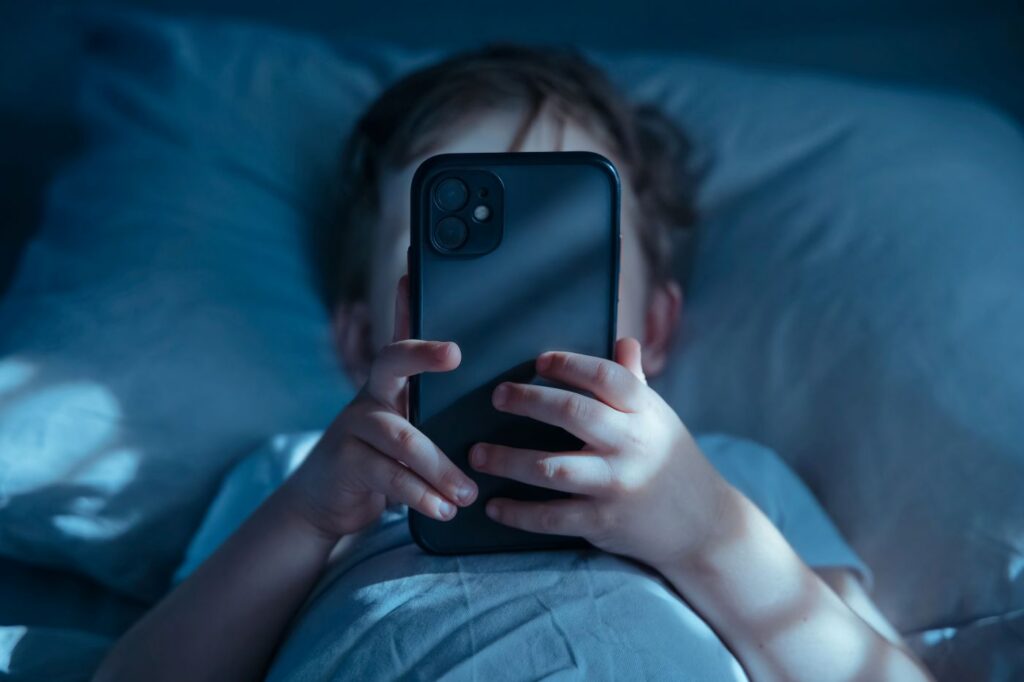
Nothing seizes our attention for long. New texts arrive, as do emails, Signal chat posts, the endless doomscroll of social media sites, not to mention a constant mix of algorithmically tailored ads. We dance and skip from app to app, alternately dulled with boredom and stoked with anger or shock or lust, somehow unable to look up from our screens and pay proper attention to the nearest live human beings. And those two-dimensional people on our screens? They are easy to divide into “them” and “us”; even when we address “them” on social media as “you,” we increasingly treat them inhumanely—because we can, and because they are not present in the room with us.
Marriott, citing Wolf, notes that reading does not come naturally to human beings the way speech does. It must be learned, and our brains “rewire” for the task. And for most of human history, illiteracy was more common than literacy, largely because the technology for reproducing the book was the pen. Gutenberg changed that, and by the eighteenth century, European nations like Britain had become voracious reading cultures. Marriott convincingly argues that the rise of literacy, reaching near-universal levels by the end of the nineteenth century, propelled the emergence of liberal democracies. The pan-European “Republic of Letters” among elites was followed by the mass democracy of newspaper readers. Parallel to these political developments was the evolution of the novel. Authors like Dumas and Dickens reached millions with novels in serial form whose readers flocked to newsstands for the latest installment. Hugo, Eliot, and Twain formed the sympathies of readers for the travails of others.
The literate age was not immune to vice and animosity, as Marriott frequently pauses to remark. As everyone knows, one of the most intellectually and aesthetically refined societies of the turn of the twentieth century existed in Germany, and the land of Goethe gave us Goebbels. Yet on the whole, Marriott argues, literacy was a force for good. “The great age of print culture,” however, “was short-lived,” he writes. “The historical window in which reading was widespread and existed as society’s main form of entertainment was a brief one.”
But Marriott is not here speaking of the smartphone; not yet. It was television that first drew our eyes up from the activity of reading to the passivity of watching. As TV stations proliferated (and the remote was invented), channel-surfing was the self-distracting habit, long before doomscrolling. Forty years ago in Amusing Ourselves to Death, Neil Postman was alive to the fact that (as Marriott puts it), “if the written word imposes order on the world, the moving image tends towards disorder.”
And now, in the smartphone age? “You don’t have to spend much time on TikTok before Love Island begins to look like Kenneth Clark’s Civilisation.” We have entered what Marriott calls, in one chapter title, “The Disenlightenment.” Everything must be simplified. Film and TV scripts must put laborious expositions into dialogue, because we are too dumb to follow a plot. Conspiracy theories abound. Podcast celebrities blather about how they have been attacked by demons, and rapt audiences nod gravely. Cabinet secretaries spread disinformation about vaccines. The president of the most powerful nation on earth has apparently not read a single book straight through since the fifth grade, but he knows how to jab his adversaries on social media. “Britain and America are now led by what is probably the least literate political class in the history of their respective democracies.” The rise of leaders and parties promising strength, vengeance on “them,” and miracle cures for our self-inflicted social and economic ills is the unsurprising result.
As I said, Marriott is a worried man. So am I, when I read passages like this: “Mass literacy is a recent phenomenon. So is mass democracy. We simply don’t know whether one can survive without the other.” But, he urges those readers who have made it to the end of his book, “reading and a cultural reverence for reading will be around for a long while yet. And that means those of us who value books and reading still have a chance to make our case.” I am by disposition sunny, and rarely morose. I detect similar inclinations in James Marriott. But there is no question that we have some darkness to contend with.
Interestingly, neither Wolf nor Marriott has much of anything to say about artificial intelligence, which at the moment bids fair to take us from dumb to dumber. Wolf published her book in 2018, which may let her off the hook. But Marriott, who keenly appreciates what screens have already done to reading comprehension and to writing, should have taken stock of where AI is already pointing us—to acceleration of our downward trends. But The New Dark Ages is so good, I look forward to his thoughts on the subject.